

History often hinges on the most unexpected moments of curiosity, patience, and technological adaptation. While major historical narratives are frequently constructed from monumental diaries, official state proclamations, and widely distributed broadsheets, some of the most profound historical insights emerge from the dusty corners of archival vaults. One of the most fascinating instances of archival serendipity occurred in 1952 within the United States National Archives, where a dedicated archivist named Josephine Cobb altered our visual understanding of one of the most sacred moments in American history through a simple act of meticulous inspection and photographic enlargement.
For decades, historians and the American public relied on a well-established visual record of Abraham Lincoln’s presidency. Photographs captured by master lensmen such as Mathew Brady and Alexander Gardner documented the physical toll of the Civil War on the sixteenth president's face, his towering presence, and his somber dignity. Yet, despite the vast photographic output of the era, a glaring omission persisted: no definitive photograph was believed to exist of Abraham Lincoln delivering the Gettysburg Address on November 19, 1863. Generations assumed that the brief duration of the speech, the chaotic nature of the crowd, and the limitations of mid-19th-century wet-plate photography precluded anyone from capturing the president at the exact moment he uttered words that redefined the American democratic experiment.
The Mislabeled Glass Plate in the National Archives
The turning point arrived in 1952 when Josephine Cobb, a brilliant and observant archivist working as a specialist in the Still Picture Branch of the National Archives, undertook the routine yet monumental task of organizing, cataloging, and reviewing nineteenth-century photographic collections. Among the vast holdings transferred from various federal agencies were boxes of glass plate negatives that had been acquired over decades from the War Department and private collections.
Many of these glass plates suffered from inadequate or entirely erroneous cataloging. Because early photography was expensive and cumbersome, plates were frequently reused, misidentified, or stored with incorrect descriptive labels scribbled on their paper sleeves or margins. One particular glass plate, cataloged under a vague nineteenth-century heading related to general Civil War military scenes, had languished in obscurity. It was labeled as a street scene in Gettysburg, Pennsylvania, capturing the general atmosphere of the town during the dedication of the Soldiers' National Cemetery, rather than any specific focal point of the presidential entourage.
Had an ordinary cataloger glanced at the plate with casual indifference, the glass negative likely would have been returned to its shelf, condemned to another century of misidentification. However, Cobb possessed a deep, intuitive knowledge of Civil War iconography and photographic history. Staring at the small, contact-printed reference card associated with the plate, she noticed architectural anomalies and crowd formations that did not quite match the standard assumptions about the town street scenes. She decided to pull the original glass plate negative to examine its fine details under magnification.
The Technological Revelation of Photographic Enlargement
In the early 1950s, photographic enlargement techniques had advanced significantly beyond the optical limitations of the 1860s, yet examining an original glass plate negative still required specialized optical equipment and meticulous care. Glass plates offered exceptional resolution—far superior to modern consumer film formats in terms of edge-to-edge sharpness—because the photographic emulsion was coated directly onto a perfectly flat sheet of glass rather than a flexible plastic base. This unique chemical and physical structure meant that tiny details lost in a standard contact print could be recovered when projected or enlarged under controlled darkroom conditions.
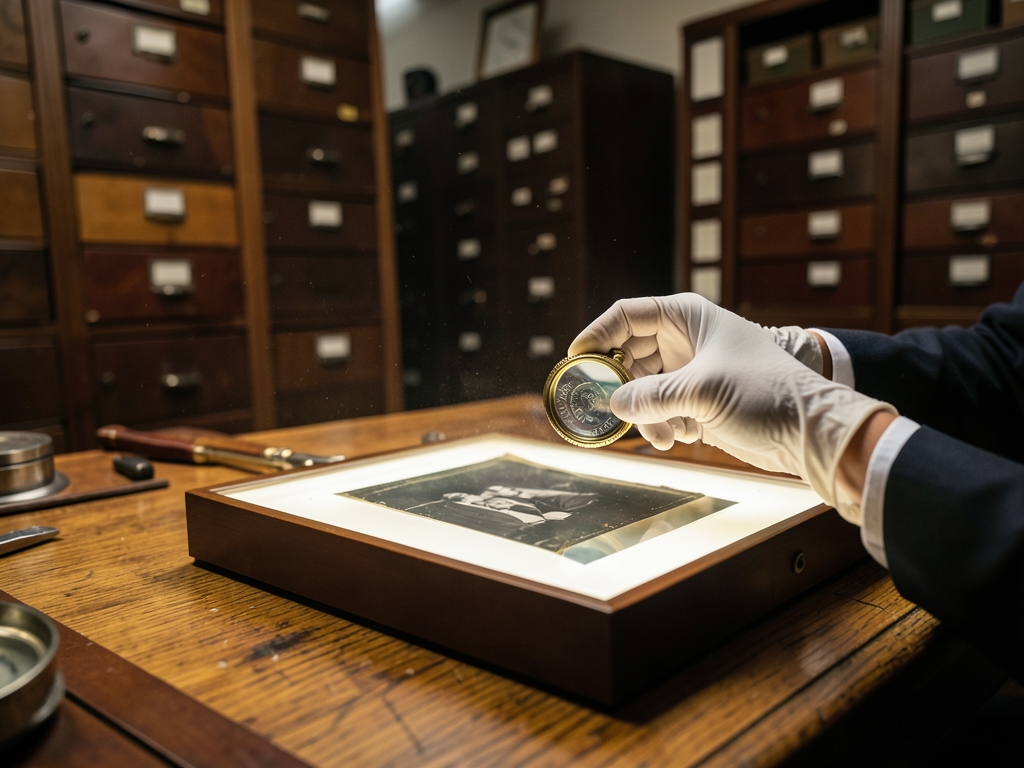
When Cobb placed the glass plate onto an archival lightbox and utilized an optical enlarger to project the image onto photographic paper at a much larger scale, hidden realities emerged from the grain of the emulsion. What appeared in the small contact print as an indistinct cluster of distant figures resolving against the backdrop of the newly established cemetery suddenly sharpened into a precise panoramic view of the speakers' platform.
As the developer bath brought the details up on the photographic paper, Cobb identified key individuals in the crowd and on the wooden dais. There was Oliver O. Howard, the prominent Union general, alongside other dignitaries, foreign ministers, and Pennsylvania state officials. But right at the center of the composition, standing tall with his characteristic stovepipe hat and a folded paper in his hand, was President Abraham Lincoln.
“Through the careful examination of a forgotten glass plate negative, archival persistence transformed a generalized townscape into the single known photographic record of Lincoln delivering his immortal address at Gettysburg.”
Verifying the Evidence: Authenticating the Gettysburg Photograph
Discovering a visual representation of Lincoln at Gettysburg required rigorous historical verification before the National Archives could officially announce the finding to the scholarly community and the public. Cobb did not rely solely on her initial visual impression; she embarked on a meticulous cross-examination of the physical evidence, historical accounts, eyewitness diaries, and contemporary newspaper reports.
She began by analyzing the physical composition of the photograph itself. The angle of the shadows cast by the buildings and the platform participants matched the historical timeline of the ceremonies, which placed the presidential address in the late morning hours. Furthermore, the construction of the temporary wooden platform, the surrounding crowd of civilians and soldiers, and the specific banners fluttering in the autumn breeze aligned perfectly with written descriptions penned by reporters from the Associated Press and local Pennsylvania newspapers.
Cobb also consulted the records of photographers who were known to have been present in Gettysburg on November 19, 1863. While Mathew Brady was famously delayed and arrived late due to logistical hurdles, other photographers, including David Bachrach, had set up their heavy tripod-mounted cameras near the platform. By comparing the vantage point of the glass plate with known maps of the cemetery grounds and contemporary diary entries describing the placement of the press and official photographers, Cobb successfully established the exact provenance of the negative.
Her exhaustive research culminated in a formal authentication that stunned historians. The image was not just a picture of the event; it was confirmed to be the only known photograph capturing Abraham Lincoln in the act of delivering the Gettysburg Address. The other well-known photographs of Lincoln in Gettysburg—most notably the famous portrait taken in the studio of photographer Tyson—were captured before or after the ceremony, but never while he stood before the vast crowd to deliver his two-minute speech.
The Broader Impact on Historical Preservation and Research
Josephine Cobb’s 1952 discovery serves as a powerful testament to the vital importance of archival stewardship and the ongoing re-examination of historical collections. In an era before digital scanning, automated optical character recognition, and artificial intelligence-driven image enhancement, archival discoveries depended almost entirely on the keen eye, historical intuition, and technical resourcefulness of dedicated professionals.
The finding fundamentally altered how textbooks, museums, and historical documentaries illustrated the Gettysburg Address. Instead of relying exclusively on nineteenth-century artistic engravings—which often romanticized the scene, exaggerated crowd sizes, or placed Lincoln in dramatic theatrical postures—publishers finally had access to an authentic, unvarnished slice of photographic reality. The image revealed a remarkably human moment: a president standing before a modest gathering on a crisp autumn day, delivering words that would echo through centuries of democratic governance.
Moreover, the episode highlighted the hidden vulnerabilities and treasures resting within national repositories worldwide. Millions of historical artifacts, documents, glass plates, and manuscript fragments remain stored in climate-controlled vaults, waiting for technological advancements or fresh scholarly eyes to unlock their secrets. As modern digitization projects continue to convert fragile historical media into high-resolution digital formats, archivists and historians continue to uncover mislabeled records, forgotten correspondence, and lost visual treasures that rewrite established historical orthodoxies.
Conclusion
The story of Josephine Cobb enlarging a mislabeled glass plate in 1952 reminds us that history is not a static monument carved in stone, but a dynamic, ever-evolving dialogue with the past. Through professional dedication, rigorous verification, and a willingness to question historical assumptions, a single archivist rescued a vital visual artifact from obscurity. The photograph of Abraham Lincoln at Gettysburg stands enduringly as a monument to intellectual curiosity and the indispensable value of preserving original historical records for future generations.
When was the mislabeled glass plate discovered in the National Archives?
The glass plate negative was discovered and correctly identified in 1952 by National Archives archivist Josephine Cobb.
What was the glass plate originally mislabeled as?
The glass plate had been cataloged as a general street scene in Gettysburg, Pennsylvania, rather than a depiction of the cemetery dedication ceremony.
Why is this photograph historically significant?
It is confirmed to be the only known photograph capturing Abraham Lincoln in the act of delivering the Gettysburg Address on November 19, 1863.
How did Josephine Cobb verify the authenticity of the photograph?
Cobb authenticated the image by cross-referencing shadow angles, architectural details, platform construction, contemporary newspaper accounts, and photographer records from the event.
