

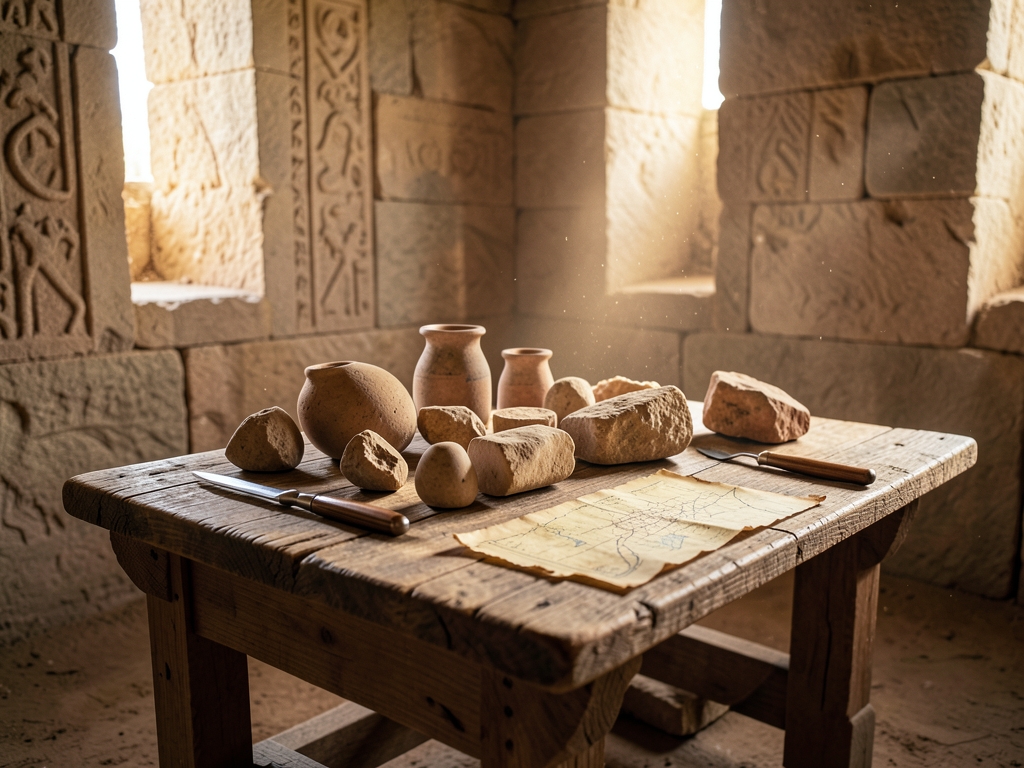
History is rarely written down in clean, continuous narratives from the very beginning. For thousands of years, the vast majority of human experiences, economic transactions, technological developments, and social structures left no written record at all. Civilizations rose and fell, languages transformed and vanished, and monumental changes swept across populations without a single chronicler recording the events for posterity. In the absence of written texts, humanity relies on the tangible remnants of past lives to reconstruct the story of civilization. These physical remains—ranging from broken pottery shards and sunken shipwrecks to ornate jewelry, stone tools, and monumental architecture—constitute the vast field of material culture. Every artifact acts as a silent witness, offering raw data that challenges, refines, and expands our understanding of history.
The study of history through physical objects has undergone a profound transformation over the last century. Where early antiquarians once focused primarily on collecting aesthetically pleasing treasures for private display or museum galleries, modern archaeology and historical research employ rigorous scientific methodologies. Archaeologists today work alongside chemists, geneticists, geologists, and digital modelers to extract microscopic details from every recovered item. Radiocarbon dating, residue analysis, stable isotope testing, and three-dimensional digital scanning allow researchers to determine not only the age of an object but also its exact geographic origin, the materials used to construct it, and even the dietary habits or migratory patterns of the people who used it. This multidisciplinary approach has turned material culture into one of the most dynamic and reliable frontiers of historical discovery.
The Silent Witnesses: What Everyday Objects Reveal
While royal steles, monumental temples, and gold-inlaid sarcophagi capture the public imagination, everyday objects often provide the most honest and revealing insights into ancient societies. Elite texts written by kings and high priests are notoriously biased, designed to project power, celebrate victories, and sanitize defeats. In contrast, domestic artifacts—such as cooking vessels, spindle whorls, simple iron tools, and children's toys—reflect the unvarnished reality of daily existence for ordinary people.
Consider, for example, the significance of ceramic analysis in modern archaeology. The chemical composition of clay used to make pottery can be traced back to specific geological deposits. When archaeologists find imported pottery in a remote inland settlement, it immediately proves the existence of long-distance trade networks that were never mentioned in surviving royal archives. Similarly, residue analysis of organic compounds trapped inside ancient cooking pots reveals ancient dietary habits, illuminating how communities adapted to local climates, adopted new agricultural techniques, or managed periods of famine and scarcity. These humble objects reconstruct the economic and social lifelines of communities that left behind no written history whatsoever.
Material culture gives a voice to the voiceless, preserving the daily realities, struggles, and innovations of ordinary people whose stories would otherwise be entirely lost to time.
Furthermore, specialized tools and manufacturing waste found at excavation sites shed light on ancient industrial engineering and labor specialization. The presence of standardized molds, specialized metalworking slag, or imported raw materials indicates complex supply chains and organized economic structures long before the advent of modern industrialization. By examining how objects were produced, used, repaired, and eventually discarded, historians gain a nuanced view of technological evolution and resource management across different ancient cultures.
Scientific Breakthroughs in Artifact Analysis
The integration of advanced technology has revolutionized how historians and archaeologists interrogate the physical record. Traditional excavation methods, while essential, are inherently destructive; once a layer of earth is removed, it cannot be replaced. To maximize data recovery without damaging fragile remains, modern research teams rely heavily on non-invasive subsurface imaging and advanced laboratory diagnostics.
Info! Advanced techniques such as 3D laser scanning, subsurface radar, and chemical residue analysis allow researchers to study ancient artifacts without altering or destroying their physical structure.
One of the most remarkable technological leaps in recent decades is the application of micro-CT scanning and high-resolution digital microscopy to corroded or damaged artifacts. For instance, heavily oxidized metallic items, ancient scrolls, and tightly bound organic bundles can now be digitally unrolled and examined layer by layer in three dimensions. This technology has successfully revealed hidden inscriptions, manufacturing marks, and internal structures that were completely invisible to the naked eye. In many cases, these non-destructive methods prevent the physical degradation of delicate specimens while unlocking historical secrets that have remained hidden for millennia.
Isotopic analysis has similarly transformed our understanding of human mobility and ancient trade. By analyzing the chemical signatures locked inside tooth enamel or bone collagen from ancient burial sites, scientists can determine where an individual grew up versus where they lived later in life. These scientific methods have repeatedly upended traditional historical assumptions, proving that ancient populations were far more mobile, interconnected, and culturally diverse than previously imagined. Migration, intermarriage, and long-range commerce were common features of the ancient world long before modern transportation networks existed.
Bridging the Gap Between Textual Records and Material Evidence
One of the greatest challenges in historical research occurs when textual records and material evidence appear to contradict one another. Historical texts often present idealized accounts of political stability, military might, or economic prosperity. However, the physical layers of an ancient city—its destruction levels, abandoned quarters, altered fortifications, and shifts in material culture—frequently tell a very different story.
When royal chronicles boast of uninterrupted peace and abundance, archaeological excavations might uncover sudden layers of ash, abandoned hoards of valuables, and demographic shifts indicating sudden conflict, economic collapse, or rapid climate stress. Rather than dismissing one form of evidence in favor of the other, skilled historians use material culture to contextualize and critically evaluate written texts. Documents reveal how ancient societies wanted to be perceived, while artifacts reveal how they actually lived, survived, and adapted to crisis.
| Source Type | Primary Strengths | Potential Limitations |
|---|---|---|
| Written Texts | Provides names, dates, political intent, and ideological context | Often biased, elite-focused, incomplete, or prone to propaganda |
| Material Artifacts | Reflects daily life, trade, technology, and ordinary human experience | Lacks direct authorial intent, requiring interpretation and dating |
| Scientific Analysis | Delivers objective chemical, biological, and chronological data | Cost-intensive, requires specialized equipment and careful sampling |
The interplay between these different forms of evidence ensures that history remains a living, evolving discipline rather than a fixed set of dogmatic facts. As new archaeological sites are discovered, and as laboratory techniques become increasingly sensitive, long-held historical theories are continually tested and updated. The past, it turns out, is constantly being rewritten as new pieces of the puzzle emerge from the earth.
Preserving Heritage for Future Generations
The rapid expansion of modern urban infrastructure, industrial agriculture, and commercial development poses an ongoing threat to unexcavated archaeological sites around the globe. Furthermore, climate change, rising sea levels, and extreme weather events accelerate the degradation of fragile organic materials buried in soil or submerged underwater. Protecting historical heritage requires robust international cooperation, strict legal frameworks, and active community engagement.
Warning! Unregulated looting and illegal antiquities trafficking destroy crucial archaeological context, erasing irreplaceable historical information forever for private financial gain.
Digital archiving has emerged as a vital tool in heritage preservation. Museums and research institutions increasingly create high-resolution digital twins of fragile artifacts, monuments, and excavation sites. These digital repositories ensure that even if a physical object is damaged or destroyed by conflict, natural disaster, or decay, its precise geometry, surface texture, and historical data remain accessible to researchers and educators worldwide. Public access initiatives also democratize history, allowing students, scholars, and curious individuals from every corner of the globe to explore detailed 3D models of ancient treasures without needing to travel to centralized metropolitan museums.
Why are everyday objects often more informative than royal texts?
Royal texts and inscriptions are often designed to project political propaganda and reflect only the perspectives of the ruling elite. In contrast, everyday objects like household pottery, simple tools, and domestic waste reveal the unvarnished economic reality, diet, and daily life of ordinary people.
How do scientists determine where ancient artifacts originated?
Researchers use advanced laboratory techniques such as chemical residue analysis, mineralogical testing, and isotopic profiling to match the raw materials of an artifact—such as clay, stone, or metal—to specific geological sources.
What role does digital archiving play in modern archaeology?
Digital archiving involves creating high-resolution 3D models and detailed databases of excavated items and sites. This protects fragile heritage against physical loss, deterioration, or destruction while enabling global access for researchers and educators.
Why is the archaeological context of an artifact so important?
The exact spatial location and physical layer where an object is found provide essential chronological and cultural context. Removing an artifact without recording its context destroys crucial historical data, making it difficult to accurately date or interpret.
Ultimately, the study of material culture reminds us that human history is a shared, continuous tapestry. Every artifact discovered in the soil—whether a magnificent Roman sarcophagus, an ancient Babylonian clay tablet, or a humble ceramic sherd—serves as a tangible reminder of the generations that came before us. By combining meticulous field archaeology with cutting-edge scientific analysis, we continue to piece together the complex, fascinating story of human civilization.
