

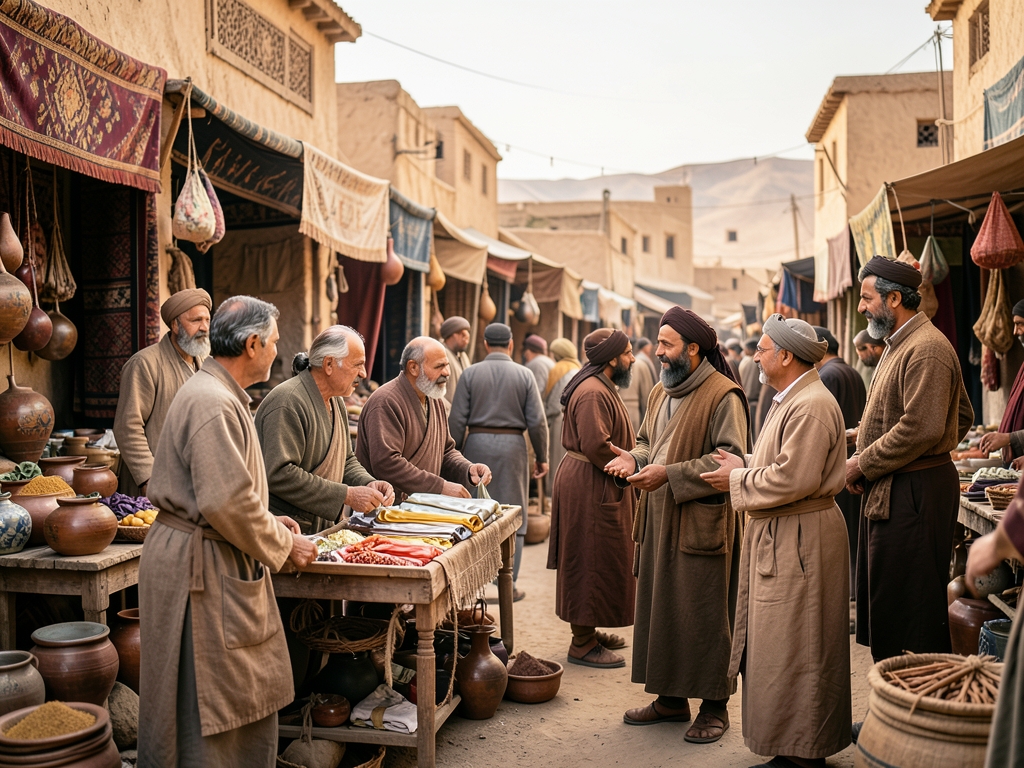
Few historical phenomena have exerted as profound an influence on the development of human civilization as the vast network of transcontinental trade routes collectively known as the Silk Road. Spanning thousands of miles across rugged mountain ranges, unforgiving deserts, and expansive steppes, this intricate web of pathways connected the great empires of China, India, Persia, the Middle East, and Europe. Far more than a mere commercial conduit for the exchange of exotic goods, the Silk Road functioned as the world's first great highway of ideas, technologies, religions, and artistic styles. Understanding how these ancient arteries of exchange operated provides essential insight into the interconnected origins of the modern globalized world.
The origins of the Silk Road trace back deep into antiquity, long before the term itself was coined by German geographer Ferdinand von Richthofen in the nineteenth century. While localized trade existed between neighboring tribes and city-states for millennia, the true crystallization of the trans-Asian network occurred during the Han Dynasty in China around the second century BCE. Recognizing the strategic necessity of securing western frontiers against nomadic incursions, Emperor Wu dispatched the diplomat and explorer Zhang Qian to the regions of Central Asia. Zhang Qian's momentous journeys opened diplomatic and commercial channels with the kingdoms of Fergana, Bactria, and Parthia, effectively linking the Eastern and Western worlds for the first time in recorded history.
The Economic Engines of Transcontinental Commerce
At the heart of this sprawling network was a profound asymmetry of supply and demand that made long-distance commerce economically viable despite staggering logistical challenges. Silk, produced exclusively in China through the meticulous cultivation of silkworms and the processing of their cocoons, held an almost mythical status among the Roman elite. The fabric was prized for its luxurious texture, vibrant colors, and lightweight durability, commanding astronomical prices in Western markets. The Roman historian Pliny the Elder famously lamented the immense financial drain that the obsession with silk imposed on the imperial treasury, noting how much gold flowed eastward to satisfy this insatiable aristocratic appetite.
In exchange for silk, porcelain, tea, and lacquerware traveling westward, a diverse array of precious commodities flowed eastward toward the Middle Kingdom. Central Asian and European merchants supplied prized horses—particularly the legendary Heavenly Horses of Fergana, which were vital for military defense—along with jade from the mountains of Khotan, lapis lazuli from Badakhshan, glass vessels from the Roman Levant, precious stones, furs, and woolen textiles. Because no single merchant traveled the entire distance from Chang'an to Rome, goods changed hands numerous times at bustling oasis trading posts such as Dunhuang, Samarkand, Bukhara, and Merv. Each intermediary took a profit, yet the final retail value of these goods remained high enough to sustain an entire ecosystem of caravanserai operators, guides, guards, and brokers.
Oasis Cities and the Logistics of Desert Travel
Traversing the Silk Road required extraordinary resilience, specialized knowledge, and complex logistical organization. The routes bypassed the impassable Tibetan Plateau and split into northern and southern branches that skirted the perimeter of the Taklamakan Desert—a barren expanse whose name translates colloquially to mean that those who enter rarely return. Caravans relied heavily on Bactrian camels, hardy two-humped beasts capable of carrying heavy loads across shifting dunes and surviving extreme temperature fluctuations. Local guides who understood water sources, seasonal weather patterns, and the shifting geography of salt flats were indispensable members of every expedition.
Along these perilous stretches, oasis cities emerged as vital hubs of commerce, culture, and rest. Settlements like Kashgar, Khotan, Turpan, and Dunhuang became melting pots of humanity where Sogdian, Tocharian, Chinese, Persian, and Greco-Bactrian languages mingled in bustling bazaars. To accommodate weary travelers, local rulers and wealthy merchants established fortified waystations known as caravanserais at regular intervals along the routes. These facilities provided secure lodging for merchants and their animals, fresh water, secure storage for valuables, and spaces for trading goods and sharing news from distant lands.
The Transmission of Religion, Philosophy, and Science
Perhaps the most enduring legacy of the Silk Road was not the exchange of physical commodities, but the cross-pollination of intangible cultural achievements. Religions that originated in specific localized contexts found pathways to spread across entire continents. Buddhism traveled from its birthplace in the Indian subcontinent along northern trade routes through Central Asia, eventually sinking deep roots in China, Korea, and Japan. The monumental cave complexes of Dunhuang, Kizil, and Yungang, adorned with exquisite mural paintings and sculptural masterpieces, stand as enduring testaments to this profound spiritual migration, blending Indian iconography with Hellenistic and Chinese artistic traditions.
Similarly, Islam expanded rapidly along trade routes following the conquests of the seventh century CE, transforming the cultural and architectural landscape of Central Asian cities like Bukhara and Samarkand into legendary centers of Islamic scholarship. Nestorian Christianity, Zoroastrianism, Manichaeism, and Judaism likewise traversed the network, finding adherents in distant cosmopolitan centers. Alongside religious doctrines traveled critical scientific knowledge, including papermaking techniques captured by Islamic forces from Chinese craftsmen at the Battle of Talas in 751 CE, astronomical tables, mathematical concepts such as zero and decimal systems, and medical treatises that were subsequently translated and preserved in great centers of learning like Baghdad's House of Wisdom.
The Pax Mongolica and the Peak of Interconnectedness
The thirteenth century marked the zenith of Silk Road connectivity under the vast administrative umbrella of the Mongol Empire. By unifying the disparate kingdoms and nomadic tribes of Eurasia under a single pax—the Pax Mongolica—the descendants of Genghis Khan created an unprecedented era of security and stability across the entire overland corridor. Travelers could cross the continent with a degree of safety that had never before been possible.
It was during this period that the Venetian merchant Marco Polo embarked on his legendary journey to the court of Kublai Khan, recording vivid descriptions of the wealth, sophistication, and organizational efficiency of Yuan Dynasty China. Other remarkable travelers, such as the Moroccan scholar and explorer Ibn Battuta, traversed extensive portions of the network, documenting the vibrant Muslim communities and vibrant trade networks stretching from North Africa to East Asia. This era demonstrated the immense potential of cross-cultural communication, though it also carried tragic consequences, most notably the facilitation of the transmission of the Black Death pandemic westward into Europe during the mid-fourteenth century.
Decline of the Overland Routes and Legacy in the Modern World
By the late fifteenth century, the geopolitical landscape of Eurasia shifted dramatically, precipitating the decline of the traditional overland Silk Road. The fragmentation of the Mongol Empire, the rise of the Ottoman Empire in the Middle East—which imposed heavy taxes and restrictions on Christian European merchants—and the final expulsion of Mongol influence from China disrupted traditional security frameworks.
More decisive, however, was the Age of Discovery pioneered by European maritime nations. Portuguese navigators rounding the Cape of Good Hope and Spanish expeditions crossing the Atlantic inaugurated a new era of global maritime trade. Ships capable of carrying vastly larger volumes of goods at lower relative risk replaced overland caravans. Oasis cities that had flourished for millennia gradually receded into isolation as global commerce pivoted toward oceanic ports.
Despite its eventual decline, the historical footprint of the Silk Road remains indelible. The linguistic, culinary, artistic, and genetic connections forged across centuries of exchange continue to bind diverse societies together. Today, as modern nations seek to revitalize these ancient corridors through infrastructure investments and geopolitical initiatives, the enduring spirit of the Silk Road endures as a powerful reminder of humanity's innate drive to connect across vast geographical and cultural divides.
What was the primary historical purpose of the Silk Road?
The Silk Road originally served as a strategic and commercial network linking China with Western markets, facilitating the exchange of luxury goods, diplomatic missions, and military intelligence.
Why was silk so valuable in the Roman Empire?
Silk was prized for its luxurious texture, lightweight durability, and exotic appeal, becoming a major status symbol among the Roman aristocracy despite its immense cost.
How did religion spread along the ancient trade routes?
Merchants, pilgrims, and monks traveled alongside trade caravans, sharing philosophical beliefs, religious texts, and artistic traditions that took root in oasis cities and distant empires.
Why did the overland Silk Road eventually decline?
The overland routes declined due to the fragmentation of empires, political instability, and the rise of maritime trade routes pioneered by European explorers during the Age of Discovery.
The legacy of the ancient trade routes persists as a monument to human curiosity, perseverance, and exchange. By bridging distant civilizations, the Silk Road laid the foundational framework for modern global interaction, proving that cultural cooperation and commerce are among the most powerful catalysts for historical progress.
