

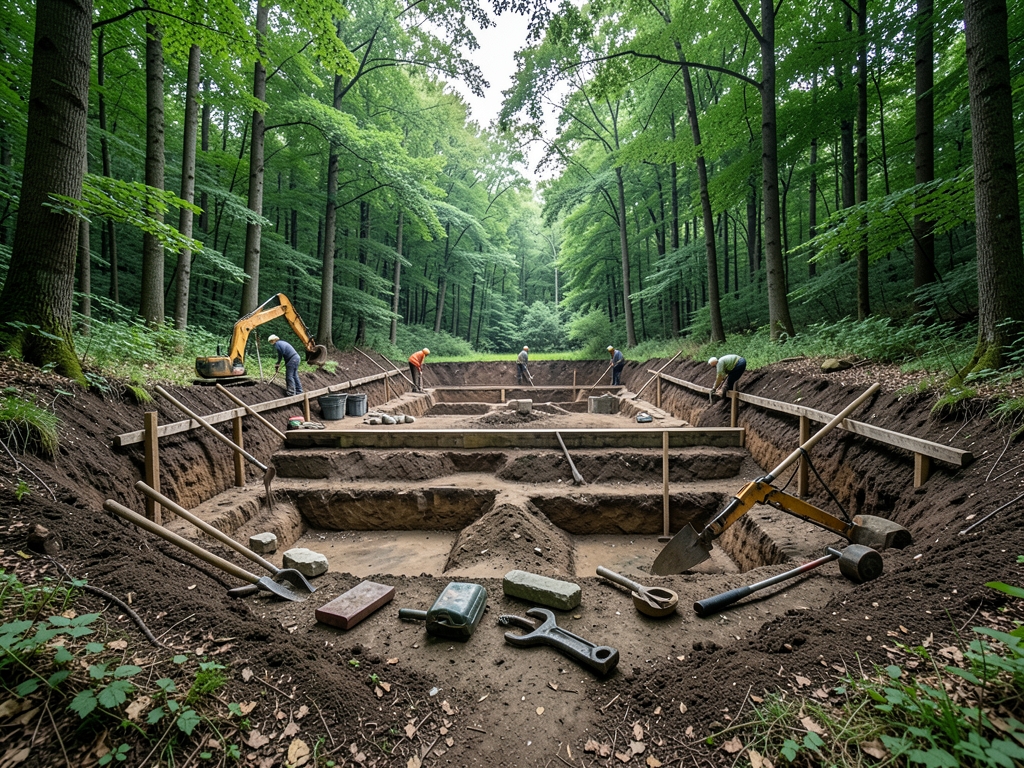
Archaeology has always been the bridge between humanity's forgotten past and our modern understanding of civilization. Throughout history, researchers, historians, and field archaeologists have tirelessly sifted through layers of earth, stone, and debris to piece together the narratives of those who came before us. Recent months have brought forth extraordinary findings across the globe, shedding new light on ancient engineering, lost trade routes, imperial power dynamics, and forgotten settlements. From subterranean infrastructure discovered beneath European forests to rare artifacts unearthed in Central Asia and East Asia, these developments remind us that the planet still holds countless secrets beneath its surface.
Understanding how modern archaeologists uncover, document, and preserve these fragile remnants requires looking closely at both the field methodologies employed and the historical contexts of the discoveries themselves. Advanced non-invasive scanning technologies, combined with traditional excavation techniques, have transformed how researchers approach historical sites. This comprehensive exploration examines recent notable archaeological discoveries, the methods used to protect fragile artifacts, and the broader historical implications of these finds for our understanding of human development.
Subterranean Engineering: The German Forest Mining Tunnel
One of the most fascinating recent discoveries in European archaeology involves a subterranean mining tunnel network uncovered beneath a densely wooded German forest. Spanning approximately 130 meters in length, this complex network of shafts and corridors provides tangible evidence of historical resource extraction techniques that predated modern industrial machinery. Archaeologists working on the site utilized high-resolution ground-penetrating radar and laser scanning before entering the unstable corridors, ensuring both structural safety and the preservation of fragile strata.
Mining archaeology is a specialized discipline that requires meticulous documentation of tool marks, shoring timbers, and waste rock deposits known as spoil heaps. The German forest tunnel exhibited sophisticated timber framing methods characteristic of pre-industrial engineering, where miners relied on empirical knowledge of load-bearing pressures rather than mathematical calculations. Pottery sherds and metal fragments recovered from the floor levels of the tunnel have helped researchers date the active phase of extraction, pointing toward periods of intense regional economic expansion and mineral prospecting during earlier centuries.
Info! Subterranean archaeological sites require specialized environmental monitoring to prevent the rapid degradation of organic materials such as support timbers once they are exposed to modern oxygen levels.
Central Asian Stele Discoveries and Cultural Exchange
Moving eastward, recent archaeological investigations in Kyrgyzstan and surrounding regions have yielded remarkable insights into nomadic and sedentary cultural interactions along historical exchange networks. Among the notable finds is a rare stone stele featuring intricately carved, intertwined dragons. Stele monuments served diverse functions in ancient societies, ranging from territorial markers and ancestral memorials to religious talismans and diplomatic records.
The stylistic analysis of the dragon motifs reveals a fascinating blend of regional craftsmanship and cross-cultural artistic influences. During antiquity, Central Asia acted as a vast melting pot where Eastern and Western artistic traditions converged. The study of such stone monuments involves examining tool incision depths, weathering patterns on exposed granite or sandstone surfaces, and iconographic comparisons with contemporaneous artifacts found in neighboring river valleys. These objects help historians reconstruct the intricate geopolitical alliances and trade dynamics that defined ancient steppe empires.
Furthermore, international academic collaboration has become paramount in preserving these fragile stone artifacts. Epigraphers and historians work alongside field archaeologists to translate faded inscriptions and compare regional dialect variations, ensuring that the contextual narrative surrounding each monument is accurately captured before environmental erosion compromises the stone surface further.
Imperial Power and Material Culture in East Asia
Recent discoveries in East Asia have also significantly advanced our knowledge of early state organization and elite material culture. Excavations focusing on high-status burials and royal archives, such as those shedding light on the governance and power of Shang dynasty queens, offer a direct window into ancient administrative structures. Material culture—comprising ritual bronze vessels, jade ornaments, oracle bones, and inscribed ceramics—provides concrete proof of literacy, religious rituals, and economic centralization.
When archaeologists uncover elite tombs or palace complexes, the primary objective is stratigraphic excavation. Every layer of soil removed is documented in three-dimensional space to record the precise spatial relationship between funerary goods. This meticulous process prevents the loss of contextual data that is vital for distinguishing between primary burials, subsequent looting events, and natural geological shifts. Laboratory analysis of recovered bronzes often reveals metallurgical formulas, casting techniques, and regional ore sources, painting a vivid picture of ancient manufacturing capabilities and long-distance procurement networks.
| Discovery Region | Artifact Type | Historical Significance |
|---|---|---|
| Central Europe | 130-Metre Mining Tunnel | Demonstrates pre-industrial resource extraction and regional economic expansion. |
| Central Asia | Intertwined Dragon Stele | Highlights cross-cultural artistic exchange and nomadic-sedentary diplomacy. |
| East Asia | Royal Tombs and Bronzes | Illuminates early state administration, metallurgy, and elite governance. |
The Intersection of Technology and Modern Field Archaeology
Modern archaeological excavation is unrecognizable compared to the exploratory digs of the nineteenth and early twentieth centuries. Today, non-destructive testing forms the bedrock of preliminary site assessments. Technologies such as LiDaR (Light Detection and Ranging) allow researchers to map micro-topography beneath dense forest canopies without disturbing a single square inch of topsoil. Magnetometry and electrical resistivity tomography help detect subterranean anomalies, foundation walls, and filled-in ditches before physical digging begins.
Once excavation is underway, photogrammetry creates millimeter-accurate 3D models of entire trenches and fragile artifacts in situ. This digital preservation ensures that even if an organic object disintegrates upon exposure to air, researchers retain a permanent, measurable visual record. Archaeometry—the application of physical and chemical sciences to archaeological materials—further enhances our understanding through residue analysis, radiocarbon dating, stable isotope analysis, and thermoluminescence.
Archaeology is not merely about recovering treasures; it is about recovering the silent stories of everyday human existence, environmental adaptation, and societal transformation preserved beneath the earth.
Despite these technological leaps, the fundamental challenges of archaeology remain unchanged. Urban expansion, agricultural intensification, climate change, and illicit looting pose constant threats to unexcavated heritage sites worldwide. International frameworks, local community engagement, and rigorous legal protections are essential for safeguarding these irreplaceable windows into human history.
- Conduct non-invasive remote sensing using LiDaR and magnetometry to map site anomalies.
- Establish strict stratigraphic grids to record the precise three-dimensional location of all finds.
- Perform meticulous manual excavation using trowels, brushes, and dental picks for delicate contexts.
- Execute laboratory analysis, including radiocarbon dating and archaeometric residue testing, to interpret the findings.
How do modern archaeologists determine the age of newly discovered artifacts?
Archaeologists use a combination of relative dating—such as analyzing the stratigraphic layer where an artifact is found—and absolute dating methods like radiocarbon dating for organic materials, thermoluminescence for ceramics, and dendrochronology for wooden timbers.
What role does LiDaR technology play in contemporary archaeological discoveries?
LiDaR uses laser pulses from airborne sensors to penetrate dense vegetation canopies, generating precise 3D topological maps that reveal hidden earthworks, ancient roads, structural ruins, and subterranean anomalies without disturbing the soil.
Why is stratigraphic excavation important in archaeological fieldwork?
Stratigraphic excavation preserves the chronological sequence of soil layers. Because older layers generally lie beneath newer ones, recording the exact vertical and horizontal position of objects helps researchers reconstruct the timeline of human occupation.
How do researchers preserve fragile organic artifacts recovered from underground sites?
Fragile organic materials like ancient wood, leather, or textiles require controlled environmental conditions, gradual dehydration, chemical stabilization treatments, and specialized storage to prevent rapid structural collapse upon exposure to oxygen.
Conclusion
The continuous stream of discoveries—from subterranean mining networks in European forests to intricate stone steles in Central Asia and imperial treasures in East Asia—demonstrates that the study of history is a dynamic, ongoing endeavor. Each excavation adds vital pieces to the intricate mosaic of human civilization, illustrating our ancestors' ingenuity, adaptability, and cultural expression. By combining rigorous scientific methodology with careful historical interpretation, archaeology ensures that the voices of the past continue to resonate in the modern world.
Sources and Further Reading
- Archaeologists Discover 130-Metre Mining Tunnel Beneath German Forest - EU Today — EU Today (published 2026-10-17 04:52)
- In Kyrgyzstan, a rare stele with two intertwined dragons was studied - open.kg — open.kg (published 2026-10-16 09:37)
- Treasures reveal the power of a Shang queen - China Daily Global Edition — China Daily Global Edition (published 2026-10-16 09:26)
