

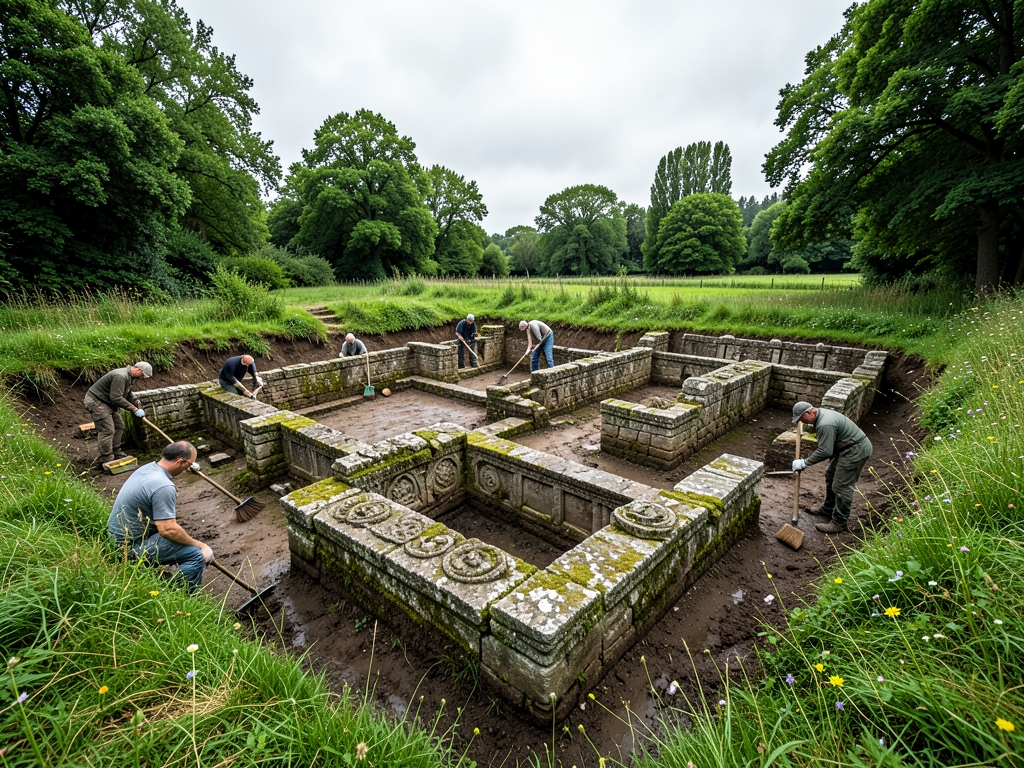
Archaeological discoveries around the Venetian lagoon continue to reshape our understanding of early medieval settlement patterns, religious infrastructure, and societal organization in Northern Italy. Recent excavations conducted near Venice have brought to light the remains of a long-lost early medieval church, offering scholars an unprecedented window into a period often overshadowed by the later splendour of the Venetian Republic. This significant find highlights the rich, complex history of the lagoon communities that thrived centuries before the rise of the iconic maritime empire.
The Historical Context of the Venetian Lagoon
Long before Venice became the dominant trading power of the Mediterranean, the islands and marshlands of the Venetian lagoon were inhabited by scattered fishing communities, monastic groups, and refugees fleeing mainland invasions during the decline of the Western Roman Empire. Historical records from the early medieval period in this region are often sparse, fragmented, and heavily reliant on later chroniclers who sought to mythologize the origins of the lagoon settlements. Consequently, physical archaeological evidence remains the most reliable tool for reconstructing the daily lives, religious practices, and architectural achievements of these early inhabitants.
During the early medieval era, church buildings served not only as places of worship but also as vital administrative and social centers. They anchored local communities, acted as focal points for economic exchange, and marked territorial boundaries within a shifting aquatic landscape. Finding an intact or structurally legible church foundation from this era provides crucial data regarding population density, architectural capabilities, and the diffusion of Christianity across the northern Adriatic basin.
Unearthing the Lost Medieval Structure
The recent discovery near Venice is the result of meticulous field surveys and targeted archaeological excavations. Researchers utilizing non-invasive remote sensing techniques initially identified subterranean anomalies beneath the topsoil, suggesting the presence of ancient masonry walls. Subsequent exploratory trenches confirmed the layout of a substantial religious structure featuring typical early medieval architectural elements.
The excavation revealed well-preserved stone foundations, fragments of liturgical furnishings, and remnants of ancient flooring materials. These artifacts allow specialists to date the construction to the early medieval period, aligning with a time when regional builders adapted Roman techniques to suit the damp, challenging environment of the lagoon. The alignment of the church, its orientation toward the east, and the spatial arrangement of the interior spaces conform closely to ecclesiastical standards of the period, demonstrating sophisticated building knowledge.
Archaeological discoveries in the Venetian lagoon remind us that the glittering maritime empire was built upon centuries of resilient, localized community development, agricultural adaptation, and religious devotion.
Material Culture and Artifact Analysis
Alongside the architectural remnants, the archaeological team recovered various artifacts that shed light on the material culture of the site's occupants. Fragments of pottery, metalwork, and glass provide clues about local trade networks and economic standing. While luxury items are scarce—indicating a community of modest means rather than a major urban cathedral—the presence of imported raw materials suggests that the lagoon inhabitants maintained active commercial links with mainland Italy and broader Mediterranean trade routes.
Particularly noteworthy are the ceramic fragments discovered within the stratigraphic layers associated with the church's active use and subsequent abandonment. By analyzing the clay composition, firing techniques, and stylistic features of these potsherds, specialists can establish a relative chronology for the site. This helps historians determine how long the church remained standing, whether it suffered destruction from floods or conflicts, and when it eventually fell into disuse.
Implications for Early Medieval Settlement Studies
The identification of this early medieval church contributes significantly to broader scholarly debates regarding the settlement history of Northern Italy. Traditional narratives often portrayed the early medieval lagoon as a desolate refuge populated solely by transient fishermen and salt-producers. However, recent archaeological campaigns increasingly demonstrate that the lagoon supported stable, organized agrarian and maritime communities capable of monumental building projects.
Furthermore, the geographic location of the newly discovered church offers insights into how early populations navigated the ecological challenges of the lagoon environment. Building heavy stone structures in marshy terrain required advanced engineering solutions, including timber pile foundations and specialized drainage techniques. Understanding these methods enhances our appreciation of medieval technological ingenuity.
Info! Archaeological excavations in wetland environments require specialized conservation techniques to prevent organic materials like wood and textiles from degrading rapidly upon exposure to air and changing moisture levels.
Preservation and Future Research Directions
As the excavation campaign concludes its initial phases, the focus shifts toward laboratory analysis, artifact conservation, and site preservation. Local heritage authorities and academic institutions are collaborating to ensure that the structural remains are properly documented and protected from environmental erosion and modern agricultural encroachment. Advanced digital modeling, including photogrammetry and 3D laser scanning, is being employed to create virtual reconstructions of the church as it would have appeared centuries ago.
Future research will likely involve broader landscape analyses to locate associated settlements, cemeteries, and agricultural plots that undoubtedly surrounded the religious site. By integrating archaeological data with archival documents, historians hope to reconstruct a comprehensive picture of life in the Venetian lagoon during the early medieval epoch.
When was the early medieval church near Venice discovered?
The discovery was announced by researchers and reported in October 2026, following meticulous field surveys and archaeological excavations in the Venetian lagoon region.
What architectural features were found at the excavation site?
Archaeologists uncovered well-preserved stone foundations, liturgical fragments, flooring remnants, and an east-facing orientation typical of early medieval ecclesiastical architecture.
Why is this archaeological find important for Venetian history?
It challenges the notion that the early lagoon was merely a desolate refuge, proving that organized, stable communities built significant religious and civic structures long before the rise of the Venetian Republic.
What artifacts were recovered alongside the church foundations?
Researchers recovered ceramic fragments, metalwork, and glass pieces that provide valuable insights into local trade networks, daily life, and the economic status of the community.
Conclusion
The unearthing of the early medieval church near Venice represents a major milestone in Italian archaeology and medieval studies. By bridging the gap between sparse written records and tangible material evidence, this discovery enriches our understanding of the resilient societies that laid the foundations for one of history's most celebrated maritime civilizations. As ongoing analysis continues, these ancient stones will undoubtedly yield further secrets about the human history embedded within the Venetian lagoon.
