

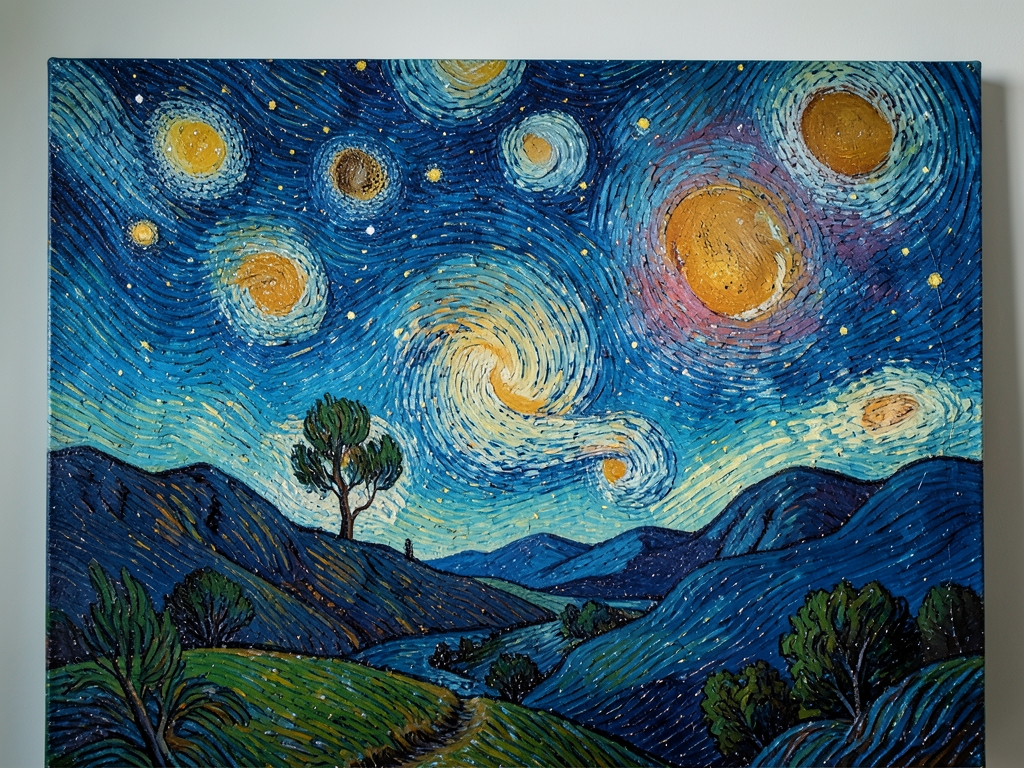
Few works in the history of Western art evoke as much immediate wonder and emotional resonance as Vincent van Gogh’s The Starry Night. Painted from the window of his asylum room at Saint-Paul-de-Mausole in Saint-Rémy-de-Provence, the swirling cypress tree, vibrant yellow stars, and glowing crescent moon have captivated art lovers, scientists, and casual observers for generations. While art historians have long debated the precise circumstances of its creation, a groundbreaking study by modern astronomers has finally solved a long-standing historical mystery by determining the exact date and time the Dutch post-impressionist master captured his celestial vision on canvas.
By applying rigorous astronomical positioning, historical weather records, and detailed analysis of the painter's correspondence, researchers have moved past generalized estimates. Instead, they have pinned down the precise astronomical alignment depicted in the masterpiece. This interdisciplinary breakthrough bridges the gap between fine art and hard science, offering a fascinating glimpse into how historical celestial phenomena can be authenticated through modern computational astronomy.
The Intersection of Art and Historical Astronomy
For decades, art historians relied primarily on van Gogh’s letters to his brother Theo and his friend Émile Bernard to date his works. In letters penned around June 18, 1889, van Gogh mentioned working on a new study of a starry sky. However, because painters frequently adjusted compositions from memory, sketched multiple views, or worked over extended periods, pinning down a singular, definitive date remained elusive. Was the swirling vortex painted on a clear June night, or was it a composite of several evenings?
To answer this, astronomers turned to the canvas itself as an observational record. Just as modern scientists analyze ancient rock art or medieval tapestry records for solar eclipses and supernova remnants, researchers examined the relative positions of the celestial bodies in The Starry Night. The painting prominently features a brilliant morning star—easily identifiable as Venus—shining brightly near a waning crescent moon. By calculating planetary positions, orbital mechanics, and the exact geographic coordinates of the asylum window in Saint-Rémy-de-Provence during the summer of 1889, scientists reconstructed the precise night sky visible to the artist.
The calculations revealed that Venus was at its maximum morning elongation during that period, shining with exceptional brilliance just as van Gogh depicted. By cross-referencing these celestial mechanics with historical meteorological data and the artist's personal timelines, the research team established that van Gogh captured this exact view during the early morning hours of June 18, 1889.
Methodology Behind the Celestial Dating
Reconstructing a night sky from the 19th century requires sophisticated tools and meticulous cross-verification. Researchers do not simply guess at star charts; they utilize high-precision ephemeris software capable of rolling back the clock centuries to model the exact positions of planets, stars, and lunar phases for any given geographic coordinate on Earth.
The process involves several critical scientific steps:
- Geographic Triangulation: Confirming the exact architectural orientation of the window in the Saint-Paul-de-Mausole asylum where van Gogh painted. Because the artist faced a specific window orientation looking out toward the Alpilles mountains, the field of view was physically restricted to a specific sector of the eastern horizon.
- Planetary Alignment Modeling: Running astronomical simulations for June and July 1889 to match the brightness, altitude, and relative angular separation of Venus and the Moon.
- Atmospheric and Lighting Analysis: Evaluating how twilight interacts with planetary visibility, ensuring that the ambient light levels in the simulation match the pre-dawn glow captured in the oil on canvas.
- Epistolary Cross-Check: Verifying that the computed date aligns seamlessly with the dispatch dates of van Gogh's letters, which frequently documented the completion of specific canvases before packaging them for shipment to Paris.
Info! Historical astronomical dating has increasingly become a powerful tool for authenticating and contextualizing works of art, literature, and archaeology by matching creative descriptions with verifiable cosmic events.
Why The Starry Night Defies Pure Realism
One of the most fascinating outcomes of this astronomical investigation is how it highlights the deliberate choices van Gogh made as an artist. While the positions of Venus and the crescent moon correspond with extraordinary accuracy to the morning sky of June 18, 1889, the village nestled below the swirling hills did not exist in that exact field of view from his window.
Historical records and topographical studies show that the window faced away from the village of Saint-Rémy. Instead of painting a literal, photographic snapshot of his immediate surroundings, van Gogh blended his direct observation of the pre-dawn celestial sky with nostalgic memories of his Dutch homeland, inserting a traditional church steeple reminiscent of architecture from the Netherlands into the Provençal landscape.
This revelation reinforces our understanding of post-impressionism. Van Gogh was not striving for mechanical replication; he sought to convey emotional truth and spiritual intensity. The scientifically verified date proves that while the stars and planets were grounded in genuine astronomical reality, the swirling composition was an emotional synthesis designed to express inner turmoil and awe.
Broader Implications for Cultural Heritage Research
The successful dating of The Starry Night demonstrates the immense value of cross-disciplinary collaboration between humanities scholars and physical scientists. Art conservation and historical research are no longer confined to chemical pigment analysis and stylistic comparison. Modern computational physics, optical modeling, and astronomical databases now play an active role in decoding cultural artifacts.
Researchers have similarly applied astronomical dating to analyze historical battles, ancient architectural alignments, and other masterworks of painting. By establishing absolute temporal anchors, historians can better understand the psychological and environmental context in which historical figures created enduring works.
| Analytical Method | Primary Focus | Contribution to Art History |
|---|---|---|
| Astronomical Ephemeris Modeling | Planetary positions and lunar phases | Determines exact calendar dates for depicted night skies |
| Topographical Triangulation | Building orientation and window views | Distinguishes real observation points from composite elements |
| Epistolary Analysis | Artist correspondence and letters | Provides chronological bounds for creative output |
| Pigment and Material Testing | Chemical composition of oil paints | Verifies authenticity and age of the physical medium |
As computational tools continue to advance, we can expect further insights into historical masterpieces, shedding new light on the exact moments of inspiration that shaped art history.
How did astronomers determine the exact date of The Starry Night?
Astronomers used high-precision ephemeris software to model planetary positions, orbital mechanics, and lunar phases visible from Saint-Rémy-de-Provence in 1889, matching the exact alignment of Venus and the crescent moon depicted in the painting.
On what exact date was Vincent van Gogh's Starry Night painted?
Recent astronomical analysis confirms that van Gogh captured the celestial configuration shown in the painting during the early morning hours of June 18, 1889.
Was the landscape in The Starry Night entirely accurate to van Gogh's view?
While the celestial sky was scientifically accurate to his actual pre-dawn window view, the village and church steeple were composite elements drawn from van Gogh's memory and nostalgia for his native Netherlands.
Where was van Gogh staying when he painted The Starry Night?
He created the masterpiece while residing at the Saint-Paul-de-Mausole asylum in Saint-Rémy-de-Provence, France, where he had admitted himself in May 1889.
Conclusion
The scientific confirmation of the date behind Vincent van Gogh’s The Starry Night bridges two seemingly disparate worlds: the analytical precision of orbital astronomy and the profound emotional depth of post-impressionist art. By proving that the morning star and crescent moon shining over the canvas correspond precisely to the pre-dawn sky of June 18, 1889, researchers have added a new layer of appreciation to a beloved masterpiece. It reminds us that even the most expressive and surreal artistic creations can be deeply rooted in the authentic, observable wonders of the natural universe.
