

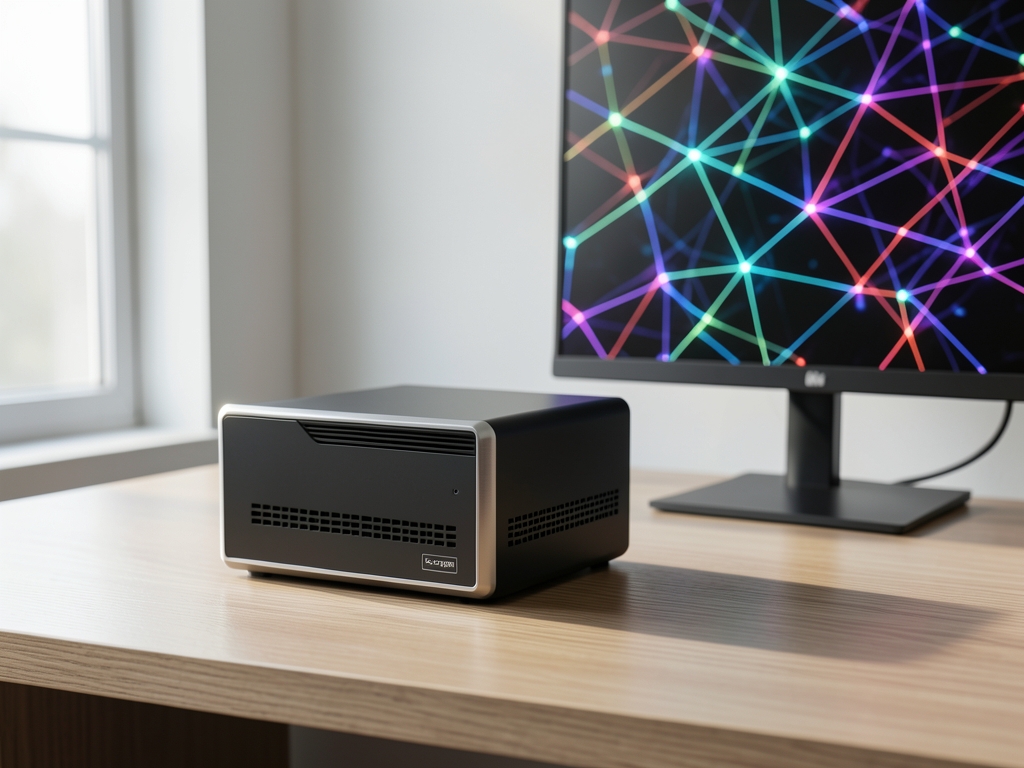
The landscape of edge computing and localized artificial intelligence infrastructure has experienced a profound shift with the introduction of specialized hardware designed to run massive language models directly on local devices. Among recent developments, the unveiling of the Lenovo AI Host P7 marks a notable milestone in hardware engineering, packing dense processing capabilities into a remarkably lightweight 300-gram form factor. Designed to support models reaching up to 125 billion parameters locally, this device represents a significant departure from traditional cloud-dependent architectures, offering enterprises and advanced users unprecedented control over their computational workloads, data privacy, and operational latency.
As organizations increasingly seek alternatives to cloud-hosted API services due to compliance mandates, security protocols, and connectivity costs, the demand for compact, high-performance edge servers has surged. The AI Host P7 addresses these challenges by integrating specialized silicon accelerators, high-bandwidth memory pooling, and optimized thermal management into a footprint that fits easily within a standard workspace or mobile deployment kit. Understanding the technical specifications, architectural design, and practical implications of this hardware provides valuable insight into the future trajectory of enterprise and consumer AI deployment.
Architectural Overview of the Lenovo AI Host P7
At the core of the Lenovo AI Host P7 is a tightly integrated system-on-chip design optimized specifically for tensor processing and matrix multiplication workloads typical of modern transformer models. Unlike traditional desktop workstations that rely on discrete graphics processing units with high power consumption, edge-specific AI hosts prioritize energy efficiency without sacrificing raw inference throughput. The device achieves its ability to handle 125 billion parameter models through advanced model quantization techniques, optimized KV-cache management, and specialized on-chip memory hierarchies.
Thermal dissipation represents one of the most formidable engineering hurdles in designing a 300-gram enclosure capable of sustaining high-load machine learning operations. Lenovo engineers incorporated a vapor-chamber cooling system paired with silent, magnetically levitated micro-fans that adjust dynamically based on thermal load thresholds. This ensures that the unit can maintain peak computational performance during prolonged inference tasks without triggering thermal throttling or generating disruptive acoustic noise in office environments.
| Hardware Feature | Specification Detail | Operational Benefit |
|---|---|---|
| Weight & Form Factor | 300 grams, ultra-compact desktop enclosure | High portability and minimal physical footprint |
| Model Capacity | Up to 125B parameters locally | Executes frontier-class reasoning offline |
| Cooling Architecture | Vapor-chamber with silent micro-fans | Sustained peak performance without thermal throttling |
| Connectivity | Multi-gigabit Ethernet, Wi-Fi 7, USB4 | Rapid data ingestion and cluster scaling |
Running 125B Models Locally: What the Engineering Means
Executing a 125-billion-parameter language model traditionally requires server racks equipped with multiple enterprise-grade accelerators drawing thousands of watts of power. Bringing this capability down to a device weighing only 300 grams requires a combination of algorithmic breakthroughs and hardware-level optimizations. Quantization plays a pivotal role here, reducing the precision of model weights from 16-bit floating-point representations to highly compressed integer formats—such as 4-bit or 3-bit quantization—without significant degradation in perplexity or task performance.
Info! Local execution ensures that sensitive enterprise data never leaves the physical premises, satisfying strict regulatory frameworks such as GDPR and HIPAA.
Furthermore, memory bandwidth dictates the speed at which tokens are generated during autoregressive decoding. The AI Host P7 utilizes high-speed unified memory architectures that bridge the gap between CPU processing units and dedicated neural processing cores. By minimizing data transfer bottlenecks across separate PCIe lanes, the device maximizes memory throughput, enabling acceptable token generation speeds even for massive models that would otherwise overwhelm standard consumer hardware.
Enterprise Implications and Edge Deployment Scenarios
The introduction of lightweight, high-capacity local inference boxes alters the calculus of enterprise digital transformation. Many organizations have hesitated to adopt generative artificial intelligence due to concerns regarding data sovereignty, third-party logging policies, and the unpredictable recurring costs associated with cloud API consumption. A dedicated physical appliance like the AI Host P7 offers a predictable, capital-expenditure-based model where organizations own their infrastructure outright.
Common deployment scenarios include:
- Secure Local Knowledge Retrieval: Indexing internal document repositories and running retrieval-augmented generation (RAG) pipelines entirely offline behind corporate firewalls.
- Edge Manufacturing and Logistics: Deploying intelligent automation nodes in remote facilities with intermittent or restricted internet connectivity.
- Regulated Financial Analysis: Processing proprietary financial models and client portfolios without exposing sensitive transactional data to external cloud providers.
By decentralizing heavy computational workloads, hardware innovations like the AI Host P7 empower organizations to harness the full potential of advanced language models while maintaining absolute ownership over their data pipelines and security perimeters.
Comparing Edge AI Approaches: Cloud vs. Local Hardware
To fully appreciate the positioning of the Lenovo AI Host P7, it is helpful to evaluate the trade-offs between centralized cloud infrastructure and decentralized edge hardware across key operational metrics.
| Evaluation Metric | Cloud-Based AI Services | Local Edge AI (e.g., AI Host P7) |
|---|---|---|
| Data Privacy | Dependent on third-party provider terms | Absolute control; data remains on-premises |
| Latency | Subject to network routing and server queues | Near-instantaneous local response times |
| Ongoing Costs | Variable token-based subscription fees | Fixed hardware investment with zero per-query fees |
| Offline Reliability | Requires active, stable internet connection | Fully functional in air-gapped environments |
While cloud infrastructure remains unmatched for training foundational models from scratch and handling massive concurrent user bases for consumer applications, local edge devices provide superior resilience, privacy, and cost predictability for specialized enterprise workflows.
Security and Compliance Advantages of Dedicated Appliances
Cybersecurity teams frequently cite third-party SaaS integrations as potential attack surfaces or vectors for unintended data exfiltration. When enterprise data is transmitted to external servers for processing, organizations must trust the third party's data retention policies, encryption standards, and compliance certifications. Dedicated local hardware eliminates these vectors entirely.
Because the AI Host P7 operates independently of external cloud networks, it can be deployed in air-gapped environments—facilities completely isolated from the public internet. This makes the device particularly attractive for defense contractors, government agencies, healthcare providers, and legal firms dealing with classified or legally protected information. Security administrators can apply strict access control lists, monitor hardware logs locally, and enforce custom encryption keys without relying on third-party attestation.
Future Outlook for Localized Machine Learning Hardware
The trajectory of semiconductor design suggests that the gap between cloud capabilities and edge computing will continue to narrow. As neural processing unit (NPU) architectures become more efficient and memory density increases, devices of this class will likely support even larger parameter spaces or run existing models with greater speed and lower energy consumption.
The Lenovo AI Host P7 serves as a clear indicator that the future of artificial intelligence is not exclusively centered in massive hyperscale data centers. Instead, a hybrid ecosystem is emerging where foundational models are trained centrally, but inference and fine-tuning are increasingly distributed to the edge where data is actually generated and consumed.
What is the Lenovo AI Host P7?
The Lenovo AI Host P7 is a compact, 300-gram edge computing hardware device engineered to run local artificial intelligence models with up to 125 billion parameters without relying on cloud connectivity.
How can such a small device run 125B parameter models?
The device utilizes advanced model quantization techniques, optimized memory architectures, and specialized tensor processing silicon to compress and efficiently execute large language models locally.
Does the AI Host P7 require an internet connection to operate?
No, the device is designed for edge deployment and can operate entirely offline in air-gapped environments, ensuring complete data privacy and security.
What are the primary use cases for enterprise edge AI hosts?
Primary use cases include secure local knowledge retrieval, offline document analysis, industrial automation, and processing sensitive financial or healthcare data under strict regulatory compliance.
