

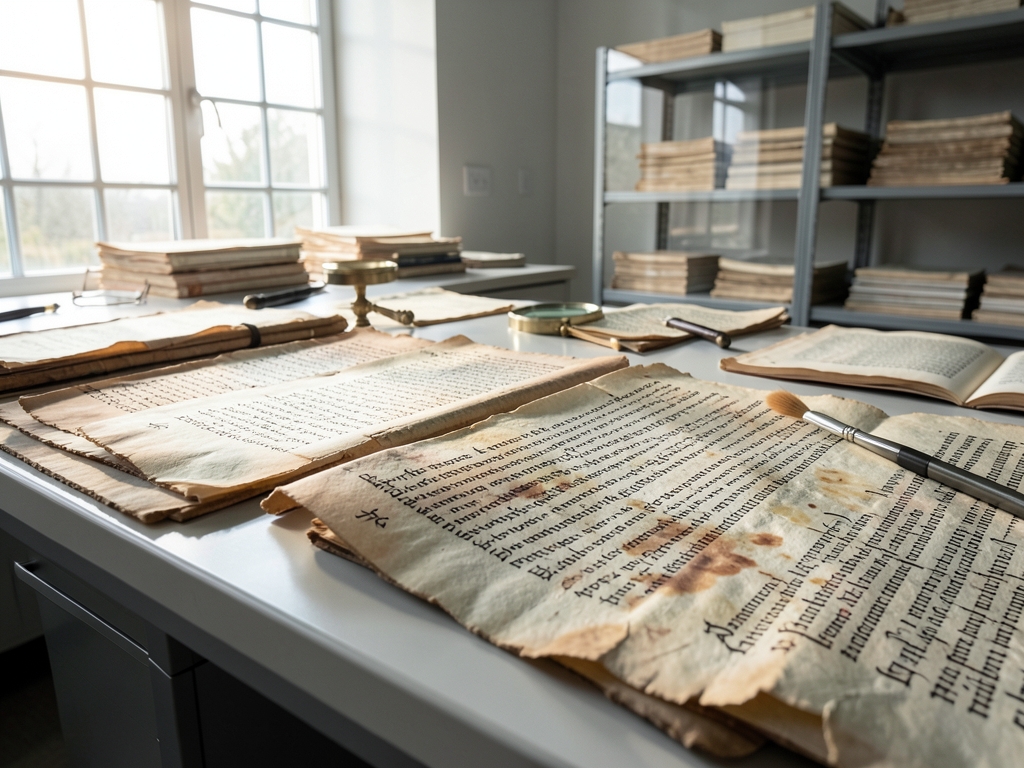
Recent archival digitization initiatives across major European cultural institutions have opened a remarkable window into the complex economic networks of late medieval Europe. By employing advanced multispectral imaging and high-resolution optical scanning, international teams of historians and paleographers have successfully transcribed thousands of heavily damaged commercial ledgers, shipping manifests, and private correspondence dating from the mid-to-late 1300s. These newly accessible documents provide unprecedented empirical data regarding how merchants, guilds, and banking dynasties navigated prolonged economic instability, shifting geopolitical boundaries, and systemic monetary fluctuations during a period previously overshadowed by macroeconomic generalizations.
The Technological Leap in Medieval Archival Digitization
For generations, historians studying the economic life of fourteenth-century Europe relied upon heavily edited transcription collections or fragile paper and parchment rolls stored in municipal and monastic vaults. Many of these manuscripts suffered severe degradation from dampness, iron gall ink corrosion, and biological damage. Traditional reading methods often left crucial marginal notes, erased financial entries, and faded signatures permanently obscured.
The recent integration of multispectral imaging techniques has fundamentally transformed this landscape. By capturing light across multiple narrow spectral bands—ranging from ultraviolet to infrared—conservation scientists can isolate underlying iron gall ink from discolored parchment backgrounds. This non-destructive technology allows researchers to recover text previously thought lost to fire damage, water staining, or deliberate scratching out. Furthermore, specialized optical character recognition (OCR) models trained specifically on medieval cursive scripts have accelerated the transcription process, converting hundreds of thousands of handwritten pages into searchable digital databases accessible to scholars worldwide.
Reconstructing Late Medieval Trade Corridors
One of the most significant insights emerging from these digitized merchant archives is the astonishing resilience and adaptability of continental and maritime trade routes during the latter half of the fourteenth century. While traditional historiography frequently portrayed this era as one of profound economic contraction following the devastating demographic shocks of the mid-fourteenth-century plague outbreaks, new ledger data reveals a dynamic restructuring of commercial enterprise.
Merchants operating out of primary commercial hubs such as Venice, Genoa, Bruges, and Lübeck did not simply retreat; rather, they diversified their shipping portfolios and established alternative overland corridors to bypass politically unstable territories. Detailed shipping logs show frequent adjustments to cargo manifests, reflecting rapid responses to local harvest failures, municipal embargoes, and regional conflicts. For instance, new entries from Hanseatic League trading posts document sophisticated risk-sharing mechanisms, early forms of maritime insurance, and complex debt-settlement networks that spanned thousands of miles.
| Major Commercial Hub | Primary Document Type | Key Trade Commodities | Recorded Financial Instrument |
|---|---|---|---|
| Venice | Maritime shipping manifests | Spices, silk, glass, alum | Commenda partnership contracts |
| Bruges | Notarial registry folios | English wool, Flemish cloth, wine | Bills of exchange |
| Lübeck | Hanseatic ledger books | Timber, grain, furs, wax | Joint-venture credit notes |
| Florence | Banking house correspondence | Gold florins, raw silk, dyes | Letter of credit transfers |
Monetary Instability and Currency Devaluations
Beyond logistics and trade routes, the newly transcribed archives offer granular documentation of monetary policy and currency manipulation practiced by medieval rulers and municipal governments. Silver shortages, fluctuating bullion supplies, and the constant temptation for sovereign entities to debase coinage created significant challenges for long-distance merchants.
Private account books maintained by prominent trading families reveal the sophisticated strategies utilized to hedge against currency depreciation. Merchants routinely calculated transactions in abstract units of account—such as the lira di conto—while executing actual payments in diverse metallic currencies of varying fineness and weight. The records detail exact exchange rates practiced at major trade fairs, illustrating how rapid fluctuations in coin values influenced commodity pricing across international markets long before the establishment of modern central banking.
Info! The preservation of these delicate parchment records requires stringent environmental controls, maintaining stable relative humidity levels between 45% and 50% to prevent both mold growth and dry embrittlement.
The Social Structure of Medieval Commercial Enterprise
The human element within these historical documents is equally compelling. Far from being the exclusive domain of isolated patrician elites, late medieval commerce relied heavily on extensive kinship networks, foreign factors, and resident agents stationed in distant foreign ports. Newly digitized correspondence reveals the daily operational realities faced by young factors living abroad—managing language barriers, navigating unfamiliar legal jurisdictions, and maintaining continuous communication with home offices through trusted couriers.
Moreover, the archives shed light on the legal and social standing of women in business. Numerous newly transcribed testaments, partnership agreements, and power-of-attorney documents demonstrate that widows and female family members frequently held substantial shares in merchant companies, actively managing commercial assets and directing overseas investments when male heads of household were traveling or deceased.
Methodological Challenges in Modern Archival Research
Despite the immense breakthroughs achieved through digital transcription, contemporary historians face distinct methodological hurdles when interpreting fourteenth-century financial records. Medieval bookkeeping was not uniform; accounting practices varied widely between Italian double-entry ledgers and the more narrative, chronological register styles common in northern European Hanseatic towns.
Translating medieval vernaculars—often a complex hybrid of regional dialects, Latinized legal terminology, and specialized commercial slang—requires rigorous philological analysis. Researchers must carefully cross-reference tax assessments, customs duties, and court litigations to verify the accuracy of figures reported in private merchant diaries, ensuring that modern economic models built upon these sources account for potential underreporting or strategic tax evasion.
The systematic digitization of late medieval merchant records bridges the gap between macroeconomic theory and individual human agency, revealing an interconnected European economy defined by remarkable adaptability.
Implications for Future Historical Scholarship
The ongoing release of these digitized archival collections marks a foundational shift in how economic history is researched and taught. By making primary source material universally accessible via digital repositories, institutions are democratizing access for researchers outside traditional academic centers. Graduate students and independent scholars alike can now analyze raw data sets spanning decades of commercial activity.
As artificial intelligence tools continue to improve in transcribing difficult paleographic hands, the scope of searchable historical data will expand exponentially. Future investigations will likely focus on large-scale quantitative analysis of price volatility, climate impact on agricultural yields, and the velocity of capital across medieval frontiers, ultimately rewriting our understanding of the foundations of modern global capitalism.
What technologies are used to read damaged medieval manuscripts?
Conservation scientists utilize advanced multispectral imaging across ultraviolet and infrared bands to isolate iron gall ink from discolored parchment, alongside specialized optical character recognition models trained on medieval cursive scripts.
How did late medieval merchants handle currency devaluation?
Merchants hedged against currency fluctuations by calculating transactions in abstract units of account while maintaining diverse portfolios of metallic coins and utilizing specialized bills of exchange at international trade fairs.
Did women participate in late medieval commerce according to the archives?
Yes, newly digitized partnership agreements and testaments demonstrate that women, particularly widows, frequently held significant business shares, managed commercial assets, and directed overseas investments.
What primary trade commodities are documented in these 14th-century ledgers?
The ledgers document a wide variety of goods, including Italian silks and spices, English wool, Flemish textiles, Baltic timber, furs, grain, and high-value metals transported across both maritime and overland trade routes.
The recovery and digital curation of fourteenth-century merchant records ensure that the complex daily realities of medieval economic life remain preserved for future generations, offering profound lessons in adaptability, resilience, and international exchange.
