

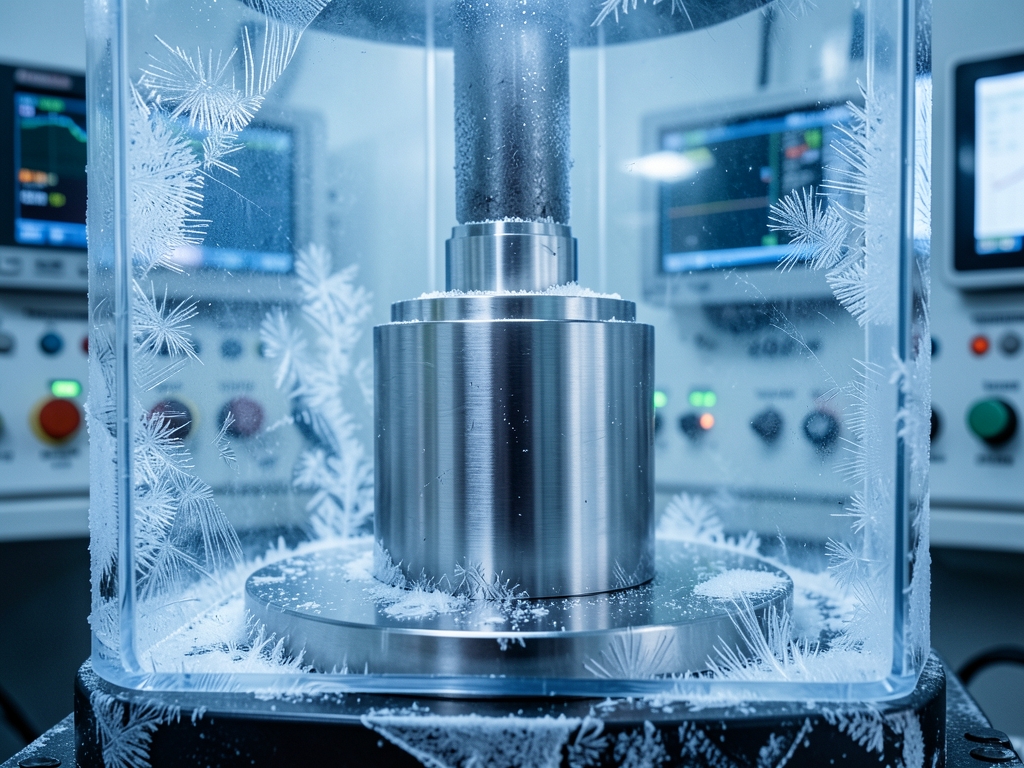
Metals exposed to sub-zero environments have long presented structural engineers with a profound paradox. While structural integrity and ductility generally govern material selection for everyday applications, plunging temperatures can abruptly strip these ductile properties away. Under extreme cold, metallic structures frequently succumb to catastrophic brittle failure, fracturing unexpectedly with little to no plastic deformation. This phenomenon has historically plagued deep-space exploration vessels, high-altitude aircraft, and industrial infrastructure operating in polar regions. However, recent scientific findings announced in October 2026 have shed light on an entirely unexpected atomic-level mechanism that enables certain metals to resist this dangerous cryogenic vulnerability.
Understanding why metals fracture under freezing conditions requires looking deep into their crystalline lattices. Traditionally, the atomic structure of metals allows planes of atoms to slide past one another when subjected to external stress, a process known as dislocation movement. This movement is what gives metals their characteristic malleability. When temperatures plummet, thermal energy drops, and the energy barrier required to move these dislocations increases dramatically. Consequently, the material loses its ability to deform plastically, concentrating stress until sudden cleavage planes open up, resulting in catastrophic failure without warning. For decades, metallurgists sought to overcome this limitation by refining alloy compositions, grain sizes, and heat treatments, but the fundamental low-temperature limits remained a formidable bottleneck.
The Breakthrough Mechanism in Cryogenic Material Science
The newly identified mechanism discovered by researchers centers on a previously unobserved interaction between localized atomic rearrangements and multi-principal element alloys. Rather than relying solely on conventional dislocation glide, the investigated metallic systems exhibit a coordinated multi-stage nano-twining and phase transformation pathway when subjected to extreme mechanical stress at cryogenic temperatures. This dual-action response absorbs incoming impact energy efficiently, redistributing localized stress peaks before they can initiate micro-cracks.
When a metallic component experiences external pressure in extreme cold, standard alloys typically experience localized stress concentrations that quickly exceed the cohesive strength of the crystal lattice. The newly documented mechanism alters this dynamic by dynamically reorienting atomic clusters at the crack tip. This local structural adjustment acts as an internal shock absorber, blunting the crack propagation path and forcing the material to consume significantly more energy to fracture. By maintaining localized plasticity even as ambient temperatures approach absolute zero, these advanced metallic configurations bypass the traditional brittle transition threshold.
Info! The discovery bridges a long-standing gap between theoretical solid-state physics and practical metallurgy, offering a predictable framework for designing next-generation alloys for extreme environments.
Implications for Aerospace and Extreme Environments
The ability of structural materials to withstand cryogenic stress without succumbing to brittle fracture carries sweeping implications across multiple engineering disciplines. In aerospace engineering, fuel tanks and structural frames designed for deep-space missions face thermal swings ranging from intense solar radiation to the near-absolute zero of deep space. Traditional aluminum and titanium alloys, while lightweight, require thick safety margins and complex thermal insulation to prevent low-temperature embrittlement. The implementation of alloys utilizing this newly understood atomic mechanism could streamline spacecraft design, reducing overall mass while enhancing structural reliability.
Similarly, terrestrial infrastructure operating in extreme northern and southern latitudes stands to benefit immensely. Pipelines, shipping vessels navigating polar routes, and energy storage facilities handling liquefied natural gas at cryogenic temperatures require materials that remain dependable over decades of service. Current engineering practices rely on heavy, expensive composite claddings or specialized nickel-rich steels to mitigate brittle fracture risks. Integrating insights from this recent study could enable metallurgists to formulate cost-effective, high-performance structural steels that inherently resist cryogenic degradation.
Comparing Traditional Low-Temperature Failure Modes and New Alloy Adaptations
| Material Property | Conventional Metals | New Cryogenic-Resistant Alloys |
|---|---|---|
| Primary Deformation Mode | Dislocation slip (inhibited at low temps) | Coordinated nano-twining and phase transition |
| Fracture Behavior at -150°C | Sudden, catastrophic brittle cleavage | Controlled energy absorption with retained plasticity |
| Stress Concentration Response | Crack propagation along rigid grain boundaries | Blunting and redistribution at the atomic scale |
| Primary Target Applications | Moderate temperature structural components | Deep-space, polar infrastructure, and cryogenic storage |
Challenges in Scaling and Manufacturing Advanced Alloys
Despite the remarkable promise shown by these findings, translating atomic-scale discoveries into commercial-grade industrial materials involves substantial metallurgical hurdles. Producing multi-principal element alloys with precise microstructural uniformity requires rigorous melting, casting, and thermomechanical processing techniques. Even minor impurities or localized segregation can disrupt the delicate balance of phase transformations required to activate the newly discovered resistance mechanism.
Furthermore, standard welding and fabrication processes can inadvertently alter the local grain structure of metals, potentially reintroducing brittle vulnerability zones near joints and fasteners. Engineers must develop specialized joining technologies, such as friction stir welding or tailored filler materials, that preserve the cryogenic resilience of the base metal across entire fabricated assemblies. Rigorous non-destructive testing protocols will also be necessary to verify structural integrity before deployment in high-stakes operational environments.
The transition from empirical alloy trial-and-error to predictive atomic-level design represents a watershed moment for modern materials science. Understanding how metals can be coaxed into retaining ductility at extreme cold redefines the boundaries of what is structurally possible in harsh environments.
Future Directions in Cryogenic Metallurgy
As computational modeling and advanced microscopy continue to evolve, researchers are now mapping the exact kinetic pathways of atomic reorientation during high-strain cryogenic deformation. By combining high-resolution electron backscatter diffraction with real-time mechanical testing inside cryogenic chambers, scientists can observe dislocation-twin interactions as they happen. This empirical feedback loop allows computational algorithms to predict optimal alloy compositions before physical casting begins, drastically accelerating the development timeline for specialized operational materials.
The convergence of advanced computational materials science and experimental metallurgy ensures that the insights gained from studying extreme cold resistance will extend far beyond specialized aerospace applications. As industries push into increasingly demanding frontiers—from deep-sea exploration to advanced energy systems—the principles uncovered by this research will form the foundation of safer, more resilient mechanical infrastructure worldwide.
Why do conventional metals fail at extreme cold temperatures?
Conventional metals fail because low temperatures reduce thermal energy, locking atomic dislocations in place. This prevents plastic deformation and concentrates stress, causing the material to fracture suddenly along brittle cleavage planes.
What is the newly discovered mechanism that prevents brittle failure?
The newly discovered mechanism involves a coordinated multi-stage nano-twining and phase transformation pathway that dynamically rearranges atomic clusters at crack tips, absorbing impact energy and maintaining local plasticity.
Which industries will benefit the most from this materials science breakthrough?
Aerospace engineering, polar maritime transport, liquefied natural gas infrastructure, and deep-space exploration sectors stand to benefit significantly from alloys capable of resisting cryogenic embrittlement.
What are the primary manufacturing challenges in producing these resilient alloys?
Key challenges include maintaining microstructural uniformity during bulk casting, preventing segregation of alloy components, and ensuring that welding or fabrication processes do not compromise low-temperature ductility at structural joints.
In conclusion, the identification of this novel atomic-level resistance mechanism marks a significant milestone in materials science. By unlocking how specific metal compositions can circumvent the traditional pitfalls of cryogenic embrittlement, researchers have opened new pathways for designing infrastructure capable of withstanding the harshest environments on Earth and beyond.
