

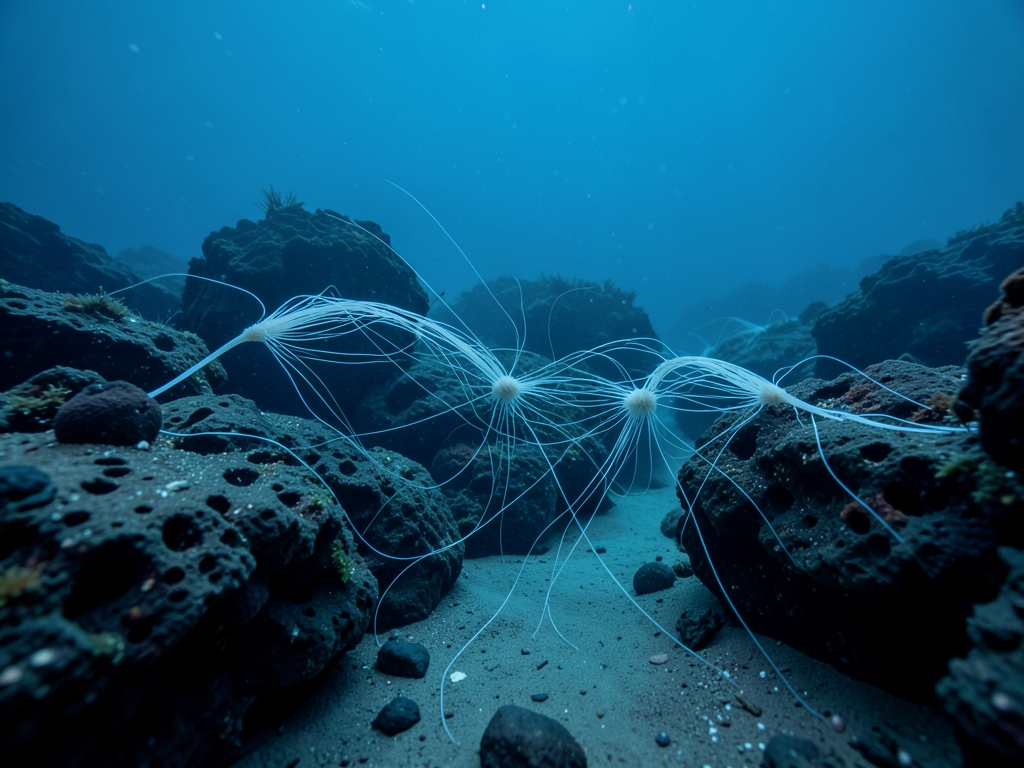
The mysteries of the deep sea continue to unfold as marine biologists formally establish an entirely new genus of deep-sea spaghetti worms. Announced in October 2026, this taxonomic breakthrough expands our understanding of benthic biodiversity and sheds light on the complex evolutionary adaptations required to survive in the extreme, high-pressure environments of the ocean floor. Deep-sea ecosystems cover the vast majority of our planet, yet they remain among the least explored habitats on Earth. Every expedition into the abyssal plains and submarine canyons uncovers organisms that challenge existing biological classifications and redefine what we know about life under extreme stress.
Spaghetti worms belong to the family Terebellidae, a diverse group of segmented marine polychaete worms known for their characteristic long, thread-like tentacles radiating from their heads. These specialized appendages stretch across the ocean floor like tangled noodles, functioning primarily as feeding mechanisms to gather microscopic organic particles, detritus, and nutrient-rich marine snow settling from the upper water columns. While shallow-water varieties of terebellid worms have been studied extensively by marine researchers for decades, deep-sea variants exhibit unique morphological, physiological, and genetic adaptations that allow them to thrive miles beneath the surface where sunlight never penetrates and temperatures hover near freezing.
Understanding the Classification of Deep-Sea Spaghetti Worms
The formal establishment of a new genus requires rigorous scientific examination, combining morphological analysis with modern molecular phylogenetics. Marine taxonomists examine the minute structural details of the worms, including the arrangement of their chaetae—tiny bristles used for locomotion and anchoring—the structure of their branchial filaments used for respiration, and the specific branching patterns of their feeding tentacles. DNA sequencing plays a critical role in distinguishing newly identified specimens from known relatives, ensuring that genetic divergence is significant enough to warrant a completely new genus classification.
In the harsh environment of the deep sea, competition for sparse food resources drives intense evolutionary specialization. Unlike coastal species that rely on abundant coastal runoff or kelp forests, deep-sea spaghetti worms depend almost entirely on organic detritus drifting down from the pelagic zones above. Their feeding tentacles have evolved to be exceptionally sensitive and flexible, capable of sweeping across broad areas of sediment to collect microscopic nutrients without disturbing the delicate benthic substrate. Establishing a new genus highlights how isolated deep-sea environments can foster distinct evolutionary lineages that remain hidden from science until specialized submersible technology enables deep-sea exploration.
Ecological Roles of Benthic Polychaetes in Deep-Sea Habitats
Polychaete worms, including spaghetti worms, play a fundamental ecological role in maintaining the health and nutrient cycling of marine sediment ecosystems. As bioturbators, these organisms continuously move through the upper layers of mud and silt, mixing organic matter into the substrate and oxygenating the sediment through their burrowing activities. This biological mixing supports a wide range of microbial communities and smaller benthic organisms that form the base of the deep-sea food web.
Furthermore, deep-sea spaghetti worms serve as a crucial food source for higher trophic levels, including specialized deep-sea fish, crustaceans, and predatory cephalopods. Despite living in regions characterized by crushing hydrostatic pressure, absolute darkness, and limited nutritional input, these resilient annelids maintain stable populations across vast submarine plains and hydrothermal vent peripheries. Their ability to successfully colonize and adapt to these extreme niches underscores the remarkable resilience of marine life.
Technological Advances Driving Deep-Sea Discoveries
The discovery and classification of new deep-sea genera are made possible by rapid advancements in marine robotics, remotely operated vehicles (ROVs), and high-resolution imaging systems. Modern oceanographic research vessels are equipped with deep-diving submersibles capable of withstanding extreme pressure while collecting delicate biological samples without causing structural damage to the specimens.
| Technological Tool | Primary Function | Impact on Marine Research |
|---|---|---|
| Remotely Operated Vehicles (ROVs) | High-precision deep-sea navigation and video recording | Allows researchers to observe live behavior in native habitats |
| Robotic Manipulator Arms | Gentle collection of fragile benthic fauna | Enables intact sample retrieval for taxonomic analysis |
| Environmental DNA (eDNA) Sampling | Detection of genetic traces in water columns | Identifies presence of rare species without visual sighting |
| Next-Gen Mass Spectrometry | Biochemical and isotopic tissue analysis | Reveals trophic relationships and dietary sources |
These technological tools have transformed marine biology from a largely speculative science into a high-precision discipline. When scientists identify a potential new species or genus during a dive, they can record high-definition data, map exact geographical coordinates, and retrieve specimens for genetic barcoding in land-based laboratories.
Conservation Implications for Deep-Sea Ecosystems
As industrial interest in deep-sea mining, deep-water fishing, and energy exploration grows, understanding benthic biodiversity becomes an urgent conservation priority. Many deep-sea organisms grow extremely slowly, reproduce infrequently, and depend on stable environmental conditions that have persisted for millennia. Disrupting deep-sea sediments through industrial activity can permanently damage fragile habitats before scientists have even had the opportunity to document their inhabitants.
Info! The formal description of new marine genera provides the legal and scientific framework required to advocate for marine protected areas in international waters.
Conservation organizations utilize taxonomic discoveries to lobby international governing bodies, such as the International Seabed Authority, to establish strict environmental safeguards. Protecting unique benthic habitats ensures that foundational species like spaghetti worms continue to support complex marine food webs and maintain global ocean health.
Future Directions in Abyssal Taxonomy
The formal identification of this new spaghetti worm genus is just one step in a much larger scientific endeavor. Researchers estimate that a significant majority of deep-sea invertebrate species remain undocumented. Future marine expeditions will focus on poorly explored regions of the Indian and Pacific Oceans, utilizing autonomous underwater vehicles (AUVs) to map uncharted trenches and seamounts.
As genetic databases expand and international collaboration among marine institutes deepens, the pace of taxonomic discovery is expected to accelerate. By documenting these hidden organisms, science gains a more complete picture of Earth's biological heritage and the intricate evolutionary pathways that enable life to flourish in the most extreme environments imaginable.
What are deep-sea spaghetti worms?
Deep-sea spaghetti worms are marine polychaete worms belonging to the family Terebellidae, characterized by long, thread-like tentacles that extend across the ocean floor to gather microscopic food particles and organic detritus.
Why is establishing a new genus important in marine biology?
Establishing a new genus formally recognizes significant morphological and genetic divergence, providing researchers with an accurate taxonomic framework to study deep-sea biodiversity and evolutionary history.
How do scientists discover new deep-sea species?
Scientists discover deep-sea species using advanced remotely operated vehicles (ROVs) equipped with high-resolution cameras and robotic arms, followed by rigorous laboratory morphological analysis and DNA sequencing.
What role do benthic polychaetes play in ocean ecosystems?
Benthic polychaetes act as bioturbators that mix sediment, cycle nutrients, oxygenate the ocean floor, and serve as an essential food source for higher trophic levels in deep-sea food webs.
The discovery and naming of this new deep-sea spaghetti worm genus remind us of the vast, unexplored wonders hidden beneath the ocean surface. As marine researchers continue to probe the abyssal depths, each new finding reinforces the importance of protecting fragile marine habitats against rising anthropogenic pressures.
