

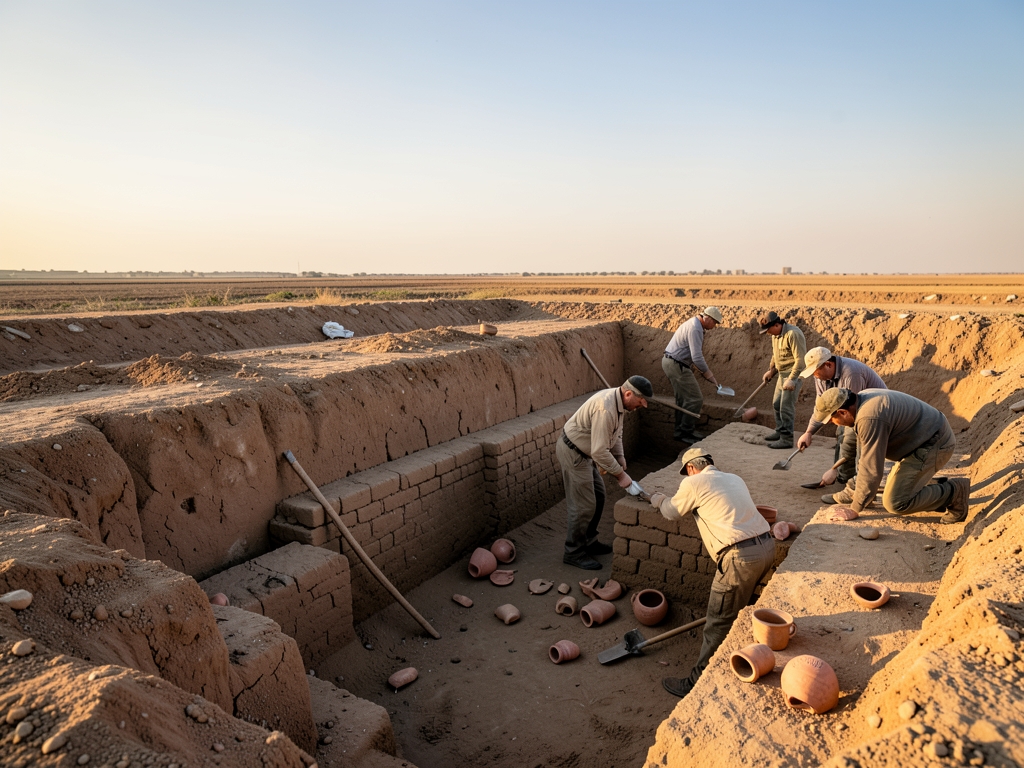
Archaeological discoveries continue to reshape our understanding of the ancient world, offering tangible connections to civilizations that flourished thousands of years ago. Recent excavations at the historical site of Tell Muhammad have brought to light remarkable insights into daily existence, social structures, and economic patterns within ancient Mesopotamia. As researchers delve deeper into the layers of earth, the artifacts uncovered provide a vivid picture of how early Babylonian communities lived, worked, and interacted with their environment.
The Significance of Tell Muhammad in Mesopotamian Studies
Tell Muhammad stands as one of the crucial archaeological windows into the heart of ancient Babylonian civilization. Situated in a region historically rich with cultural exchanges and urban development, the site has long captured the attention of historians and archaeologists seeking to unearth the complexities of ancient city life. Unlike royal palaces and grand temples that often dominate historical narratives, sites like Tell Muhammad frequently offer invaluable glimpses into the domestic and civic realities of ordinary citizens.
Recent excavation campaigns conducted by international and local archaeological teams have utilized advanced stratigraphical analysis and meticulous documentation techniques. These modern methodologies allow researchers to distinguish subtle shifts in architectural styles, ceramic production, and domestic organization across different historical periods. Consequently, historians can reconstruct the chronological evolution of the settlement with unprecedented precision, tracing how communities adapted to shifting political powers and environmental pressures over centuries.
Uncovering Daily Life and Domestic Architecture
The layout of ancient homes discovered at Tell Muhammad reveals sophisticated urban planning and domestic organization. Excavated residential quarters show multi-room structures built from sun-dried mud bricks, a standard construction material throughout ancient Mesopotamia. These homes were designed to maximize cooling in the arid climate, featuring thick walls and small courtyards that served as the focal point for family activities, cooking, and craft production.
Within these domestic spaces, archaeologists have recovered a wide array of everyday items that illuminate the daily routines of Babylonian families. Cooking vessels, grinding stones, and storage jars indicate established culinary traditions and agricultural reliance on grains such as barley and wheat. Furthermore, the discovery of spindle whorls and loom weights points to active household textile production, highlighting the division of labor and economic self-sufficiency characteristic of ancient neighborhoods.
The painstaking recovery of domestic artifacts at Tell Muhammad bridges the gap between grand imperial chronicles and the personal lives of ordinary people who built the foundations of Mesopotamian civilization.
Economic Activities and Trade Networks
Trade played a foundational role in sustaining ancient Babylonian settlements, and findings from Tell Muhammad underscore the breadth of commercial networks operating during antiquity. Cuneiform tablets, administrative seals, and imported raw materials recovered from the site demonstrate active participation in regional and long-distance trade. Merchants and artisans exchanged textiles, pottery, and agricultural surpluses for metals, precious stones, and timber brought from distant territories.
The presence of specialized craft workshops within the excavation zones indicates a stratified economy where potters, metalsmiths, and scribes honed their respective trades. Seal impressions found on clay bullae and tablet fragments offer concrete evidence of administrative oversight, tracking goods entering and leaving the civic center. These economic records provide modern researchers with quantitative data regarding commodity values, taxation, and legal contracts governing daily commerce.
Ceramic Typologies and Chronological Markers
Pottery remains one of the most reliable diagnostic tools for archaeologists working in Mesopotamia. At Tell Muhammad, the stratification of ceramic sherds has established a clear chronological timeline. Analysts have identified distinct styles ranging from utilitarian storage jars to finely decorated drinking vessels. By comparing these ceramic typologies with findings from neighboring sites, researchers can accurately date architectural phases and trace cultural influences moving across the ancient river valleys.
| Artifact Category | Primary Material | Historical Function |
|---|---|---|
| Cuneiform Tablets | Clay | Administrative records and economic contracts |
| Storage Jars | Ceramic | Grain and liquid preservation |
| Seal Impressions | Clay / Stone | Authentication and ownership marking |
| Spinning Tools | Terracotta | Textile production and weaving |
Religious Practices and Community Beliefs
Spiritual life was deeply intertwined with every aspect of ancient Babylonian society, and the excavations at Tell Muhammad have yielded significant clues regarding local religious observances. Small terracotta figurines, votive plaques, and domestic altars discovered within residential zones suggest that religious devotion was not confined to monumental ziggurats and state temples, but was actively practiced within the home and neighborhood shrines.
These household religious objects often depicted protective deities, fertility symbols, and mythical creatures intended to ward off malevolent forces and secure divine favor for the household. The integration of spiritual practices into domestic architecture underscores the holistic worldview of ancient Mesopotamians, where the boundaries between the sacred and the secular were fluid and mutually reinforcing.
Info! Ongoing analysis of organic residues on ritual vessels from Tell Muhammad is providing new insights into the specific oils, wines, and aromatics used in ancient Babylonian ceremonies.
Preservation Challenges and Future Research
Preserving the fragile mud-brick architecture and delicate organic artifacts recovered from Tell Muhammad presents ongoing challenges for conservation teams. Exposure to modern environmental fluctuations, urban encroachment, and climate shifts requires rigorous preservation protocols. Archaeologists and heritage conservationists work side by side to stabilize excavated walls, document contexts digitally, and house fragile organic finds in climate-controlled museum environments.
Looking ahead, upcoming excavation campaigns aim to explore deeper stratigraphic layers to investigate the earliest phases of settlement at the site. As analytical techniques such as DNA analysis, isotopic testing, and micro-morphology continue to evolve, researchers anticipate uncovering even finer details regarding the diet, health, and genetic makeup of the ancient population. These future endeavors promise to keep Tell Muhammad at the forefront of Mesopotamian archaeological research.
Where is the Tell Muhammad archaeological site located?
Tell Muhammad is located in the region of modern-day Iraq, an area historically rich with ancient Mesopotamian settlements and urban centers.
What types of artifacts are typically found during excavations at Tell Muhammad?
Excavations have uncovered cuneiform administrative tablets, domestic pottery, cooking vessels, textile production tools, seal impressions, and small religious figurines.
How do archaeologists date the different layers found at Tell Muhammad?
Archaeologists use a combination of stratigraphical analysis, ceramic typologies, and written records from recovered cuneiform tablets to establish accurate chronological timelines.
Why are domestic findings at Tell Muhammad important for historians?
Domestic findings provide vital insights into the daily lives, economic activities, and household religious practices of ordinary citizens rather than focusing solely on royalty and elites.
The ongoing exploration of Tell Muhammad reinforces the dynamic nature of historical research, reminding us that ancient civilizations were shaped by the everyday actions, innovations, and resilience of ordinary people. As future discoveries unfold, our understanding of the rich tapestry of human history in Mesopotamia will only grow deeper and more comprehensive.
