

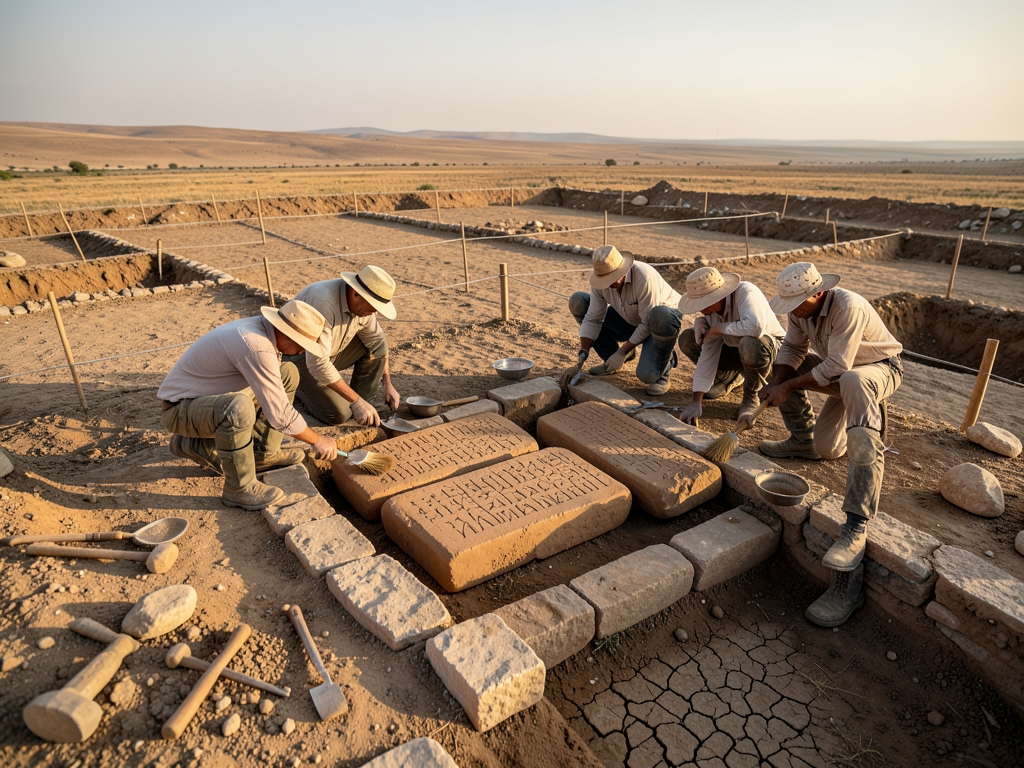
Archaeological discoveries often rewrite textbooks, shedding light on civilizations that shaped the ancient world yet remained obscured by the mists of time. Among the most compelling recent revelations in Near Eastern archaeology is the unearthing of a massive collection of texts within the heartland of ancient Anatolia. The discovery of 184 cuneiform tablets in a Hittite royal archive has offered historians an unprecedented look into the administrative genius, religious life, and political crises of one of the great superpowers of the Late Bronze Age. This landmark find not only deepens our understanding of the Hittite Empire but also unveils a poignant, 3,400-year-old royal tragedy that humanizes the rulers who once commanded empires.
The Hittites dominated much of modern-day Turkey and parts of the Levant between the 17th and 12th centuries BCE. Competing directly with ancient Egypt, Assyria, and Mitanni, the Hittite Empire was renowned for its advanced chariot warfare, sophisticated legal system, and prolific record-keeping. Unlike many contemporary cultures that recorded events primarily on perishable materials, the Hittites baked their administrative decrees, diplomatic treaties, and literary myths onto durable clay tablets. These archives have served as the primary gateway for modern scholars attempting to reconstruct the political landscape of the ancient Near East.
The Significance of the Recent Excavations in Türkiye
The excavation campaign yielding the 184 cuneiform tablets took place at a historically significant archaeological site in Türkiye, bringing to light a specialized storage and administrative complex linked to the Hittite royal administration. Researchers working at the site noted that the architectural integrity of the archive room allowed the clay tablets to survive centuries of soil pressure and seismic activity relatively intact. Each tablet represents a piece of a vast administrative puzzle, detailing grain distributions, military logistics, royal correspondence, and religious rituals performed to appease a pantheon of thousands of deities.
What makes this specific discovery extraordinary is the concentration of administrative records preserved in a single deposit. Rather than isolated fragments, the 184 tablets form a coherent corpus that allows epigraphers and historians to map out the economic and political priorities of the Hittite court during a period of intense geopolitical stress. The careful documentation reflects an empire heavily reliant on centralized control, where every bushel of grain and every troop deployment was meticulously recorded by trained scribes fluent in multiple languages, including Hittite, Akkadian, and Hattian.
Unraveling a 3,400-Year-Old Royal Tragedy
Beyond the mundane administrative tallies, the newly recovered tablets contain deeply dramatic narratives. Epigraphic analysis reveals that a subset of the archive is dedicated to documenting a severe political and personal crisis within the royal family that unfolded over three millennia ago. The texts describe a period of acute instability, marked by contested successions, suspected palace conspiracies, and the sudden downfall of prominent officials who had fallen out of favor with the reigning monarch.
Historical records from Hattusa, the Hittite capital, have long hinted at palace intrigue, royal assassinations, and dramatic curses inscribed on stone monuments. However, these newly translated tablets provide a granular, day-by-day account of how a specific royal tragedy unfolded behind closed doors. The documents detail emergency council meetings, frantic diplomatic dispatches sent to vassal states to secure loyalty, and ritual purification ceremonies ordered by the king to cleanse the palace of what was perceived as divine wrath following the crisis. Such primary evidence moves history beyond broad political outlines and into the emotional and psychological reality of Bronze Age rulers facing the collapse of their lineage.
Info! The decipherment of Hittite cuneiform is a complex linguistic feat. Deciphered in the early 20th century by Czech linguist Bedřich Hrozný, Hittite proved to be the oldest documented Indo-European language, fundamentally changing our understanding of linguistic history.
The Craft of the Hittite Scribe
To fully appreciate the weight of this discovery, one must examine the meticulous craft of the ancient scribes who pressed reed styluses into wet clay. Hittite administration relied on a sophisticated bureaucracy operating out of provincial and metropolitan centers. Scribes underwent rigorous training at specialized academies, learning not only the complex cuneiform script imported from Mesopotamia but also multiple local dialects and religious terminology.
The newly found tablets exhibit exceptional craftsmanship, with clear, legible impressions that have aided epigraphers in making rapid progress with translations. Many of the tablets feature characteristic clay seals pressed by high-ranking officials, authenticating the documents and binding the recipients to royal edicts. These seals provide vital iconographic evidence, depicting gods, sacred animals, and royal insignia that reflect the shifting artistic styles of the Late Bronze Age.
Preservation and Modern Epigraphic Analysis
Once ancient clay tablets are exposed to the open air after thousands of years underground, they are extremely fragile. Moisture fluctuations and mineral crystallization can cause the clay to crumble if not handled with precise conservation protocols. The archaeological team responsible for the recent discovery employed immediate stabilization techniques, transferring the tablets to climate-controlled conservation laboratories where sediment was carefully removed using specialized micro-tools.
Following cleaning, high-resolution 3D scanning and photogrammetry are deployed to create digital models of every tablet. This technology allows epigraphers to examine microscopic incisions and eroded signs under optimal virtual lighting conditions. International collaboration among linguists, historians, and materials scientists ensures that every historical nuance contained within the 184 tablets is thoroughly documented before the artifacts are prepared for public museum exhibition.
The recovery of intact royal archives bridges the gap between myth and historical reality, allowing us to hear the literal voices of ancient scribes and monarchs as they grappled with the triumphs and tragedies of empire.
Broader Historical Implications
The discovery in Türkiye contributes to a broader re-evaluation of the Late Bronze Age collapse—a systemic crisis that swept across the Mediterranean and Near East around 1200 BCE, leading to the sudden abandonment of major urban centers, including Hattusa. While the causes of this collapse remain a subject of intense scholarly debate—involving climate change, maritime raids by the Sea Peoples, internal rebellion, and economic disruption—archives from this era offer critical data points on the vulnerabilities of centralized Bronze Age states.
By studying how the Hittite administration managed resources and responded to internal crises in the decades leading up to their empire's demise, researchers can better understand the domino effects of political instability. The newly found tablets serve as a diagnostic tool for historians analyzing the socio-economic pressures that preceded the collapse of international trade networks across the ancient Mediterranean world.
What languages were used on the newly discovered Hittite cuneiform tablets?
The Hittite royal archives typically contain documents written in multiple languages, primarily Hittite (an Indo-European language), Akkadian (the diplomatic lingua franca of the ancient Near East), and ceremonial passages in Hattian and Hurrian.
How do archaeologists preserve fragile clay tablets after excavation?
Excavators carefully clean the tablets using micro-tools, place them in climate-controlled environments to stabilize moisture levels, and utilize high-resolution 3D scanning and digital photogrammetry to record every inscription safely.
What kind of information is typically found in Hittite administrative archives?
Hittite archives generally include economic tallies, royal correspondence, legal decrees, international treaties, land grants, and detailed descriptions of religious festivals and ritual purification ceremonies.
Why is the study of Hittite history important for understanding the Bronze Age?
As one of the dominant superpowers of the Late Bronze Age alongside Egypt and Assyria, the Hittites played a central role in international diplomacy, trade networks, and military conflicts before their empire collapsed around 1200 BCE.
The unearthing of the 184 cuneiform tablets in Türkiye stands as a testament to the enduring power of archaeological discovery. By bringing to light administrative precision alongside deeply human royal dramas, these artifacts connect modern observers directly to the complexities of the ancient world. As conservation and translation efforts continue, this remarkable archive will undoubtedly yield further insights into the rise and fall of the Hittite Empire.
