

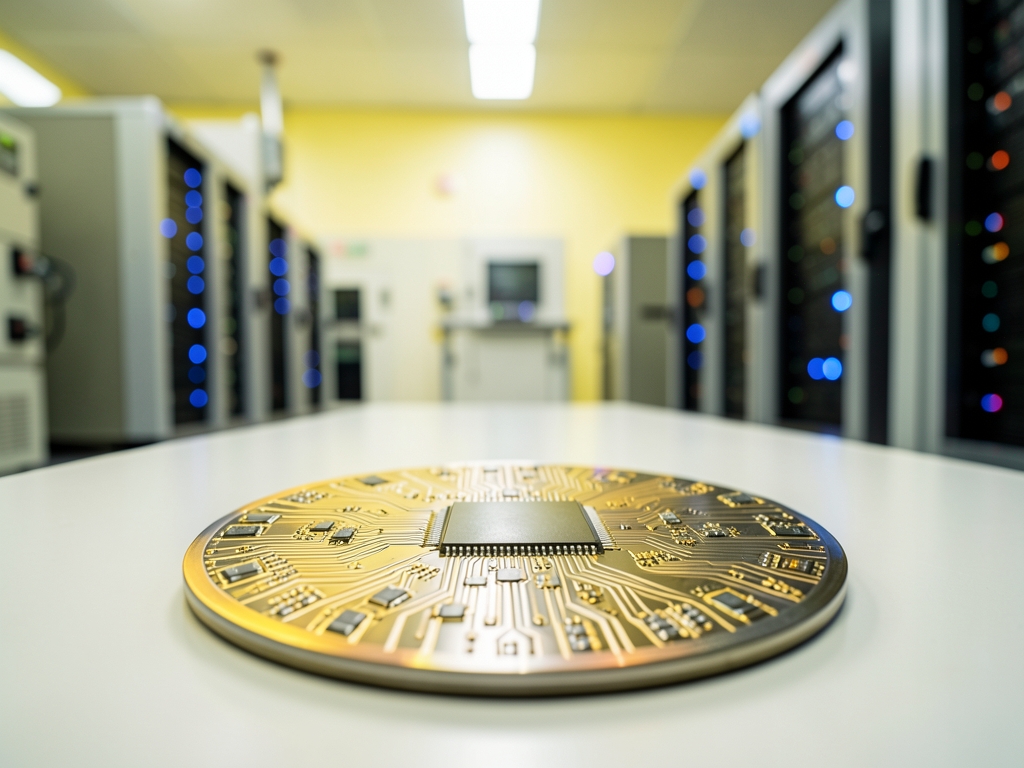
The landscape of modern computing is undergoing its most profound structural transformation in decades, driven almost entirely by the relentless demands of artificial intelligence workloads. For years, the hardware foundation of personal computers, cloud servers, and enterprise data centers relied on general-purpose processors, predominantly central processing units designed to handle sequential instruction processing with remarkable flexibility. However, the exponential rise of large language models, deep neural networks, and massive parallel training pipelines has completely altered the hardware equation. Today, technology giants, specialized semiconductor startups, and cloud service providers are engaged in an unprecedented race to design, manufacture, and deploy their own custom artificial intelligence chips.
This strategic shift away from off-the-shelf components toward proprietary silicon is not merely a technical preference; it is an economic and operational necessity. As artificial intelligence models expand into hundreds of billions of parameters, the computational bottlenecks of traditional architectures have become glaringly apparent. Memory bandwidth limitations, thermal dissipation challenges, and soaring power consumption figures threaten to cap the scalability of next-generation digital intelligence. By bypassing traditional merchant silicon vendors and crafting bespoke processors optimized specifically for matrix multiplication and tensor operations, hardware architects are redefining how computational power is delivered, measured, and monetized across global markets.
The Core Architectural Limitations of General-Purpose Processors
To understand why companies are spending billions of dollars designing custom silicon, one must examine the fundamental design differences between traditional central processing units and modern artificial intelligence accelerators. Central processing units are master multitaskers. They feature a small number of extremely powerful cores designed to execute complex, sequential instructions quickly, jump between disparate operating system tasks, and manage system resources with minimal latency.
While this architecture is ideal for running operating systems, web browsers, and desktop productivity software, it is profoundly inefficient for deep learning. Artificial intelligence training and inference do not require complex decision-making branches; instead, they demand the simultaneous execution of millions of simple mathematical operations, primarily floating-point matrix multiplications. When forced to process these workloads, traditional processors quickly saturate their internal registers, spending more time moving data between cache tiers than performing actual computations. This phenomenon, known in computer science as the memory wall, creates severe throughput bottlenecks that stall even the most powerful server configurations.
Graphics processing units offered the first major breakthrough by replacing a few large, complex cores with thousands of smaller, simpler cores capable of parallel data processing. Originally engineered to render real-time 3D graphics for video games and professional visualization tools, graphics processors proved uniquely suited for the parallel nature of neural network computations. However, as artificial intelligence models evolved beyond simple image recognition into complex generative systems and reasoning engines, standard graphics architectures also began to hit structural ceilings. Specialized hardware accelerators now go a step further, stripping away unnecessary display controllers and general-purpose logic to dedicate maximum silicon die area exclusively to tensor manipulation engines, high-speed on-chip memory, and specialized interconnects.
Economic Pressures and the High Cost of Cloud Infrastructure
Beyond raw performance metrics, the economics of cloud computing provide a powerful catalyst for the proprietary silicon race. Hyperscale cloud providers such as Amazon Web Services, Microsoft Azure, and Google Cloud operate massive server fleets numbering in the millions. Running third-party hardware accelerators at this scale incurs massive capital expenditure costs, both in initial hardware procurement and in the exorbitant electricity bills required to power and cool dense server racks.
When a cloud provider relies entirely on external merchant silicon suppliers, it remains vulnerable to supply chain disruptions, tight hardware allocations, and rigid pricing structures. More importantly, every third-party chip deployed in a data center includes a profit margin paid to the chip manufacturer. By designing custom silicon internally, technology giants can tailor the manufacturing process to their exact software ecosystems, optimize power efficiency down to the milliwatt, and drastically reduce the total cost of ownership over a server's operational lifespan.
Furthermore, custom silicon provides a formidable competitive moat in the software-as-a-service market. When a company builds its own accelerators, it can co-design the hardware and the software stack simultaneously. This vertical integration allows engineers to implement novel architectural features that accelerate specific proprietary algorithms long before those features appear in commercial, off-the-shelf components. The result is faster model training times, lower inference latency for end users, and superior profit margins on enterprise artificial intelligence services.
The Sovereign AI Movement and Regional Semiconductor Initiatives
The race to develop custom artificial intelligence hardware is not restricted to Silicon Valley behemoths. Nations and regional consortia around the world increasingly view domestic semiconductor design as a matter of national security and economic sovereignty. Relying entirely on foreign foundries and overseas chip designers exposes local economies to geopolitical tensions, trade restrictions, and sudden supply chain shocks.
In response, governments and regional alliances are pouring substantial funding into local technology ecosystems to foster sovereign artificial intelligence stacks. For instance, collaborative efforts involving cloud operators, specialized neural processing unit designers, and software developers are working to build end-to-end artificial intelligence infrastructure using domestically engineered silicon. These regional initiatives aim to ensure that critical public services, financial institutions, and research facilities can deploy advanced machine learning models without depending on foreign hardware supply chains.
Info! Sovereign artificial intelligence initiatives emphasize local control over data, software frameworks, and hardware manufacturing to protect national digital infrastructure against external disruptions.
Similarly, academic institutions and international cybersecurity alliances are establishing specialized research centers dedicated to securing artificial intelligence hardware against emerging threat vectors. As custom chips become deeply embedded in critical infrastructure, ensuring that these specialized processors are free from hardware trojans, side-channel vulnerabilities, and unauthorized access points has become an urgent priority for computer engineers worldwide.
Technical Innovations in Modern AI Chip Design
Designing a competitive artificial intelligence accelerator requires overcoming immense engineering hurdles. Modern chip designers are deploying a variety of architectural innovations to maximize performance while minimizing energy consumption and physical footprint.
- Advanced Packaging Technologies: Utilizing 2.5D and 3D chiplet architectures to integrate high-bandwidth memory directly on top of or alongside the main compute die, drastically reducing data transfer latency.
- Low-Precision Arithmetic: Shifting away from standard 32-bit floating-point calculations toward specialized formats like FP8, INT8, and custom binary quantization to multiply throughput without sacrificing model accuracy.
- Optimized Interconnect Fabrics: Implementing high-speed, low-latency network-on-chip fabrics that allow thousands of processing cores to communicate fluidly across massive multi-chip module assemblies.
- Dynamic Power Management: Integrating intelligent power gating circuits that instantly shut down idle silicon blocks, dramatically improving energy efficiency during variable workload spikes.
These hardware advancements are routinely paired with sophisticated compiler software that automatically analyzes neural network graphs and maps operations to the most efficient physical execution units on the silicon die. This seamless synergy between advanced compiler design and custom hardware architecture represents the true competitive differentiator in today's semiconductor market.
Challenges Facing New Silicon Entrants
Despite the massive potential rewards, entering the custom artificial intelligence chip market is fraught with difficulty. The semiconductor industry demands extraordinary upfront capital investments, often running into the billions of dollars before a single marketable product is manufactured. Designing a modern processor requires years of meticulous planning, complex simulation, and rigorous physical verification.
Moreover, manufacturing advanced semiconductors requires access to cutting-edge fabrication plants equipped with extreme ultraviolet lithography machines—resources controlled by only a tiny handful of companies globally. Once manufactured, a chip is only as successful as its software ecosystem. Enterprise developers will not adopt new hardware unless it supports mature, stable software frameworks like PyTorch and TensorFlow out of the box. Building a comprehensive software stack that abstracts complex hardware features into intuitive developer APIs often costs more and takes longer than designing the physical silicon itself.
| Metric | Traditional CPU | GPU Accelerator | Custom AI ASIC |
|---|---|---|---|
| Core Count | 8 to 128 Complex Cores | Thousands of Parallel Cores | Millions of Specialized Tensor Units |
| Primary Focus | Sequential Task Management | Parallel Graphics & Matrix Math | Dedicated Neural Network Inference |
| Power Efficiency | Moderate across varied tasks | High under heavy parallel load | Maximum for targeted AI workloads |
| Software Flexibility | Universal Operating Systems | Graphics APIs & Compute Frameworks | Proprietary Runtimes & Frameworks |
The Future of Enterprise Computing Infrastructure
As the artificial intelligence industry matures, the dominance of general-purpose computing is steadily receding. The future belongs to heterogeneous computing environments where traditional central processing units act as humble traffic coordinators, delegating the heavy lifting of machine learning to an array of specialized custom accelerators, neural processing units, and domain-specific processors.
This hardware evolution will inevitably reshape enterprise data centers, shrinking their physical footprint while exponentially increasing their computational capacity. Organizations that fail to adapt their infrastructure strategies to this silicon revolution risk being left behind in a marketplace where computational efficiency directly dictates operational survival. Whether through proprietary hyperscale designs or collaborative regional semiconductor initiatives, custom artificial intelligence silicon has permanently altered the trajectory of modern computer engineering.
Why are traditional CPUs inefficient for running modern AI workloads?
Traditional CPUs are designed with a small number of powerful cores meant for sequential task execution and operating system management. They struggle with the massive parallel matrix multiplications required by neural networks, leading to severe memory bandwidth bottlenecks.
What are the primary economic benefits of developing custom AI chips?
Designing custom silicon allows tech companies to eliminate third-party markup costs, optimize power efficiency to lower electricity bills, and tailor hardware specifically to their proprietary software ecosystems for maximum operational profitability.
What is sovereign AI and why is it driving domestic silicon initiatives?
Sovereign AI refers to a nation's ability to produce its own artificial intelligence infrastructure, software, and hardware. Local semiconductor initiatives protect critical national industries and public services from foreign supply chain disruptions and geopolitical trade restrictions.
What are the biggest challenges faced by new custom chip manufacturers?
New market entrants face astronomical upfront capital costs, restricted access to advanced manufacturing fabrication plants, and the monumental task of building a stable, developer-friendly software stack that supports existing machine learning frameworks.
Ultimately, the ongoing transition toward specialized hardware marks a definitive turning point in the history of computing. As technology companies continue to refine their silicon strategies, the boundaries between software development and hardware architecture will continue to blur, ushering in an era of unprecedented computational capability.
