

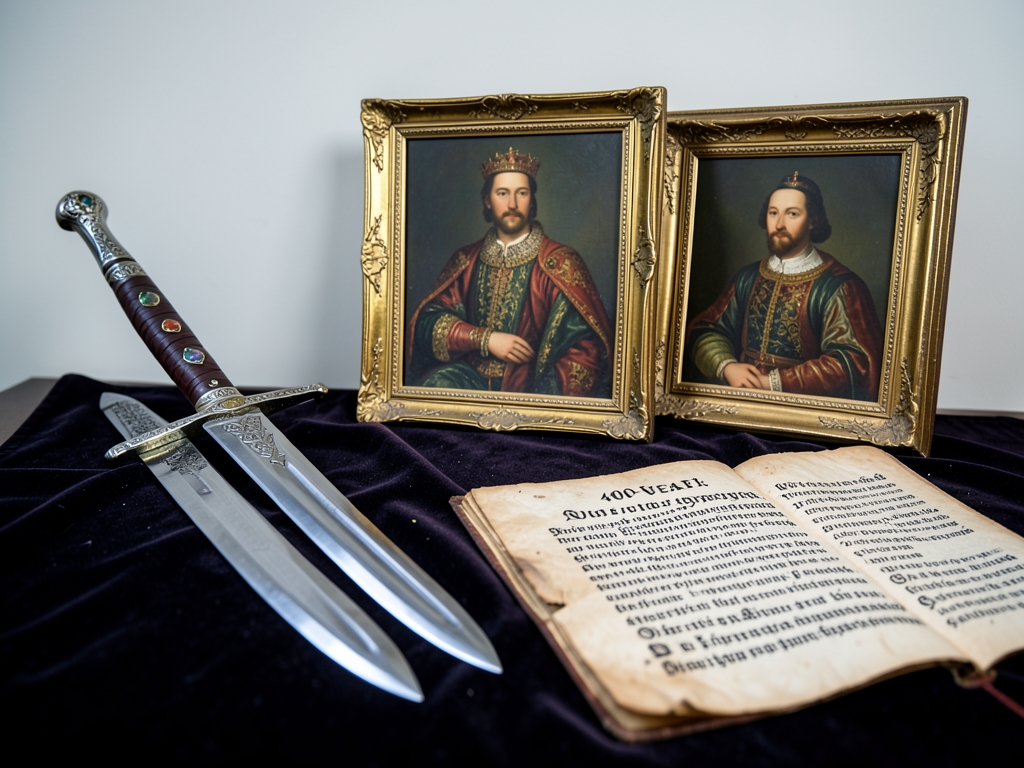
Archaeological excavations often yield remnants of past civilizations, yet certain discoveries stand out due to their extraordinary preservation and the historical puzzles they introduce. Recent excavations conducted during preparations for a new cultural center in Estonia brought to light a remarkable collection of artifacts, including a medieval sword, a 400-year-old metal printing type, and a striking portrait fragment depicting a Swedish queen. These diverse items offer a tangible connection to turbulent centuries marked by shifting geopolitical powers, trade expansion, and the evolution of written communication in Northern Europe.
The Significance of Urban Archaeological Finds
Modern construction projects in historic European cities frequently intersect with centuries of accumulated debris and forgotten structures. When civil engineers and heritage preservationists work in tandem, unexpected discoveries routinely emerge from the soil. The recent Estonian excavation is a textbook example of how urban development can act as a catalyst for historical recovery. By examining layers of soil that span multiple epochs, specialists can reconstruct daily life, manufacturing techniques, and political allegiances that traditional texts might overlook.
The recovery of metal artifacts, organic remnants, and artistic expressions from a single municipal site demonstrates the dense layering of human activity. While written chronicles document kings, battles, and treaties, physical artifacts reveal the everyday reality of artisans, soldiers, and administrators. Each object acts as an independent data point, allowing historians to verify or challenge existing narratives regarding medieval and early modern society in the Baltic region.
Unearthing a Medieval Weapon of Status and Defense
Among the most striking items recovered from the Estonian site is a well-preserved medieval sword. Swords from this era were not merely instruments of combat; they served as potent symbols of social standing, authority, and craftsmanship. The metallurgy involved in forging a balanced, durable blade required advanced technical expertise that was closely guarded by master smiths.
Analyzing the hilt construction, pommel shape, and blade geometry helps researchers date the weapon with a high degree of precision. In medieval Estonia, trade routes connected local merchants with Scandinavian, Germanic, and Slavic realms, making weapons valuable commodities that frequently crossed cultural boundaries. The presence of such a weapon in an urban or semi-urban context often points toward periods of conflict, defensive fortification, or the high status of the individual who once owned or discarded it.
Every recovered artifact carries a silent narrative, bridging the gap between contemporary inquiry and the daily realities of medieval populations.
Furthermore, the preservation state of iron and steel artifacts depends heavily on soil chemistry. Waterlogged, anaerobic conditions often protect organic materials and ferrous metals from rapid oxidation, allowing researchers to study manufacturing marks, maker's stamps, and wear patterns that reveal how the weapon was handled and maintained centuries ago.
Four Hundred Years of Typography and Communication
Equally fascinating is the discovery of a 400-year-old printing type. The introduction of movable-type printing revolutionized the dissemination of knowledge across Europe during the early modern period. Printing workshops were hubs of intellectual exchange, religious debate, and commercial enterprise. Finding an individual metal type piece provides direct physical evidence of early printing technology reaching local communities.
The exact alloy composition, letterform design, and manufacturing method of the type piece offer insights into regional printing networks. During the seventeenth century, the Baltic region experienced significant administrative and cultural transformations under various regional powers, including Sweden. Printing presses played a vital role in standardizing languages, producing administrative decrees, and spreading religious texts. The presence of this artifact suggests the operation of an early printing press or workshop nearby, shedding light on literacy rates and the mechanical arts of the period.
Portraits of Power: Uncovering a Swedish Queen's Likeness
The visual culture of the early modern Baltic region is further illuminated by the discovery of a portrait fragment depicting a Swedish queen. During the sixteenth and seventeenth centuries, the Swedish Empire exerted substantial political and cultural influence over large parts of Estonia. Royal imagery was deliberately utilized to reinforce sovereign authority, project stability, and cultivate loyalty among distant subjects.
Portraits of monarchs were reproduced and displayed in administrative centers, municipal buildings, and the estates of the nobility. Finding a surviving portrait fragment provides tangible evidence of this imperial iconography. Conservators face meticulous tasks when stabilizing such pieces, ensuring that remaining pigments, canvas or wood substrates, and stylistic details are preserved for future analysis. Art historians use these visual records to study court fashion, portraiture conventions, and the political messaging of the era.
Connecting the Material Threads of History
When considered together, the medieval sword, the printing type, and the royal portrait form a complex mosaic of a changing society. They represent three distinct pillars of historical development:
- Military and Social Structure: The sword reflects the martial culture and elite hierarchy of the medieval period.
- Intellectual and Technological Progress: The printing type highlights the mechanics of literacy and information spread in the seventeenth century.
- Political Authority and Art: The royal portrait demonstrates the projection of imperial power and cultural influence across borders.
By studying these objects within their specific stratigraphic context, archaeologists prevent them from becoming isolated curiosities. Instead, they function as vital anchors for understanding broader historical movements, economic networks, and cultural exchanges in Northern Europe.
Preservation and Future Research
The discovery of such diverse artifacts places immediate responsibilities on local museums, conservation laboratories, and academic institutions. Organic and metal preservation requires specialized environmental controls to halt degradation processes that begin the moment objects are exposed to modern air and fluctuating humidity levels. Conservation specialists employ advanced imaging techniques, chemical stabilization, and meticulous cleaning to prepare the finds for eventual public exhibition and academic study.
Info! Conservation work on newly unearthed historical metals and organic materials can take several months or even years to ensure long-term stability.
As research progresses, specialists will likely perform isotopic analysis, alloy testing, and stylistic comparisons with similar artifacts found throughout the Baltic and Scandinavian regions. These ongoing investigations ensure that each discovery contributes maximally to our collective understanding of human history.
Where were these artifacts recently discovered?
The artifacts were unearthed in Estonia during archaeological excavations conducted for a new cultural center.
What specific items were found at the excavation site?
The discovery included a medieval sword, a 400-year-old metal printing type, and a fragment of a portrait depicting a Swedish queen.
Why is the discovery of a 400-year-old printing type significant?
It provides physical evidence of early printing technology, local literacy efforts, and the mechanical arts during a period of significant regional transformation.
What does the royal portrait fragment reveal about the region's history?
It highlights the political and cultural influence of the Swedish Empire, illustrating how royal imagery was used to project authority across distant territories.
Conclusion
Discoveries such as the medieval sword, early printing type, and royal portrait in Estonia remind us that the physical foundations of our cities rest upon deep, layered histories. By carefully recovering, conserving, and analyzing these artifacts, modern researchers safeguard the material heritage of past generations. These findings transcend simple curiosity, offering valuable insights into the social structures, technological leaps, and political dynamics that shaped European civilization over the centuries.
Sources and Further Reading
- Digging For a New Cultural Center, Archaeologists Found a Sword, a 400-Year-Old Printing Type and a Queen's Face - The Daily Galaxy — The Daily Galaxy (published 2026-11-15 12:45)
- A medieval sword, a portrait of a Swedish queen, and a 400-year-old typeface were found in Estonia - Українські Національні Новини (УНН) — Українські Національні Новини (УНН) (published 2026-11-15 09:52)
- Ancient Sword, Swedish Queen’s Portrait, and Rare Printing Type Found in Estonia - Arkeonews — Arkeonews (published 2026-11-12 22:19)
