

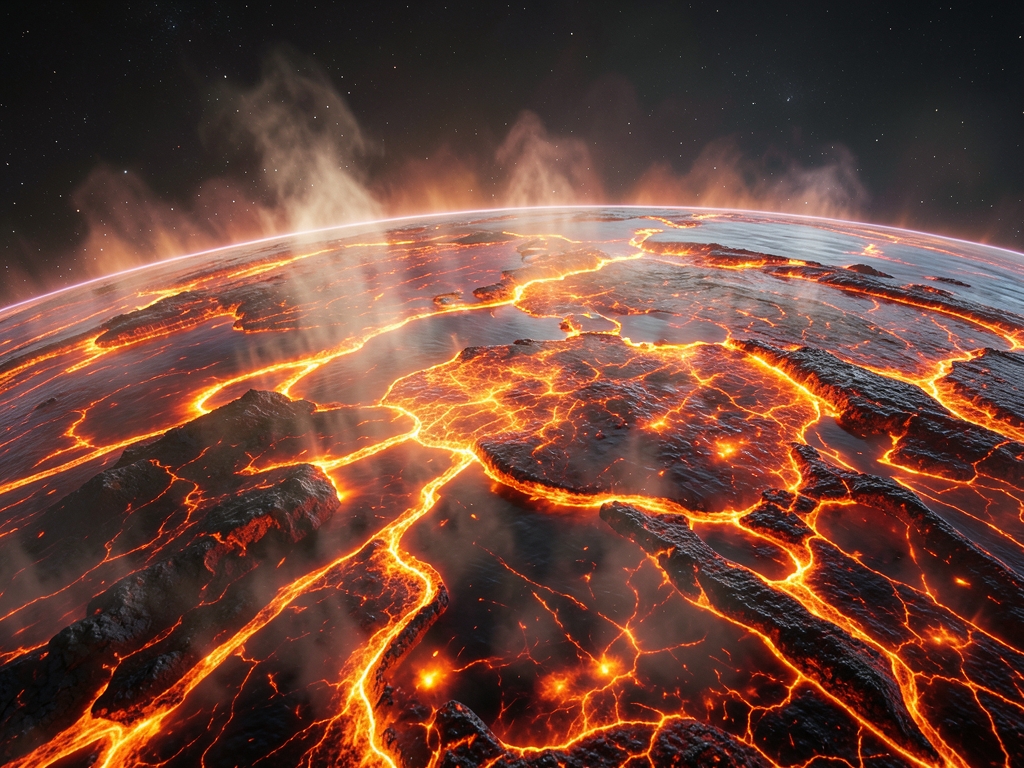
The question of how our planet acquired its vast oceans has fascinated scientists for centuries. While traditional theories often pointed toward late-stage asteroid bombardments and cometary impacts delivering water from the outer solar system, modern planetary research continues to rewrite the timeline of Earth's volatile inventory. Recent studies examining geochemical signatures and planetary accretion models suggest that the fundamental ingredients for water may have been present right from the start, woven into the very fabric of Earth during its violent and fiery birth.
Understanding how hundreds of oceans' worth of water could have originated during the planet's earliest geological epochs requires looking closely at how terrestrial planets form within circumstellar discs. As dust and planetesimals collided and accreted under gravity four and a half billion years ago, immense thermal energy melted the growing protoplanet into a magma ocean. Far from driving all volatiles away into space, high-pressure physical environments deep within early planetary interiors could have locked hydrogen and oxygen into silicate melts and nascent mantle minerals.
The Protosolar Nebular Connection and Hydrogen Storage
During the primary accretion phase, the inner solar nebula contained substantial amounts of hydrogen gas alongside rocky and metallic dust grains. Recent geochemical modeling indicates that as planetary embryos grew, their gravitational fields and intense thermal processing created conditions where hydrogen from the nebula could dissolve directly into molten magma oceans.
Info! High-pressure laboratory experiments simulate deep mantle conditions to demonstrate how hydrogen bonds with molten silicates under extreme heat and pressure.
When these magma oceans eventually cooled and crystallized, the trapped hydrogen did not necessarily escape. Instead, much of it remained chemically bound within mineral structures deep in the mantle. Over geological timescales, mantle degassing through volcanic activity and tectonic outgassing released these volatiles to the surface, where they condensed to form the primordial hydrosphere. This internal sourcing mechanism suggests that Earth was born wet, possessing the intrinsic capacity to generate extensive aquatic environments without relying entirely on external water delivery systems.
Magma Ocean Dynamics and Volatile Retention
The mechanics of a magma ocean are central to understanding planetary habitability. Unlike a static rocky body, a deep, churning sea of molten rock interacts dynamically with the overlying atmosphere. High temperatures facilitate rapid chemical reactions, and extreme pressures alter the solubility of light elements.
- High-Pressure Solubility: At pressures found hundreds of kilometers beneath a protoplanetary surface, hydrogen dissolves into magma much more readily than at surface pressures.
- Fractional Crystallization: As the magma ocean cools from the bottom up, certain minerals crystallize while others remain liquid, redistributing water-forming elements throughout the mantle layers.
- Degassing Pathways: Volatiles trapped in the deep interior slowly ascend via plume dynamics and volcanic conduits, establishing the planet's surface water over millions of years.
These processes highlight the complex interplay between mantle geodynamics and surface environmental conditions. Without these early high-pressure trapping mechanisms, Earth might have resembled a dry, barren rock similar to some of its inner solar system neighbors.
Comparative Planetary Perspectives
Comparing Earth's water inventory with that of Venus and Mars provides further context for how planetary birth conditions dictate long-term destiny. Although Venus likely experienced similar initial magma ocean phases, its proximity to the Sun and runaway greenhouse effects led to the loss of its surface water. Mars, being smaller, cooled much faster, stunting its mantle convection and volcanic degassing capabilities.
Earth struck a delicate balance. Its mass allowed for sufficient gravitational retention of an atmosphere, while its mantle dynamics sustained long-term outgassing and plate tectonics, recycling water between the surface and the interior in an ongoing biogeochemical cycle.
Implications for Exoplanetary Habitability
The realization that rocky planets can forge massive water reserves directly from their accretionary building blocks broadens the search for habitable worlds beyond our solar system. When astrobiologists evaluate exoplanets orbiting distant stars, the traditional Goldilocks zone—defined solely by distance from the host star—is no longer the only metric.
Planets that form in volatile-rich regions of protoplanetary discs may inherit substantial internal water budgets regardless of subsequent comet impacts. This intrinsic volatile endowment increases the statistical likelihood that rocky exoplanets could support liquid surface water, enhancing the prospects for discovering habitable environments across the galaxy.
| Mechanism | Source Material | Primary Delivery / Storage Phase | Surface Impact |
|---|---|---|---|
| Nebular Ingassing | Hydrogen Gas in Protosolar Nebula | Deep Magma Ocean Dissolution | Intrinsic Water Generation via Mantle Outgassing |
| Planetesimal Accretion | Water-Rich Asteroids and Meteorites | Late-Stage Impact Bombardment | Supplementing Surface Oceans and Crustal Hydration |
| Mantle Recycling | Subducting Oceanic Crust | Plate Tectonic Subduction Cycles | Long-Term Stabilization of Sea Levels |
Future Directions in Planetary Geochemistry
Unraveling the exact sequence of events that shaped Earth's early environment requires continuous refinement of isotopic analysis techniques. Researchers analyze ancient zircons, meteoritic inclusions, and mantle xenoliths to trace hydrogen and noble gas isotope ratios. These chemical fingerprints help distinguish between primordial nebular water and water delivered by later asteroidal impacts.
As analytical precision improves, planetary scientists hope to construct a definitive chronology of Earth's volatile evolution. Such insights not only illuminate our own planet's unique history but also deepen our understanding of the universal laws governing planetary formation and the emergence of habitable worlds.
How did Earth acquire its early water according to recent studies?
Recent studies suggest that hydrogen from the early solar nebula dissolved directly into Earth's primordial magma oceans under extreme pressure and heat, creating internal water reserves that were later released through volcanic outgassing.
What role did magma oceans play in early planetary water retention?
Deep magma oceans acted as high-pressure chemical reactors that dissolved and trapped volatile elements like hydrogen deep within the planetary interior during the accretion phase.
Did comet impacts play the sole role in filling Earth's oceans?
While comets and asteroids contributed water later in Earth's history, geochemical evidence indicates that a significant portion of Earth's water may be intrinsic, originating from the planet's primary formation materials.
Why is this research important for finding habitable exoplanets?
Understanding that rocky planets can form with substantial internal water reserves suggests that habitable worlds might be more common around distant stars than previously estimated based solely on external water delivery.
The investigation into Earth's fiery birth and water origins underscores the dynamic nature of planetary science. By bridging astrophysics, geochemistry, and geodynamics, researchers continue to piece together the extraordinary narrative of how a molten, chaotic ball of rock transformed into a vibrant, water-rich home capable of supporting complex life.
