

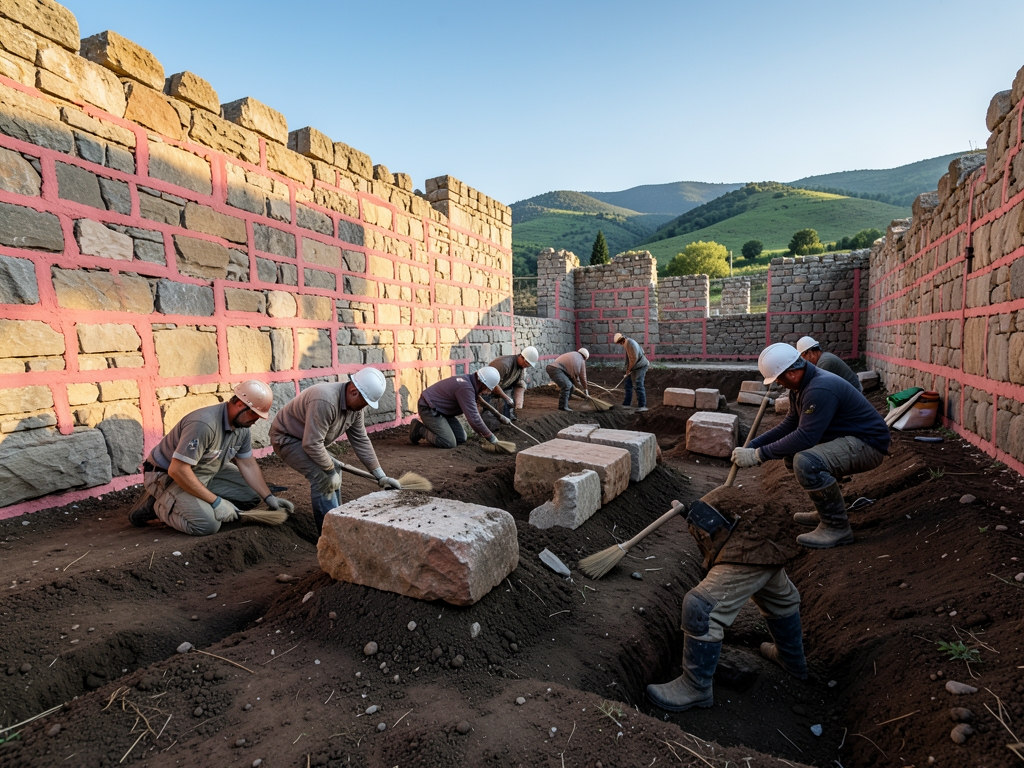
Archaeological discoveries constantly challenge and refine our understanding of ancient engineering, construction techniques, and architectural longevity. Recent excavations at a medieval fortress site in Bulgaria have brought to light a monumental building featuring a rare and remarkably resilient structural component: waterproof pink mortar. This significant find provides profound insights into how medieval builders mastered complex hydraulic and structural challenges long before modern industrial waterproofing compounds existed. By examining the chemical composition, application methods, and historical context of this pink mortar, modern historians and materials scientists can better appreciate the sophisticated knowledge possessed by medieval master builders in the Balkans.
Info! Recent archaeological campaigns in Eastern Europe continue to unearth exceptionally well-preserved architectural elements that showcase advanced ancient and medieval building capabilities.
The Significance of the Medieval Bulgarian Fortress Discovery
The discovery of the monumental building within the Bulgarian medieval fortress complex highlights the strategic and economic importance of the site during its operational centuries. Fortresses built across the Balkan landscape served not only as military strongholds defending regional borders and trade routes but also as administrative centers capable of sustaining prolonged sieges. The presence of a monumental structure—distinguished by its sheer scale, thick load-bearing walls, and specialized mortar—suggests that this building served a vital function, potentially housing high-ranking officials, storing critical supplies, or functioning as an essential cistern or bathhouse where water management was paramount.
In medieval military architecture, water security was often the single most critical factor determining a stronghold's survival. Constructing waterproof walls required innovative mortar recipes that could withstand constant moisture exposure without degrading or allowing seepage. The identification of pink mortar at this Bulgarian fortress points directly to specialized hydraulic engineering practices handed down through generations, combining regional mineral resources with precise artisanal techniques.
Unraveling the Mystery of Waterproof Pink Mortar
The distinctive pink coloration of the mortar found in the Bulgarian fortress is not merely an aesthetic choice; it is a chemical fingerprint of specific ingredients used by medieval masons. Historically, waterproof mortars—often referred to by historians as opus signinum in Roman and Byzantine traditions—relied on the inclusion of crushed ceramic fragments, terracotta, or brick mixed with lime and sand.
When finely crushed ceramic material is added to slaked lime, a pozzolanic reaction occurs. This chemical process allows the mortar to cure even in wet conditions and creates a dense, highly durable matrix that prevents water infiltration. The pulverized ceramic gives the resulting mixture its characteristic pink or reddish hue. The discovery in Bulgaria demonstrates that this sophisticated pozzolanic technique remained in active use or experienced a significant revival during the medieval period, long after the fall of the classical Roman Empire.
The integration of crushed ceramic pozzolans into medieval mortar demonstrates an unbroken chain of empirical scientific knowledge regarding hydraulic engineering and material durability.
Comparative Analysis of Ancient and Medieval Mortar Technologies
To fully grasp the technological achievement represented by the Bulgarian fortress discovery, it is helpful to examine how mortar technologies evolved across different epochs and civilizations. The table below outlines key mortar variations and their primary structural applications.
| Mortar Type | Primary Ingredients | Key Characteristics | Typical Application |
|---|---|---|---|
| Standard Lime Mortar | Lime, sand, water | Flexible, breathable, slow curing | Standard stone and brick masonry |
| Pozzolanic Pink Mortar | Lime, crushed pottery, sand | Waterproof, highly durable, hydraulic cure | Cisterns, baths, fortress foundations |
| Volcanic Ash Mortar | Lime, volcanic tephra, aggregate | Extremely strong, marine-resistant | Roman harbors, monumental arches |
| Modern Portland Cement | Limestone, clay, gypsum | Rapid high strength, rigid | Contemporary structural concrete |
Archaeological Methodology and Excavation Challenges
Unearthing structures built with ancient hydraulic mortars requires meticulous archaeological fieldwork. Researchers working at medieval sites in Bulgaria must employ careful excavation strategies to avoid damaging fragile wall facings and mortar beds that have spent centuries underground. Every layer of soil, debris, and fallen stone is documented systematically to reconstruct the building's collapse sequence and eventual abandonment.
Furthermore, multidisciplinary collaboration is essential. Archaeologists work alongside geologists, chemists, and conservation specialists to analyze mortar samples using advanced techniques such as X-ray diffraction and scanning electron microscopy. These scientific analyses reveal the exact mineral ratios, firing temperatures of the crushed ceramics, and local provenance of the raw materials used, painting a vivid picture of the medieval supply chain and local manufacturing capabilities.
Preservation and Cultural Heritage Management
Discoveries of this magnitude carry significant responsibilities regarding heritage conservation and public presentation. Once exposed to modern atmospheric conditions, ancient masonry and hydraulic mortar can degrade rapidly due to freeze-thaw cycles, moisture fluctuations, and biological growth like lichen and moss.
Conservation teams utilize specialized lime-based grouts and protective capping techniques to stabilize the newly revealed walls of the Bulgarian fortress. Maintaining the integrity of the pink mortar requires careful environmental monitoring and adherence to international conservation standards. Additionally, opening such sites to researchers and cultural tourists fosters a deeper appreciation for regional history while supporting local educational and economic initiatives.
- Site Documentation: High-resolution photogrammetry and 3D laser scanning record the exact position of every stone and mortar joint before physical extraction or stabilization begins.
- Laboratory Sampling: Small, non-destructive core samples of the pink mortar are extracted for chemical and petrographic analysis to determine aggregate composition.
- Microclimate Stabilization: Protective shelters and breathable mineral shelters are installed over vulnerable architectural sections to prevent weather-induced decay.
- Public Interpretation: Informative signage and digital exhibitions are developed to translate complex archaeological findings into accessible history for visitors.
Warning! Unregulated exploration or amateur digging at protected archaeological sites can permanently destroy fragile stratigraphy and invaluable historical evidence.
What makes the pink mortar found in Bulgaria unique?
The pink mortar is unique because it incorporates crushed ceramic materials that trigger a pozzolanic chemical reaction, making the structure highly waterproof and durable even in damp subterranean or defensive environments.
Which historical period does the newly discovered monumental building belong to?
The building dates back to the medieval period, a time when fortress construction in the Balkan region required sophisticated engineering to withstand territorial conflicts and harsh environmental conditions.
How do scientists analyze ancient mortar compositions?
Scientists use advanced laboratory techniques such as X-ray diffraction, petrographic microscopy, and scanning electron microscopy to identify the exact mineral ratios and source materials used by ancient builders.
Why was waterproof mortar critical for medieval fortresses?
Waterproof mortar was essential for constructing secure water reservoirs, cisterns, bathhouses, and subterranean defensive structures where preventing water seepage and structural degradation was vital for survival during prolonged sieges.
Conclusion
The uncovering of a monumental building with waterproof pink mortar at a medieval fortress in Bulgaria serves as a powerful reminder of the ingenuity embedded in our shared historical landscape. By bridging archaeological fieldwork with modern scientific analysis, researchers continue to decode the sophisticated building traditions that allowed ancient and medieval civilizations to construct enduring monuments. As ongoing excavations proceed across the region, each new discovery adds another vital chapter to our understanding of human engineering history.
