

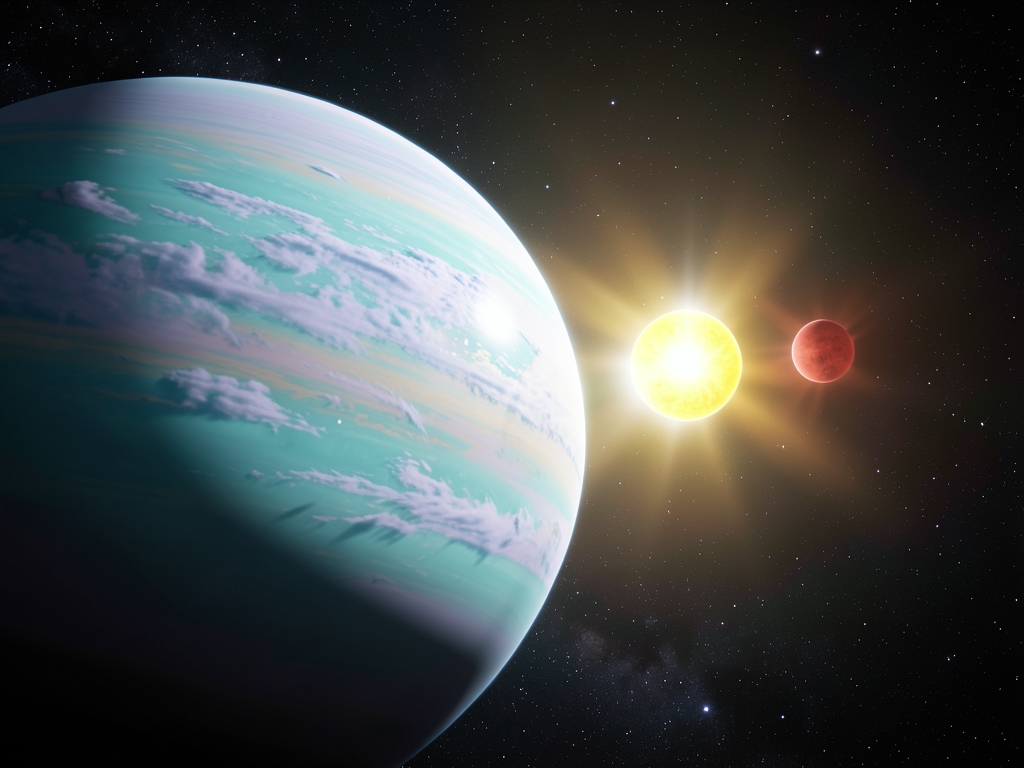
In the vast realm of modern observational astronomy, major scientific breakthroughs frequently emerge from automated supercomputing pipelines, artificial intelligence algorithms, and vast teams of seasoned astrophysicists. However, one of the most remarkable planetary discoveries of recent times belongs to a 17-year-old high school student working as a summer intern at NASA Goddard Space Flight Center. On just his third day examining photometric light curves recorded by the Transiting Exoplanet Survey Satellite (TESS), Wolf Cukier identified a subtle signal that had eluded automated search scripts. That signal marked the existence of TOI 1338 b, a world roughly 6.9 times the size of Earth located approximately 1,300 light-years away in the constellation Pictor. What makes this world profoundly captivating to scientists and the public alike is its celestial configuration: TOI 1338 b is a circumbinary planet, an alien world that circles two suns rather than one.
The concept of a world with twin sunsets was once confined to the realm of speculative science fiction, most famously embodied by the desert planet Tatooine in the Star Wars universe. Yet over the past decade, observational evidence has demonstrated that circumbinary systems are not only real but offer essential clues into the dynamics of planet formation under complex gravitational stresses. Finding such systems remains exceptionally challenging because the mutual orbital motion of twin host stars constantly alters the timing, depth, and duration of planetary transits. The discovery of TOI 1338 b highlights both the extraordinary precision of NASA's space-borne observatories and the enduring value of human visual analysis in identifying scientific phenomena hidden within massive astronomical datasets.
Understanding TOI 1338 b: Physical Profile of a Twin-Sun Exoplanet
TOI 1338 b is classified as a gas giant exoplanet whose physical dimensions place it between Neptune and Saturn in size. With a radius approximately 6.9 times that of Earth, the world possesses a dense atmospheric envelope composed primarily of hydrogen and helium, likely surrounding a solid rock-ice core. Located roughly 1,300 light-years from our solar system, TOI 1338 b orbits its parent stars at a distance that keeps it on a nearly circular path, completing one full revolution around the stellar binary every 93 to 95 days.
Because of its gaseous composition and proximity to its dual host stars, TOI 1338 b is not considered a candidate for liquid water ocean development or terrestrial life as we know it. However, its atmosphere experiences a complex thermodynamic environment driven by the alternating radiation intensities of two distinct stellar bodies. As the planet orbits, the relative positions of the primary and secondary stars shift constantly relative to the planet's sky, creating erratic diurnal radiation cycles unlike anything seen in single-star solar systems.
The discovery of TOI 1338 b demonstrates that planetary systems can form and maintain long-term orbital stability even within the turbulent gravitational fields of close binary star systems.
To fully grasp the nature of TOI 1338 b, astronomers must analyze the physical characteristics of the stellar pair at the center of the system. The binary host, known collectively as TOI 1338, consists of two stellar components with vastly different masses, temperatures, and luminosity profiles:
- The Primary Star: A yellow-white main-sequence star roughly 10% more massive than our Sun, possessing a surface temperature of approximately 6,000 Kelvin and contributing the vast majority of the light emitted by the system.
- The Secondary Star: A cool M-dwarf red star with a mass only one-third that of our Sun, emitting a dim reddish glow and possessing a surface temperature far lower than its primary companion.
The two stars revolve around a common gravitational center of mass once every 14.6 days. Because their orbital plane is aligned close to our line of sight from Earth, the pair regularly eclipses each other from our perspective. The primary eclipse occurs when the smaller red star passes in front of the larger sun-like star, creating a pronounced drop in overall light output. The secondary eclipse happens when the red star passes behind the primary star, resulting in a much smaller, subtle dip in system brightness.
How a NASA Intern Spotting the Unseen Light Dips
The Transiting Exoplanet Survey Satellite (TESS) searches for alien worlds using the transit method. As an exoplanet passes between its host star and the space telescope's sensitive camera array, it blocks a minute fraction of the star's light. By recording continuous changes in stellar brightness over time—creating a graphical plot known as a light curve—astronomers can detect periodic dimming events that indicate the presence of an orbiting world.
When TESS monitors a single star, planetary transits produce predictable, clockwork dips in brightness occurring at perfectly regular intervals. However, in a binary star system like TOI 1338, automated transit-detection software frequently founders. Because the primary star is also moving rapidly in its 14.6-day orbit around the system's center of mass, the planet does not cross the star at identical physical locations or regular intervals during each pass. Consequently, the depth and timing of transits vary slightly from one orbit to the next, causing automated algorithms to misinterpret planet transits as noise or secondary stellar eclipses.
Info! Automated computer scripts frequently fail to detect circumbinary planets because the mutual movement of twin host stars causes transit timing and transit duration to vary irregularly across successive orbits.
This is where human visual analysis proved decisive. During his summer internship at NASA Goddard Space Flight Center in Greenbelt, Maryland, 17-year-old Wolf Cukier was tasked with inspecting light curves flagged by citizen scientists working through the Planet Hunters TESS project. While examining light curves from the TOI 1338 system, Cukier noticed a small, non-periodic dip in brightness that occurred at a point in time unrelated to the binary stars' mutual 14.6-day eclipses.
Recognizing that the dip could represent an undiscovered planet, Cukier brought the light curve anomaly to the attention of research mentors. Follow-up investigations using specialized analytical suites, including the Eleanor software package and high-resolution ground-based Doppler spectroscopy, confirmed that the light dip was indeed caused by an exoplanet transiting the primary star. The discovery marked the first circumbinary planet ever detected directly by the TESS mission.
The Complex Mechanics of Circumbinary Orbits
The physics governing circumbinary planets like TOI 1338 b represents one of the most intriguing chapters in modern celestial mechanics. In a single-star system, planetary orbits follow classic Keplerian ellipses dictated by a single gravitational well. In contrast, a planet orbiting two stars feels a dynamic, continually shifting gravitational torque generated by the two revolving bodies.
Gravitational Stability Boundaries
For a planet to survive long-term around a binary pair, it must orbit beyond a critical outer boundary known as the gravitational stability limit. If a planet strays too close to the binary center, the chaotic gravitational nudges from the two revolving stars will gradually pump up the planet's orbital eccentricity, eventually slinging the planet out into deep space or driving it into a collision with one of the stars. In the TOI 1338 system, the dual stars orbit each other at a distance of roughly 0.13 Astronomical Units (AU). Detailed mathematical modeling revealed that the inner stability limit for the system lies at approximately 0.35 AU. TOI 1338 b orbits at roughly 0.46 AU, placing it safely outside the chaotic zone in a remarkably stable configuration that has endured for billions of years.
Transit Precession and Vanishing Transits
Another fascinating aspect of circumbinary dynamics is orbital precession. The gravitational interaction between the central binary and the outer planet causes the planet's orbital plane to slowly wobble, or precess, like a spinning top. Because of this precession, TOI 1338 b's orbit changes its inclination relative to Earth's line of sight over time.
Astrophysical calculations indicate that while TOI 1338 b currently transits its primary star as viewed from Earth, this alignment is temporary. The orbital precession will eventually tilt the planet's path slightly out of view from our perspective, causing transits to cease temporarily for several years before precession brings them back into alignment. This phenomenon means that astronomers have specific observational windows to study the world before it temporarily disappears from transit detection views.
Comparing TOI 1338 b With Other Planetary Systems
To understand the place of TOI 1338 b in astronomical cataloging, it is helpful to compare its fundamental parameters against iconic worlds within our own solar system as well as historic exoplanet discoveries like Kepler-16b—the first circumbinary planet confirmed by NASA's Kepler Space Telescope in 2011.
| Property | TOI 1338 b | Kepler-16b | Earth | Jupiter |
|---|---|---|---|---|
| Radius (Earth Radii) | 6.9 R⊕ | 8.4 R⊕ | 1.0 R⊕ | 11.2 R⊕ |
| Orbital Period | ~93-95 days | 229 days | 365.25 days | 4,333 days |
| Host System Type | Binary (F/M-Dwarf) | Binary (K/M-Dwarf) | Single (G-Dwarf) | Single (G-Dwarf) |
| Stellar Binary Period | 14.6 days | 41 days | N/A | N/A |
| System Distance | ~1,300 light-years | ~245 light-years | 0 light-years | 0.00008 light-years |
| Discovery Method | TESS Transit | Kepler Transit | Direct Observation | Direct Observation |
The Role of Citizen Science and Human Eyes in Astronomy
The identification of TOI 1338 b underscores a crucial theme in 21st-century science: the power of combining machine data processing with human visual pattern recognition. Projects such as Planet Hunters TESS allow volunteers around the globe to examine raw photometric light curves recorded by space telescopes. Human brains excel at recognizing irregular shapes, anomalous dips, and subtle visual patterns that automated search algorithms often discard as noise.
- Space Telemetry Acquisition: TESS monitors thousands of target stars continuously across 27-day observation sectors, generating vast gigabytes of light curve data.
- Automated Data Reduction: Computer pipelines clean the photometric data, removing background instrument noise and flagging obvious periodic transit candidates.
- Citizen Science Upload: Unresolved or complex light curves are uploaded to public platforms where volunteers visually inspect the light trends for hidden dips.
- Intern Verification & Modeling: Anomalous signals identified by users or interns are vetted using stellar collision scripts, orbital modeling software, and ground-based spectroscopic follow-ups.
Warning! Without human validation, complex multi-body systems risk being misclassified as instrument anomalies or eclipsing binary noise by standard automated search pipelines.
Scientific Significance and Future Directions
The discovery of TOI 1338 b carries implications that extend far beyond the excitement of an intern finding an alien world. Circumbinary planets serve as exceptional cosmic laboratories for testing planet formation theories. Standard core accretion models suggest that planets form within protoplanetary disks of gas and dust surrounding young stars. However, inside a binary star system, the dual gravitational forces create powerful tidal shocks and violent collision speeds within the disk, which theoretically should break planetesimals apart rather than allowing them to gently coalesce into full-sized worlds.
The existence of gas giants like TOI 1338 b proves that planet formation can overcome these chaotic gravitational barriers. Astronomers hypothesize that TOI 1338 b likely formed much farther out in the protoplanetary disk—where gravitational perturbations from the central binary pair were weaker—and subsequently migrated inward to its current stable orbit through friction with the remaining gas disk.
As next-generation observatories like the James Webb Space Telescope (JWST) and the Nancy Grace Roman Space Telescope continue their operations, target systems like TOI 1338 will undergo detailed transmission spectroscopy analysis. Scientists hope to measure the chemical signatures of gases within circumbinary atmospheric envelopes, offering fresh insights into how dual radiation fields influence planetary atmospheric chemistry, thermal distribution, and cloud formation over billions of years.
What is TOI 1338 b?
TOI 1338 b is a circumbinary gas giant exoplanet located roughly 1,300 light-years from Earth in the constellation Pictor. It is approximately 6.9 times the size of Earth and orbits a dual star system composed of a solar-type star and a smaller red dwarf star.
How was TOI 1338 b discovered?
The planet was discovered by 17-year-old NASA intern Wolf Cukier during his third day analyzing light curve photometric data from the Transiting Exoplanet Survey Satellite (TESS) at NASA Goddard Space Flight Center.
What does it mean for a planet to be circumbinary?
A circumbinary planet orbits two host stars that revolve around a shared center of mass, rather than orbiting a single central star like Earth orbits the Sun.
Could TOI 1338 b support human life?
No, TOI 1338 b is a gas giant exoplanet comparable in size to Neptune or Saturn, meaning it lacks a solid surface and possesses an intense atmospheric pressure and radiation environment unsuitable for life as we know it.
Conclusion: A Landmark Milestone in Astronomy
The discovery of TOI 1338 b stands as a testament to the endless surprises waiting to be uncovered in astronomical archives. By spotting a faint, irregular dip in light curves during the third day of his NASA internship, Wolf Cukier helped confirm that worlds orbiting twin suns are a captivating reality in our galaxy. As observational techniques advance and public participation in scientific data analysis grows, discoveries like TOI 1338 b will continue to redefine our understanding of celestial dynamics, planetary formation, and the diverse architectures of stellar systems across the cosmos.
