

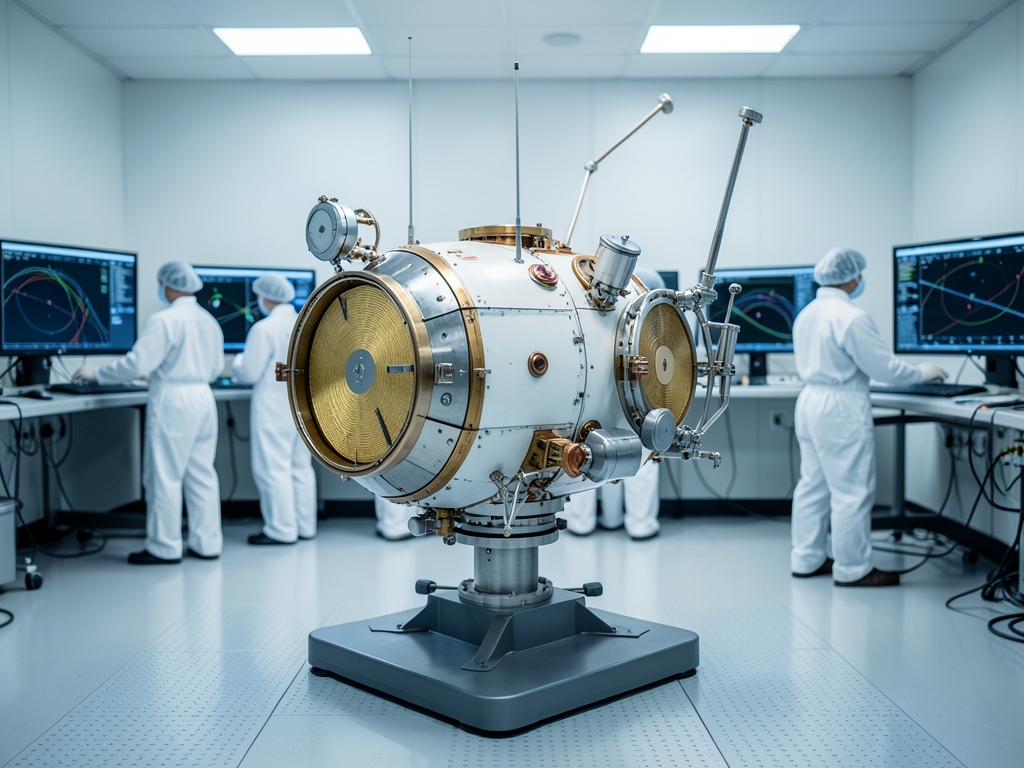
The exploration of deep space has continually pushed the boundaries of human engineering, testing the limits of what mechanical devices and electronic telemetry systems can endure across decades of hostile exposure. Among the most triumphant achievements in the history of aerospace engineering is the ongoing mission of Voyager 1. Managed by the National Aeronautics and Space Administration through its Jet Propulsion Laboratory, this iconic spacecraft has captured the imagination of scientists and the general public alike since its launch. Reaching unprecedented milestones in interstellar space, Voyager 1 remains a testament to the durability, foresight, and ingenuity of the teams who designed and built it more than four decades ago.
The Historic Journey Beyond the Solar System
Launched in September 1977, Voyager 1 was originally designed primarily to study the outer planets of our solar system, including Jupiter and Saturn. Alongside its twin spacecraft, Voyager 2, it executed a magnificent planetary tour that provided humanity with its first close-up views of the complex cloud bands, swirling storms, and diverse moons characterizing the outer gas giants. Once these primary planetary objectives were successfully completed, the mission trajectory shifted toward an even grander horizon.
Over the decades, Voyager 1 continued outward, eventually crossing the heliopause—the boundary where the sun's constant flow of material and magnetic field is stopped by the interstellar medium. This monumental transition marked the official entry of a human-made object into interstellar space. Operating billions of miles away from Earth, the spacecraft sends data back across unimaginable distances, requiring deep space network antennas to capture extremely faint radio signals. Maintaining communication with a probe operating at such extreme distances represents a continuous challenge for mission controllers and navigation engineers.
The longevity of the spacecraft is largely attributed to its nuclear power source, a set of radioisotope thermoelectric generators that convert the heat produced by the natural radioactive decay of plutonium-238 into electricity. Although this power output has steadily declined over the years, careful energy management and the systematic shutting down of non-essential instruments have allowed critical scientific sensors to remain operational. Engineers must constantly adapt to aging hardware, writing software patches and troubleshooting complex issues across a communication delay that takes nearly a full day for signals to travel one way.
Understanding the One-Light-Day Frontier
As the spacecraft pushes deeper into uncharted regions, the physical distance between Earth and the probe has expanded to an astonishing scale. In astronomical terms, distance in the outer solar system and interstellar space is often measured in light-hours and light-days. The time it takes for a radio frequency signal traveling at the speed of light to reach the spacecraft—and for the corresponding telemetry data to return to our planet—has reached approximately one full light day. This means that if an anomaly occurs or a command must be issued, engineers experience a round-trip communication delay of roughly forty-eight hours before any verification or correction can be confirmed.
Operating a spacecraft at a distance of one light-day requires extraordinary patience, meticulous advance planning, and flawless predictive modeling from the ground control team.
This immense spatial separation transforms routine maintenance into an exercise in high-stakes problem-solving. Controllers cannot rely on real-time feedback loops. Instead, every operational command must be tested thoroughly on Earth-based simulators before transmission. The data returned by Voyager 1 provides invaluable insights into the interstellar medium, including measurements of cosmic rays, magnetic field strength, and plasma density outside the protective bubble of our sun. These empirical observations help researchers model the broader galactic environment and understand how stellar winds interact with the material drifting between star systems.
The Engineering Legacy of the Voyager Program
The triumph of Voyager 1 is not merely a milestone in distance traveled; it is a profound lesson in robust engineering and redundant system architecture. Built during an era when computational power was a fraction of what is found in modern pocket devices, the computer memory aboard Voyager 1 is remarkably modest by contemporary standards. Yet, the simplicity and durability of its mechanical and electronic components have defied the ravages of radiation, extreme cold, and mechanical wear.
To honor these enduring achievements and engage the global community, institutions such as the NASA Jet Propulsion Laboratory routinely coordinate public outreach and educational activities. These initiatives invite enthusiasts, students, and media representatives to explore the technical hurdles of deep space communication and appreciate the sheer scale of the cosmos. Understanding the operational realities of the mission inspires new generations of aerospace engineers to design resilient systems capable of surviving long-duration space voyages.
Info! Data transmitted from Voyager 1 travels at the speed of light, yet it takes nearly twenty-four hours to cross the vast void separating the spacecraft from Earth's deep space antennas.
Scientific Implications of Interstellar Data Collection
The ongoing transmission of scientific data from outside the heliosphere has fundamentally altered our comprehension of galactic boundaries. Before the Voyager missions, theoretical models of the heliosphere's outer limits were largely unverified. Direct sampling of plasma density and energetic particles has allowed scientists to refine these models significantly, revealing unexpected characteristics of how interstellar wind interacts with solar plasma.
Furthermore, the mission highlights the importance of long-term scientific investments. Space exploration often yields its most profound dividends over generational timescales. By maintaining continuous observation platforms across decades, humanity gains empirical baselines that short-term missions simply cannot achieve. The legacy of Voyager 1 extends far beyond its hardware; it represents a permanent bridge connecting human curiosity to the wider universe.
How far away is Voyager 1 currently located?
Voyager 1 is located billions of miles from Earth, operating at a distance where radio signals take approximately one full light-day to travel in a single direction.
What power source keeps Voyager 1 operating after all these years?
The spacecraft is powered by radioisotope thermoelectric generators, which convert the heat generated by the natural radioactive decay of plutonium into electrical energy.
What was the original primary objective of the Voyager mission?
The mission was originally launched in 1977 to conduct close-up studies of the outer gas giant planets, specifically Jupiter and Saturn, before continuing outward toward interstellar space.
How do engineers manage communication delays with the spacecraft?
Because communication requires nearly a day each way, mission controllers must meticulously simulate and test all commands on Earth before transmitting them to the probe.
Conclusion
The remarkable journey of Voyager 1 stands as a monumental achievement in the annals of science and space exploration. From its initial planetary flybys to its historic crossing into interstellar space, the spacecraft continues to defy expectations and expand our understanding of the cosmos. Through the dedicated oversight of the NASA Jet Propulsion Laboratory, this legendary mission demonstrates the enduring power of human curiosity and technological excellence, leaving an indelible mark on the history of scientific discovery.
Sources and Further Reading
- NASA Invites Media, Public to Join Voyager 1 One-Light Day Activities - NASA Jet Propulsion Laboratory (JPL) (.gov) — NASA Jet Propulsion Laboratory (JPL) (.gov) (published 2026-11-18 07:17)
- Iowa-connected Voyager 1 reaches historic milestone in space - Iowa Now — Iowa Now (published 2026-11-17 19:40)
