

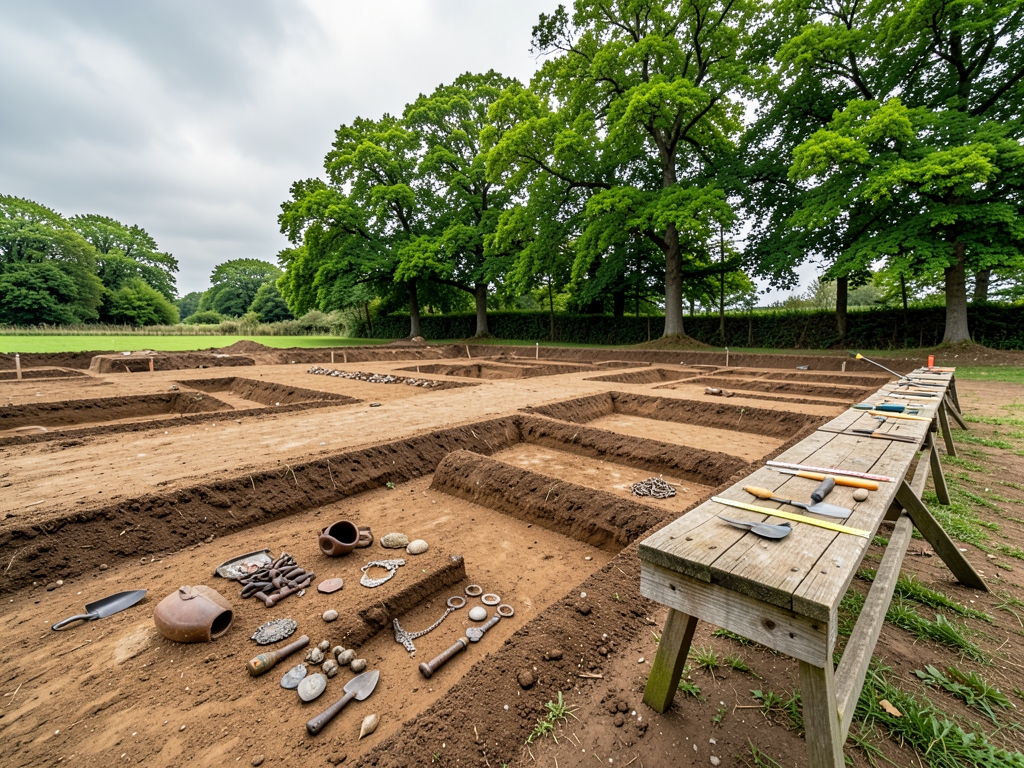
The iconic landscape of Sutton Hoo in Suffolk has once again captured the attention of historians, archaeologists, and medieval enthusiasts worldwide. Renowned as the site of one of the most astonishing archaeological discoveries in British history—the magnificent 7th-century Anglo-Saxon ship burial unearthed in 1939—this hallowed ground continues to yield secrets from early medieval England. Recent archaeological investigations have successfully identified a brand-new Anglo-Saxon grave situated well beyond the boundaries of the famous royal mounds. This latest finding offers fresh insights into the burial customs, social hierarchies, and territorial organization of East Anglia during the early medieval period, prompting experts to re-examine how communities outside the immediate royal lineage laid their dead to rest.
The Significance of Sutton Hoo in Early Medieval Studies
To understand the true weight of this new discovery, one must look at the historical and archaeological weight that the name Sutton Hoo carries. Located overlooking the River Deben in Suffolk, the site served as a major burial ground during the late 6th and early 7th centuries. The most famous feature of the site is Mound 1, which contained an undisturbed ship burial widely believed to be the final resting place of Raedwald, an East Anglian king who held significant power and influence. The treasures recovered from that ship—including the iconic helmet, gold shoulder clasps, intricate sword fittings, and Byzantine silverware—fundamentally transformed modern perceptions of the so-called 'Dark Ages,' proving that early medieval Britain possessed sophisticated artistry, extensive international trade networks, and complex political structures.
However, focusing exclusively on the royal mounds provides an incomplete picture of Anglo-Saxon society. While kings and high-ranking elites commanded immense resources for their funerary monuments, the broader population and lower-tier nobility practiced diverse burial customs that often remain shrouded in mystery. The identification of a grave beyond the royal core at Sutton Hoo provides a crucial piece of this societal puzzle. By examining graves located away from the primary ceremonial center, archaeologists can better understand the spatial organization of the cemetery, the social stratification of the local community, and the relationship between common elites and the ruling dynasty.
Uncovering Graves Beyond the Royal Mounds
Modern archaeological exploration relies heavily on non-invasive geophysical prospecting techniques, precision mapping, and careful, targeted excavation. While the initial decades of research at Sutton Hoo concentrated heavily on the prominent earthen mounds visible across the estate, recent work has expanded outward. Archaeologists exploring peripheral zones have increasingly recognized that the sacred landscape of Sutton Hoo extended far beyond the immediate cluster of royal barrows.
The discovery of peripheral graves demonstrates that the sacred geography of Sutton Hoo was expansive, encompassing varied tiers of early medieval society rather than serving solely as an exclusive dynastic necropolis.
Excavating outside the main mounds presents unique technical and interpretive challenges. Soil conditions at Sutton Hoo are notoriously acidic, which means that unburnt bone rarely survives intact in its original state. Instead, archaeologists frequently uncover 'sand silhouettes'—delicate impressions left in the sandy soil where bodies and organic grave goods once rested. Detecting and recording these fragile shadows requires meticulous hand-trowelling, microscopic soil analysis, and advanced digital recording techniques. The newly discovered grave required extraordinary patience from the field team to ensure that every subtle shift in soil coloration and texture was documented before any physical removal of material took place.
What the New Finds Tell Us About Anglo-Saxon Burial Customs
Although comprehensive analysis of the grave goods and organic remains from the newly found Sutton Hoo burial is ongoing, initial reports highlight several intriguing features that align with broader Anglo-Saxon funerary practices. Early medieval burials in this region frequently varied between inhumation and cremation, sometimes incorporating elaborate grave goods designed to accompany the deceased into the afterlife. The presence of a separate grave outside the royal mounds raises compelling questions regarding who was permitted burial within this hallowed landscape.
| Feature | Royal Mounds (e.g., Mound 1) | Peripheral Graves |
|---|---|---|
| Location | Central ridge overlooking the River Deben | Outer zones beyond the main barrow cluster |
| Monument Type | Large earthen barrows covering timber chambers | Flat graves or smaller, less prominent markers |
| Grave Goods | Extensive imported treasures, gold, weapons | Local personal items, utilitarian objects, simpler adornments |
| Historical Function | Dynastic display of royal power and ancestry | Community burial or reflection of lower nobility |
Historians note that burial grounds like Sutton Hoo were not merely places for disposing of the dead; they were potent political statements. In an era marked by shifting kingdoms, religious transitions—as pagan traditions gradually interacted with incoming Christianity—and violent territorial rivalries, claiming an ancestral landscape mattered deeply. By burying their dead near the monumental tombs of kings, lesser elites or regional families could visually and symbolically align themselves with the ruling power, cementing their status within the East Anglian kingdom.
Advanced Preservation and Scientific Analysis
The study of Anglo-Saxon archaeology has undergone a quiet revolution over the past few decades, shifting from simple treasure recovery to rigorous scientific analysis. When organic remains survive—even in minuscule quantities—modern bioarchaeologists employ sophisticated techniques such as ancient DNA (aDNA) profiling, stable isotope analysis, and radiographic imaging.
Info! Modern scientific methods allow researchers to determine the geographical origins, diet, and familial relationships of individuals buried centuries ago, transforming our understanding of migration and kinship in early medieval Britain.
Isotope analysis of tooth enamel, for instance, can reveal where an individual spent their childhood, tracking migration patterns across Europe during the turbulent post-Roman migration period. Meanwhile, portable X-ray fluorescence (pXRF) allows researchers to analyze corroded metal artifacts in situ without damaging delicate surface patinas or organic residues like textiles and leather trapped in corrosion products. These technological advancements ensure that every new grave discovered at Sutton Hoo yields exponentially more data than the excavations of the 20th century could ever achieve.
Contextualizing the Find Within Wider European Archaeology
The discovery at Sutton Hoo does not exist in a vacuum. Throughout Northern Europe, archaeologists are re-evaluating elite centers and their surrounding landscapes. Comparable sites in Scandinavia—such as Valsgärde and Vendel in Sweden—exhibit similar patterns of monumental boat graves surrounded by extensive cemeteries that span multiple social strata. By comparing the Sutton Hoo peripheral grave with contemporary continental burial sites, historians can map out the extensive cultural, economic, and familial networks that linked Anglo-Saxon England with the Scandinavian mainland and the wider Frankish world.
Trade routes across the North Sea brought Baltic amber, Rhenish glassware, and Mediterranean textiles into East Anglia. The individuals interred in these cemeteries—whether kings or regional landowners—were active participants in a dynamic, interconnected northern world. Each newly discovered grave adds crucial data points to our understanding of how goods, ideas, and people circulated across early medieval Europe.
Public Engagement and Heritage Preservation
The preservation and presentation of sites like Sutton Hoo represent a delicate balancing act between academic research, heritage conservation, and public education. Managed by the National Trust, Sutton Hoo welcomes thousands of visitors annually who come to marvel at the replica ship, explore the exhibition hall, and walk the tranquil burial mounds. Integrating new discoveries into the visitor narrative ensures that public understanding of archaeology remains dynamic rather than static.
Furthermore, protecting these fragile archaeological reserves from environmental pressures—such as coastal erosion along the East Anglian coast, changing weather patterns, and intensive modern agriculture—remains a top priority for heritage agencies. Non-destructive surveying methods and careful excavation protocols ensure that future generations of researchers will still have pristine archives beneath the soil to explore.
What makes the new Sutton Hoo grave discovery significant?
The discovery of a new Anglo-Saxon grave beyond the royal mounds is significant because it expands our understanding of the cemetery's layout and provides valuable context about non-royal or lower-elite burial customs in early medieval East Anglia.
How do archaeologists excavate graves at Sutton Hoo given the soil conditions?
Because acidic soil typically destroys unburnt bone, archaeologists often rely on identifying 'sand silhouettes'—delicate color and texture impressions left in the sandy earth—requiring meticulous hand-trowelling and digital recording.
Were only kings buried at Sutton Hoo?
While the most famous mounds were reserved for high-ranking royalty and elite figures like King Raedwald, the broader Sutton Hoo landscape contains peripheral burials that reflect other members of the early medieval community and regional nobility.
What modern scientific techniques are used to study these artifacts?
Researchers use advanced scientific methods such as stable isotope analysis, ancient DNA profiling, and portable X-ray fluorescence to study diet, geographical origins, and delicate metalwork without damaging the artifacts.
Ultimately, the unearthing of a new Anglo-Saxon grave beyond the royal mounds at Sutton Hoo underscores the enduring allure of early medieval archaeology. As long as researchers continue to probe the sandy soils of East Anglia with modern scientific precision, the past will continue to speak, revealing the intricate lives, beliefs, and societal structures of the people who shaped the foundations of medieval Britain.
