

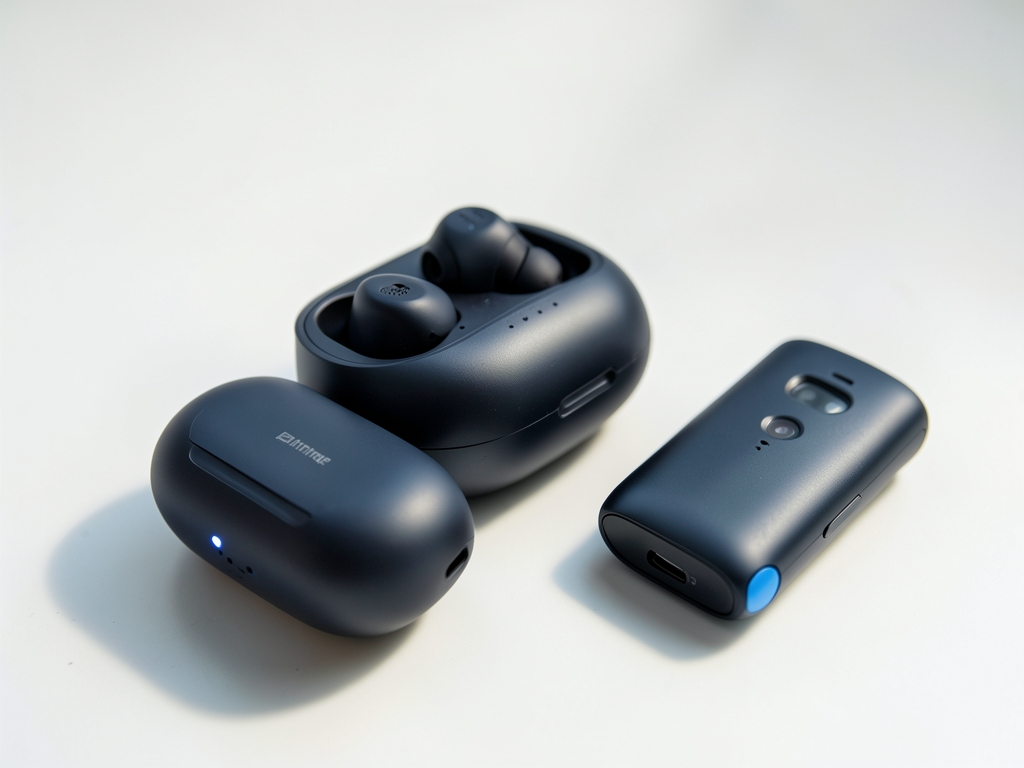
London-based consumer technology venture Nothing has officially announced its foray into dedicated AI-powered audio hardware with the upcoming launch of the Nothing Ear (note). Scheduled for a formal public unveiling on December 8, the new wireless earbuds introduce a distinct hardware concept that pairs active noise-canceling earphone acoustics with an intelligent, voice-recording charging case. Designed to operate as both a high-fidelity listening accessory and a screenless ambient note-taker, the Ear (note) represents Nothing's initial hardware release centered specifically around artificial intelligence integration.
Unlike traditional wireless earbuds that depend entirely on smartphone software to process voice commands and ambient recordings, the Nothing Ear (note) embeds dedicated microphone arrays and processing silicon directly within its charging container. This architectural shift enables users to capture verbal notes, transcribe spoken meetings, summarize lectures, and index personal ideas without taking out a smartphone or navigating graphical app menus. The development marks a significant turn in consumer audio accessories, shifting the humble storage container into an active edge-computing recorder.
A Screenless Approach to Artificial Intelligence Hardware
In recent years, hardware manufacturers have struggled to create dedicated artificial intelligence gadgets that fit naturally into everyday consumer habits. Early attempts at wearable AI pendants and standalone companion gadgets often suffered from high latency, limited battery performance, and the inconvenience of requiring users to carry yet another single-purpose device. Nothing's approach with the Ear (note) addresses these pain points by integrating AI capabilities directly into an accessory millions of users already carry daily: a wireless earbud charging case.
By selecting a screenless form factor, Nothing emphasizes low-friction user interaction. Rather than staring at a digital display or executing complex touch gestures on a phone screen, users interact with the Ear (note) through single-press mechanical controls, audio cues, and background ambient listening. The screenless design philosophy minimizes visual distractions while maintaining instant accessibility, making recording and note creation as simple as holding down a physical tactile button on the side of the case.
By placing physical recording controls and dedicated silicon directly inside the charging case, ambient audio capture becomes an instant, frictionless action rather than a multi-step smartphone workflow.
Info! The Nothing Ear (note) event scheduled for December 8 will mark the official reveal of detailed global retail availability, regional pricing structures, and initial carrier partner bundles.
The Smart Charging Case: Engineering a Dedicated Audio Recorder
The core technological shift introduced in the Nothing Ear (note) resides within its redesigned charging case. While standard earbud cases serve primarily as battery banks and pairing hubs, the Ear (note) case acts as an autonomous audio recorder. Constructed with Nothing's signature transparent aesthetic, the chassis houses high-sensitivity omnidirectional microphones engineered to capture clear voice recordings across short and medium distances.
Integrated Acoustic Architecture and Microphones
To capture accurate spoken audio in diverse environments—ranging from quiet conference rooms to bustling coffee shops—the charging case features a dual-microphone array equipped with real-time acoustic beamforming. When the user initiates a voice memo, the system dynamically isolates the primary speaker's voice while suppressing background noise. This hardware-level filtering ensures that raw audio feeds fed into local and cloud transcription engines retain high clarity, reducing transcription error rates for technical jargon, foreign names, and fast speech.
Local Storage and Standalone Operation
A major bottleneck for mobile AI recorders has historically been persistent cloud connectivity. To prevent data loss when traveling or operating in low-connectivity areas, the Ear (note) case incorporates embedded onboard solid-state memory. Voice memos, ambient recordings, and quick audio clips are stored securely on the device until a stable Wi-Fi or Bluetooth connection is established with a host device. Once reconnected, the case automatically synchronizes encrypted audio logs to the user's paired device or cloud storage vault.
AI Workflows: Transcription, Summarization, and Contextual Search
While high-grade microphone hardware secures quality sound, software intelligence turns raw audio recordings into structured, searchable digital assets. The Nothing Ear (note) leverages a hybrid processing pipeline that splits computational workloads between local edge processing and cloud-based natural language models.
- Instant Audio Capture: Press and hold the dedicated record control on the Ear (note) case to begin recording immediately, whether the earbuds are currently in your ears or resting inside the case.
- Automated Speech-to-Text: Upon completing a recording session, onboard acoustic filters scrub background hums, after which speech recognition algorithms convert the voice track into formatted text.
- Intelligent Summarization: Generative text engines process long-form transcripts into concise bullet points, highlighting action items, key deadlines, speaker tags, and decisions.
- Cross-Platform Sync and Search: Transcripts and audio files sync automatically with the companion application, allowing users to query past meetings or sound clips using natural language search.
This automated workflow is particularly targeted at students, journalist professionals, research teams, and corporate executives who frequently need to document lectures, interviews, and strategic discussions. Rather than manually typing meeting minutes or re-listening to hours of unindexed audio tracks, users can query their audio library via text search to jump directly to specific quotes or summarized key takeaways.
Hardware & Specs Comparison: Standard Earbuds vs. Nothing Ear (note)
To highlight how the Ear (note) alters traditional earbud case capabilities, the following comparative framework details key hardware differences between conventional wireless audio cases and Nothing's new AI recording container:
| Hardware Feature | Standard Wireless Earbud Case | Nothing Ear (note) AI Case |
|---|---|---|
| Primary Function | Battery Charging & Device Pairing | Charging, Edge AI Recording & Audio Processing |
| Dedicated Microphones | None (Earbuds only) | Dual-Microphone Beamforming Array |
| Onboard Memory | None (EEPROM for firmware only) | Dedicated Solid-State Storage for Audio Logs |
| Standalone Audio Capture | Unsupported | Supported via Physical Case Interface |
| Transcription & Summarization | Requires Phone App & Active Screen | Automated Background Sync & AI Analysis |
| Data Connectivity | Bluetooth LE (Basic Control) | High-Bandwidth Bluetooth & Fast Cloud Sync |
Privacy, Security, and Ethical Considerations in Ambient Recording
The introduction of a portable, easily accessible recording device built directly into a everyday accessory naturally raises privacy questions regarding consent and data handling. Nothing has integrated several hardware-level and software security protocols to safeguard both the user and surrounding individuals.
Warning! Always observe local privacy laws regarding conversation recording. Many jurisdictions require explicit two-party consent before recording meetings, telephone calls, or private discussions.
Visual and Acoustic Recording Indicators
To prevent discreet or unauthorized audio monitoring, the Ear (note) case includes a dedicated physical LED status light and subtle auditory chimes. When recording mode is active, the LED illuminates steadily, providing a visual signal to everyone in the room that audio capture is under way. Hardware interlocks prevent the microphone circuit from operating covertly without illuminating the status lamp.
End-to-End Encryption and Local Data Ownership
Data stored on the case's onboard memory is secured using hardware-level AES-256 encryption. If the charging case is misplaced or stolen, third parties cannot extract stored voice clips directly from the physical memory chips. Furthermore, user data sent to cloud servers for deep AI processing is governed by strict opt-in privacy policies, ensuring audio transcripts are not retained for model training without explicit user permission.
Strategic Market Positioning and Industry Outlook
Nothing's announcement arrives at a pivotal moment for the consumer technology sector. As consumer excitement surrounding standalone AI badges, pins, and clips faces skepticism due to high costs and redundant functionality, integrating specialized AI features into proven device categories like true wireless stereo (TWS) earphones presents a more practical consumer pathway.
The December 8 debut will showcase how Nothing intends to bundle software subscription tiers, desktop companion utilities, and ecosystem integrations with Nothing OS. If successful, the launch may encourage competing audio brands to re-examine the role of charging cases, shifting them from simple battery enclosures toward active peripheral computers.
When will the Nothing Ear (note) be officially released?
Nothing has scheduled the formal unveiling of the Ear (note) for December 8, at which point comprehensive technical specifications, global market availability, and official pricing details will be confirmed.
Can the charging case record audio when the earbuds are not in use?
Yes, the charging case features built-in beamforming microphones and dedicated onboard storage, allowing it to record voice notes independently even when the earbuds remain docked inside the case.
Does the Nothing Ear (note) require a constant internet connection to record?
No, raw audio recordings can be captured and stored locally on the case's internal memory offline. AI transcriptions and summaries process automatically once connected to a paired smartphone or Wi-Fi network.
Are recordings encrypted to protect user privacy?
Audio files saved on the device's internal storage utilize hardware-based encryption. Additionally, visual LED indicators notify nearby individuals whenever active recording takes place.
Final Thoughts
The Nothing Ear (note) marks a logical evolution in smart personal audio accessories. By transforming the charging case into an autonomous voice recorder backed by artificial intelligence, Nothing bridges the gap between screenless ambient hardware and practical productivity tools. As the official December 8 launch date approaches, the technology industry will closely watch how consumers respond to this screen-free audio note-taking companion.
Sources and Further Reading
- Nothing Ear (note) Unveiled: Earbuds with AI Recorder Charging Case Set to Debut Soon - Tech Times — Tech Times (published 2026-11-24 08:20)
- Phone Maker Nothing to Launch Earbuds and Case With AI Recording - Bloomberg.com — Bloomberg.com (published 2026-11-23 18:00)
- Nothing Sets December 8 Reveal for Its First Screenless AI Device - Technology Org — Technology Org (published 2026-11-23 14:06)
