

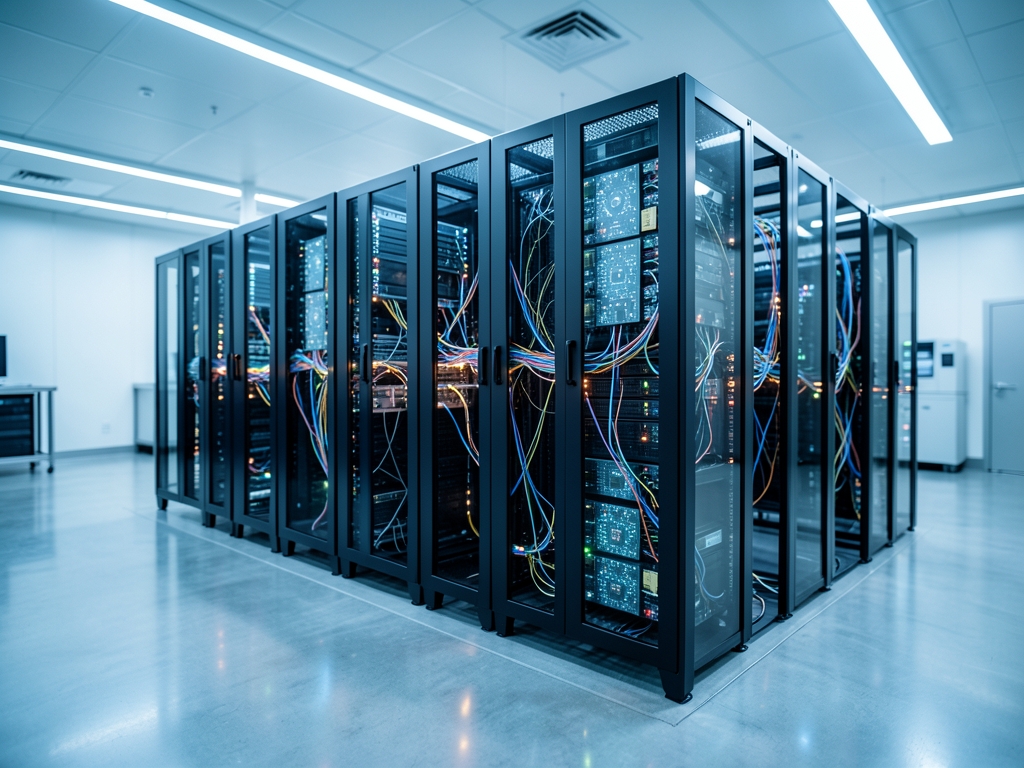
The race toward commercial, fault-tolerant quantum computing has entered a decisive engineering phase focused on solving the massive classical compute bottlenecks that surround quantum hardware. In a major industry development, quantum computing pioneer PsiQuantum has announced a strategic collaboration with semiconductor leader AMD to co-design and deploy the high-performance computing foundation necessary for utility-scale quantum systems. The partnership bridges the gap between photonic quantum processing units and ultra-low-latency classical compute clusters, targeting one of the most persistent hurdles in quantum scaling: managing sub-microsecond error correction feedback loops across millions of physical qubits.
For years, public discussions around quantum progress focused primarily on physical qubit counts and raw gate fidelity. However, as quantum architectures transition from Noisy Intermediate-Scale Quantum (NISQ) demonstrations to fault-tolerant, utility-scale deployments, attention has shifted to the immense classical computing control plane required to operate these systems. Utility-scale quantum computers will rely on quantum error correction (QEC), a continuous process that ingests petabytes of diagnostic measurement data, computes error syndromes, and executes immediate corrective controls. By partnering with AMD, PsiQuantum aims to integrate custom adaptive logic, high-density EPYC server CPUs, and advanced FPGA interconnect fabrics directly into its photonic quantum architecture.
The Classical Compute Bottleneck in Fault-Tolerant Quantum Systems
To understand why a quantum hardware company requires partnership with a tier-one silicon manufacturer like AMD, one must look at the mechanics of quantum error correction. Quantum states are inherently fragile, vulnerable to environmental decoherence, temperature fluctuations, and electromagnetic noise. To execute useful algorithms in molecular simulation, materials discovery, or complex cryptography, a quantum computer cannot rely on bare physical qubits alone. Instead, thousands of physical qubits must be grouped into a single error-protected logical qubit.
Info! Utility-scale quantum computing requires maintaining logical qubits with operational error rates lower than one in a trillion operations. Achieving this requires continuous classical processing to analyze error syndromes without destroying quantum superposition.
In a fault-tolerant system scaled to hundreds of thousands or millions of physical qubits, the volume of diagnostic telemetry produced every microsecond is staggering. Physical syndrome measurements must be streamed out of the quantum hardware, decoded by classical processors to identify where errors occurred, and translated into precise corrective control signals. If the classical control system fails to compute the error pattern within the strict coherence window of the quantum system—typically measured in nanoseconds to microseconds—the quantum state degrades, rendering the computation useless.
This creates a massive real-time data processing challenge that far exceeds the capabilities of standard off-the-shelf server architectures. The integration of AMD's heterogeneous compute technologies, including high-throughput adaptive silicon and low-latency system interconnects, provides PsiQuantum with a scalable architecture tailored to ingest, route, and solve complex graph-decoding algorithms in real time alongside its photonic quantum chips.
Silicon Photonics Architecture Meets High-Density Classical Compute
PsiQuantum’s approach to fault-tolerant quantum computing relies on silicon photonics, using individual particles of light (photons) routed through optical waveguides on standard silicon chips rather than trapped ions or superconducting circuits. Photonic systems possess distinct operational advantages, including room-temperature operation for key optical routing components, high connectivity via optical fibers, and compatibility with existing high-volume semiconductor fabrication foundries.
However, photonic architectures process information at optical speeds. As single photons travel through optical networks, high-speed single-photon detectors generate massive streams of electrical signal pulses. AMD’s processing hardware will serve as the neural core of the classical control plane, managing the continuous ingestion of these optical detector outputs.
Building a million-qubit quantum machine is as much a challenge of high-performance classical compute and data communications as it is a challenge of quantum physics.
The collaboration focuses on several key areas of compute infrastructure co-design:
- Real-Time Error Syndrome Decoding: Custom hardware pipelines utilizing AMD FPGAs and custom adaptive accelerators to execute decoding algorithms, such as Minimum Weight Perfect Matching (MWPM) or union-find decoders, within microsecond time bounds.
- High-Bandwidth Interconnect Systems: Developing low-latency PCIe and Compute Express Link (CXL) data pathways between optical detector interfaces and classical processing nodes to prevent memory and pipeline stalls.
- Heterogeneous Cluster Orchestration: Deploying AMD EPYC server processors to manage high-level quantum circuit compilation, dynamic algorithm re-routing, and integration with classical HPC workflows.
Comparative Breakdown: NISQ Systems vs. Utility-Scale Systems
The joint initiative by PsiQuantum and AMD represents a fundamental shift away from small-scale experimental systems toward industrial-scale computing infrastructure. The table below outlines how infrastructure requirements evolve when moving from legacy NISQ systems to fault-tolerant, utility-scale architectures.
| Metric / Feature | NISQ Era Systems | Utility-Scale Systems (PsiQuantum & AMD) |
|---|---|---|
| Physical Qubit Scale | 50 to 1,000 qubits | 1,000,000+ photonic qubits |
| Primary Error Handling | Error mitigation & noise averaging | Active real-time Quantum Error Correction (QEC) |
| Classical Compute Role | Pulse generation & post-processing | Microsecond sub-system syndrome decoding |
| Data Telemetry Rates | Megabytes to Gigabytes per second | Terabytes to Petabytes per second |
| Target Applications | Proof-of-concept experiments | Commercial chemistry, materials science, encryption |
| Hardware Architecture | Superconducting / Trapped Ion cryo-rigs | Silicon photonics integrated with adaptive HPC silicon |
Quantum-AI Convergence and the Broader Industry Ecosystem
The PsiQuantum and AMD collaboration highlights a broader technological trend: the convergence of quantum hardware architecture, classical high-performance computing, and artificial intelligence. As quantum hardware scales up, machine learning algorithms are increasingly being used to optimize classical control feedback, recalibrate optical components dynamically, and refine real-time error-decoding models.
This systemic integration is being echoed across the entire quantum technology ecosystem. For instance, quantum control software enterprise Q-CTRL recently closed a US$290 million Series C funding round led by Salesforce Ventures to accelerate software that converges quantum control with AI logic. As quantum hardware gains operational complexity, enterprise software layers and specialized compute accelerators are becoming critical components of the quantum stack.
By pairing photonic QPUs with enterprise-grade AMD silicon, PsiQuantum is ensuring that when photonic chips reach commercial scale, the supporting computational backplane, network switching, and power delivery infrastructure will already be qualified for enterprise data centers.
Engineering Challenges: Latency, Thermal Budgets, and Signal Routing
Building a utility-scale quantum platform presents formidable engineering challenges that span multiple physics and compute domains. While PsiQuantum's photonic chips avoid the ultra-deep cryogenic requirements of superconducting systems for many routing tasks, single-photon detectors still operate in cryogenic environments. Connecting low-temperature optical detectors to high-power ambient classical processors requires carefully engineered signal interfaces.
- Cryogenic-to-Ambient Signal Conversion: Photonic signals detected inside cryogenic modules must be converted to ultra-fast electrical pulses and transmitted to classical processing racks with minimal signal attenuation or heat leakage.
- Sub-Microsecond Latency Envelopes: Classical decoding hardware must process streaming syndrome data and calculate error corrections faster than the optical storage delay lines within the photonic QPU.
- Thermal and Power Management: Running dense clusters of high-frequency FPGAs and CPUs adjacent to quantum control systems requires specialized liquid-cooling racks to handle significant heat density.
Addressing these hardware constraints demands tight co-engineering between chip designers, system packaging engineers, and software architects. AMD’s extensive background in high-density chiplet design, advanced substrate packaging, and energy-efficient data center architectures provides the critical foundational technology required to solve these physical constraints at scale.
Enterprise Outlook: What IT Leaders and Data Centers Must Prepare For
For enterprise technology leaders, CIOs, and data center architects, the PsiQuantum-AMD alliance provides clear visibility into how quantum systems will eventually be integrated into corporate IT environments. Utility-scale quantum computers will not exist as isolated lab instruments; they will operate as specialized co-processors embedded directly inside modern high-performance computing data centers alongside conventional CPU and GPU clusters.
Organizations looking to harness quantum advantages in fields such as pharmaceutical molecular modeling, battery chemistry, logistics optimization, and financial risk modeling should recognize that early adoption will require hybrid computational workflows. Applications will execute classical pre-processing on standard server infrastructure, offload complex quantum subroutines to photonic QPUs, and utilize continuous high-speed feedback control supplied by custom classical hardware.
Why do quantum computers require classical hardware like AMD processors?
Fault-tolerant quantum computers rely on continuous quantum error correction, which generates massive amounts of diagnostic measurement data every microsecond. Classical processors like AMD CPUs and FPGAs are needed to ingest this telemetry, run error-decoding algorithms, and send real-time correction commands back to the quantum hardware before quantum coherence is lost.
How does PsiQuantum's photonic approach differ from traditional quantum hardware?
PsiQuantum uses silicon photonics, manipulating individual light particles (photons) through optical waveguides manufactured on standard semiconductor fabrication lines. This approach allows high connectivity via optical fibers and avoids many of the scaling and manufacturing limits associated with traditional trapped ion or superconducting qubit designs.
What is the significance of real-time error syndrome decoding?
Real-time error syndrome decoding is the computational process of analyzing physical qubit measurements to identify and correct hardware errors. In a utility-scale machine, decoding must occur within microsecond latency windows to prevent small environmental errors from corrupting the overall logical computation.
When will utility-scale quantum computing become commercially available?
PsiQuantum and its industry partners are aiming to deploy full-scale fault-tolerant quantum systems toward the latter half of the decade. Recent collaborations with semiconductor giants like AMD focus specifically on building out the scalable manufacturing, packaging, and classical compute infrastructure necessary to meet that timeline.
Unifying Quantum Physics and High-Performance Silicon
The strategic partnership between PsiQuantum and AMD underlines a fundamental reality of modern physics and computer engineering: building a practical, utility-scale quantum computer is as much a challenge of high-performance classical compute and interconnect design as it is of quantum mechanics. By pairing silicon photonics with high-density classical processing, the collaboration establishes a credible architectural blueprint for fault-tolerant computing. As quantum development shifts from small laboratory demos to enterprise-grade data center infrastructure, co-designed compute foundations will play a decisive role in making useful quantum computation a reality.
