

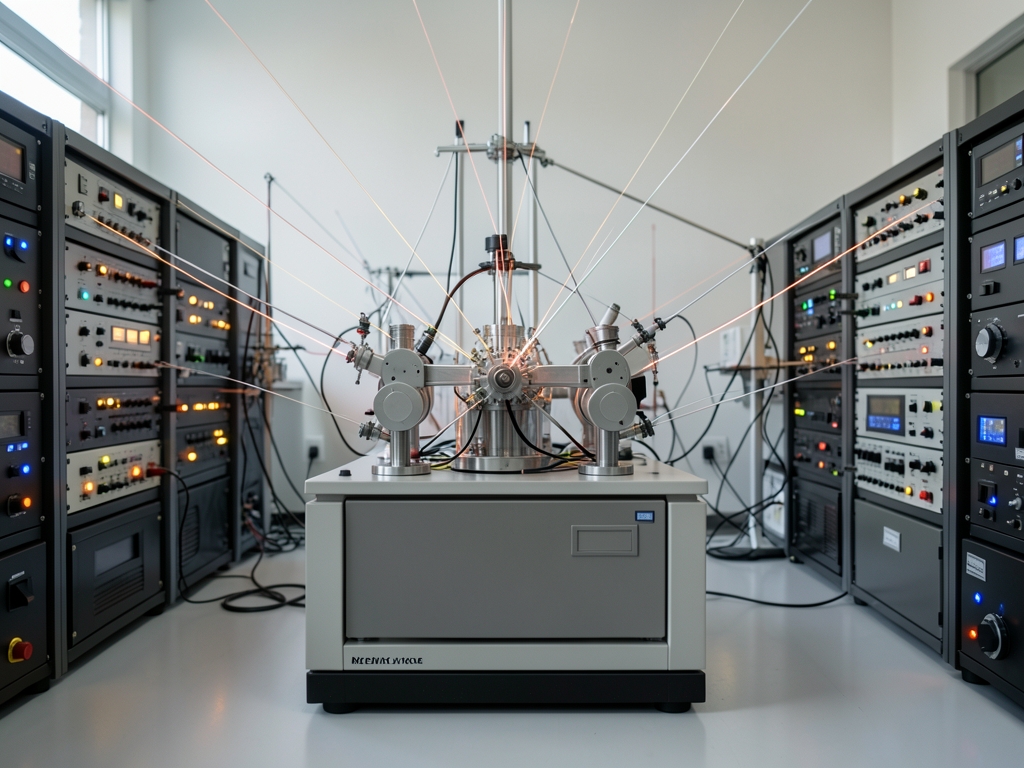
Quantum simulation has reached a major milestone as researchers from QuEra Computing and the Lawrence Berkeley National Laboratory published a comprehensive Nature study detailing the real-time simulation of complex quantum dynamics across up to 180 individual qubits. This breakthrough marks a significant leap forward in our ability to model quantum many-body systems that remain entirely intractable for classical supercomputers. By leveraging neutral-atom architectures, the research team successfully tracked highly entangled quantum states over extended evolution times, opening new pathways for understanding fundamental material science, condensed matter physics, and molecular interactions at a microscopic scale.
The core challenge in modern quantum computing has always been scaling up the number of controllable qubits while preserving coherence and minimizing environmental interference. Traditional superconducting circuit architectures face severe physical wiring constraints as they scale into hundreds or thousands of elements. In contrast, neutral-atom platforms utilize arrays of ultra-cold rubidium or similar atoms trapped in optical tweezers—tightly focused laser beams that arrange individual atoms in precise one-dimensional, two-dimensional, or three-dimensional geometries. This programmable optical lattice allows researchers to dynamically alter distances and interactions between qubits, offering unmatched architectural flexibility for simulating complex physical phenomena.
Understanding Neutral-Atom Quantum Dynamics
To appreciate the significance of simulating 180 qubits, one must examine the sheer mathematical complexity of quantum states. As the number of qubits increases linearly, the size of the corresponding Hilbert space grows exponentially. A system containing 180 interacting quantum elements possesses a state space so vast that storing its complete wave function would require more classical memory than the total number of atoms on Earth. Simulating such systems requires sophisticated algorithmic approaches that can capture entanglement propagation without explicitly calculating every hidden variable.
The collaboration between QuEra Computing and Berkeley Lab focused on Rydberg atom arrays, where atoms are temporarily excited to high principal quantum numbers. In this Rydberg state, atoms exert massive forces on one another through dipole-dipole interactions, effectively blocking neighboring atoms from being simultaneously excited. This phenomenon, known as the Rydberg blockade, acts as a natural quantum gate, enabling high-fidelity entanglement generation across the entire array. By tuning the laser pulses governing these excitations, the researchers could induce complex phase transitions and observe how quantum information scrambles across the 180-qubit system in real time.
The ability to manipulate nearly two hundred individually addressed neutral atoms with high fidelity transforms quantum simulation from a theoretical exercise into a predictive tool for discovering novel states of matter.
During the experiment, the team tracked non-equilibrium quantum dynamics, studying how closed quantum systems thermalize or fail to thermalize when subjected to periodic driving forces. These dynamics are crucial for understanding exotic phases of matter such as quantum spin liquids and time crystals—states that defy conventional thermodynamic expectations. The precision achieved in the Berkeley Lab study demonstrates that neutral-atom platforms can maintain quantum coherence long enough to execute deep circuits filled with entangling operations, outperforming previous generations of analog quantum simulators.
Technical Architecture and Experimental Setup
Achieving stable operation across 180 qubits requires exceptional control over external noise sources, magnetic field fluctuations, and laser intensity stability. The neutral-atom system relies on ultra-high vacuum chambers where atoms are initially captured and cooled using magneto-optical traps. Once cooled to microkelvin temperatures—just a fraction of a degree above absolute zero—the atoms are loaded into a configurable array of optical tweezers generated by spatial light modulators.
| System Parameter | Specification Detail | Scientific Significance |
|---|---|---|
| Qubit Count | Up to 180 neutral atoms | Enables exploration of massive Hilbert spaces beyond classical simulation limits |
| Qubit Modality | Laser-cooled Rubidium atoms in optical tweezers | Provides reconfigurable geometry and long coherence times |
| Entangling Mechanism | Rydberg blockade interactions | Facilitates high-speed, parallel two-qubit gate operations |
| Measurement Fidelity | High-efficiency site-resolved fluorescence imaging | Allows precise readout of individual atomic states post-experiment |
Info! Site-resolved fluorescence imaging allows researchers to take a direct snapshot of every individual atom in the array at the end of an experimental run, converting quantum states into directly observable digital data.
The integration of algorithmic error mitigation strategies further enhanced the reliability of the output data. While fault-tolerant, error-corrected quantum computers with millions of physical qubits remain under active development, near-term intermediate-scale quantum (NISQ) devices like QuEra's processor are proving immensely valuable as specialized co-processors. By pairing high-performance classical supercomputing resources at Berkeley Lab with QuEra's programmable analog-digital hardware, the researchers established a hybrid workflow capable of validating complex quantum simulations against theoretical models.
Implications for Material Science and Chemistry
The successful execution of quantum dynamics across 180 qubits extends far beyond fundamental physics. Many of the most pressing challenges in clean energy research, pharmaceuticals, and catalyst design involve understanding quantum mechanical interactions in molecules and materials that classical computers can only approximate. Traditional density functional theory and Monte Carlo methods often break down when strong electron correlation comes into play, such as in high-temperature superconductors or nitrogenase enzymes responsible for biological nitrogen fixation.
By simulating quantum magnetism and lattice models that mimic electronic behavior in solid-state materials, researchers can use programmable neutral-atom arrays as physical analog simulators. Instead of calculating equations on a classical computer, scientists can set up an atomic array that obeys the exact same quantum Hamiltonian they wish to study. The system then naturally evolves into its low-energy state or dynamic equilibrium, revealing properties that would take millennia to compute via brute-force numerical simulation.
Warning! While analog quantum simulation provides profound insights into complex Hamiltonians, translating these physical models into practical industrial catalysts or room-temperature superconductors still requires bridging significant engineering gaps between idealized atomic arrays and messy real-world chemical environments.
Future Outlook for Scalable Quantum Systems
The joint study by QuEra Computing and Berkeley Lab highlights the rapid maturation of neutral-atom technology as a dominant paradigm in the quantum computing landscape. While early quantum hardware development was heavily dominated by superconducting circuits, neutral-atom systems have closed the gap by demonstrating superior scalability, uniform qubit properties, and native multi-qubit connectivity. As research teams around the world push beyond the 200-qubit threshold, the focus is shifting toward fault-tolerant architectures capable of running deep error-corrected algorithms.
Future iterations of these platforms aim to incorporate mid-circuit measurements and dynamic feedback loops, enabling real-time error correction and adaptive quantum circuit execution. This will allow researchers not only to simulate closed quantum systems but also to study open quantum systems interacting with controlled environments—a critical step toward modeling chemical reactions and biological processes with absolute quantum fidelity.
What makes neutral-atom quantum computers different from superconducting systems?
Neutral-atom systems use laser beams called optical tweezers to trap and arrange individual atoms in customizable grids, whereas superconducting systems rely on fixed circuits etched onto physical microchips. Neutral atoms offer greater scalability, natural uniformity, and the ability to dynamically rearrange qubit positions during an experiment.
Why is simulating 180 qubits considered a major computational milestone?
A quantum system with 180 interacting qubits generates a Hilbert space so enormous that storing its full quantum state would exceed the classical memory capacity of any existing supercomputer. Simulating such complex dynamics experimentally demonstrates the unique power of quantum hardware.
What is the Rydberg blockade mechanism used in these experiments?
When atoms in the array are excited to high principal quantum numbers known as Rydberg states, their strong interactions prevent neighboring atoms from being simultaneously excited. This physical phenomenon acts as a natural quantum gate for generating high-fidelity entanglement.
How will this research impact industries outside of theoretical physics?
By accurately modeling complex quantum many-body systems, this technology lays the groundwork for discovering advanced materials, designing efficient catalysts for clean energy production, and accelerating molecular research in pharmaceuticals.
Conclusion
The collaborative study by QuEra Computing and Berkeley Lab demonstrates that neutral-atom quantum simulation has crossed a critical threshold of scale and precision. By successfully observing and controlling quantum dynamics across 180 qubits, researchers have unlocked a powerful new window into many-body physics that bypasses the fundamental limitations of classical computing. As hardware fidelity continues to improve and hybrid algorithmic workflows mature, neutral-atom platforms are poised to accelerate breakthroughs across material science, chemistry, and fundamental physics in the years ahead.
