

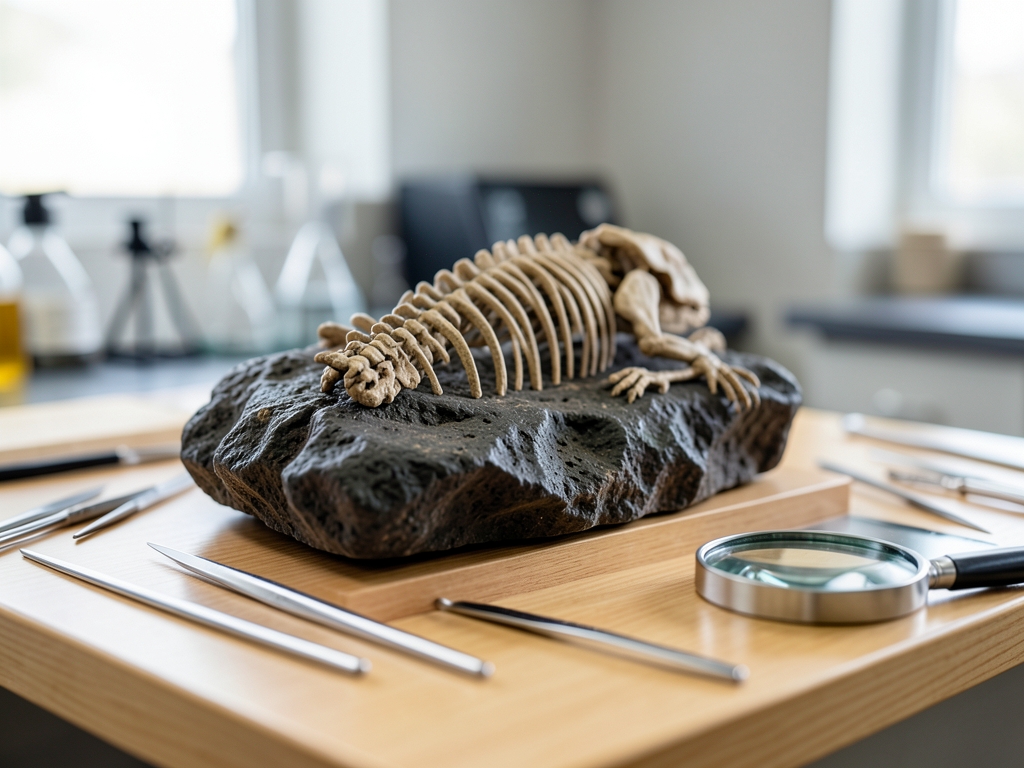
Paleontology has long taught us that the transition of vertebrate life from water to land is one of the most defining chapters in evolutionary history. The early tetrapods that crawled out of the Devonian swamps eventually gave birth to modern amphibians, reptiles, birds, and mammals. However, the evolutionary tree of amphibians is fraught with branches that zig-zag across ancient environments, defying simple categorizations. A groundbreaking fossil discovery has now added a remarkable new chapter to this narrative, revealing the existence of the first fully marine stem amphibian dating back to the Late Triassic epoch.
This remarkable finding shifts our conventional understanding of how early amphibian lineages adapted to aquatic environments. While many modern amphibians spend parts of their life cycles in water, their physiological makeup generally restricts them from thriving in high-salinity marine ecosystems. The discovery of a stem amphibian uniquely adapted to life in the open ocean sheds light on ancient marine food webs and the evolutionary plasticity of early tetrapod groups during a time of immense global transition.
Unraveling the Late Triassic Marine Ecosystem
The Late Triassic was a turbulent period in Earth's history, marked by the aftermath of major extinction events, shifting continental plates, and the dawn of the dinosaur age. Marine environments during this epoch were complex, teeming with marine reptiles, early fish lineages, and diverse invertebrate communities. Finding a stem amphibian adapted to these open-water conditions challenges long-held assumptions that early amphibian groups were strictly restricted to freshwater swamps, rivers, and terrestrial margins.
Researchers analyzing the fossilized remains noted specialized anatomical adaptations that point directly to a pelagic or fully marine lifestyle. Unlike their freshwater counterparts, whose skeletal structures often reflect weight-bearing limbs or semi-aquatic habits tied to shallow banks, this newly described specimen exhibits streamlined skeletal features optimized for swimming and navigating marine currents. These adaptations suggest that certain stem amphibians successfully carved out an ecological niche in the ancient oceans, competing and coexisting with established marine predators.
| Anatomical Feature | Freshwater Amphibians | Marine Stem Amphibian |
|---|---|---|
| Skeletal Structure | Robust limbs for terrestrial or shallow movement | Streamlined body adapted for open-water propulsion |
| Habitat Range | Rivers, lakes, swamps, and temporary ponds | Fully marine, pelagic, or coastal shelf environments |
| Physiological Tolerance | Low salinity tolerance | High-salinity marine adaptation |
Evolutionary Significance of Stem Amphibians
To understand the importance of this discovery, it is essential to distinguish between crown-group amphibians—which include modern frogs, salamanders, and caecilians—and stem amphibians. Stem amphibians represent a diverse array of extinct, more primitive lineages that branched off before the common ancestor of today's living amphibians evolved. These ancient creatures display a fascinating mosaic of primitive fish-like traits and advanced tetrapod characteristics.
The revelation that at least one branch of these stem amphibians ventured into fully marine habitats proves that vertebrate evolution experimented wildly with aquatic reinvasion. Just as modern whales and dolphins returned from land to the sea, ancient tetrapod lineages occasionally found evolutionary success by heading back into the saltwater realm. This discovery provides empirical evidence that the physiological barriers preventing amphibians from enduring marine salinity were sometimes overcome by specialized evolutionary adaptations.
Methodology and Fossil Analysis
Unearthing and analyzing fossils from the Late Triassic requires meticulous care and advanced imaging technologies. Paleontologists working on this specimen utilized high-resolution computed tomography (CT) scanning to peer inside the dense rock matrix without damaging the delicate fossilized bone structures. This non-invasive scanning revealed internal cranial structures, vertebral alignments, and limb modifications that would have remained hidden under traditional mechanical preparation alone.
Info! Advanced digital reconstruction techniques allow modern paleontologists to create precise 3D models of crushed or distorted fossils, offering unprecedented accuracy in phylogenetic analyses.
The detailed morphological data gathered from these scans were then integrated into massive phylogenetic matrices, comparing the new specimen against hundreds of known tetrapod taxa. The results consistently placed the animal within the stem amphibian lineage while highlighting unique autapomorphies—distinctive anatomical features not seen in any other related group—that cement its status as a fully marine specialist.
Broader Implications for Paleoclimatology and Biodiversity
Discoveries of this magnitude do more than just add a new species to the paleontological catalog; they reframe how we view ancient marine ecosystems and the resilience of life through climate shifts. The Late Triassic experienced fluctuating sea levels and changing ocean temperatures, creating dynamic habitats that favored adaptable organisms. By identifying a marine stem amphibian, scientists gain a better proxy for understanding how vertebrate biodiversity responded to ancient environmental stressors.
Furthermore, this find encourages researchers to re-examine existing fossil collections housed in museums around the world. Specimens previously dismissed as fragmentary marine reptile remains or misidentified fish fossils might actually belong to overlooked marine amphibians. As analytical techniques improve, the fossil record continues to prove that ancient life was far more diverse and experimental than previously imagined.
What is a stem amphibian?
A stem amphibian is an extinct group of primitive tetrapods that branched off before the common ancestor of modern living amphibians (frogs, salamanders, and caecilians) evolved.
Why is finding a fully marine stem amphibian significant?
It proves that some ancient amphibian lineages overcame physiological barriers to salt water and successfully adapted to live in fully marine environments, expanding our view of tetrapod evolution.
How did researchers analyze the newly discovered fossil?
Scientists used high-resolution CT scanning and digital 3D reconstruction to examine internal bone structures without damaging the delicate fossil embedded within the rock.
Which geological period did this marine amphibian inhabit?
The fossil dates back to the Late Triassic epoch, a dynamic period marked by major global transitions and shifting marine ecosystems.
Ultimately, the discovery of the first fully marine stem amphibian underscores the dynamic nature of evolutionary history. It highlights how ancient vertebrate lineages continually tested the boundaries of their physiological limits, venturing into open oceans and establishing complex roles in prehistoric marine food webs. As ongoing research continues to unearth and re-evaluate fossil discoveries across the globe, our appreciation of Earth's ancient biodiversity deepens, reminding us that the journey of life on our planet has taken many surprising and magnificent detours.
