

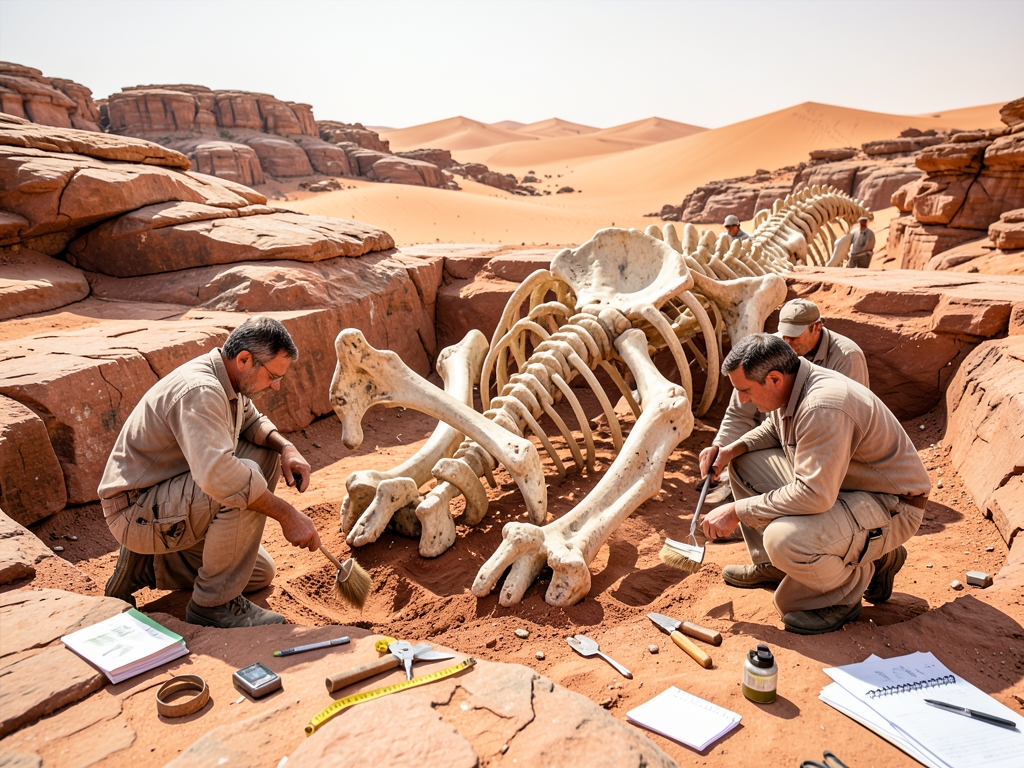
Paleontological expeditions into some of the most remote and inhospitable regions of the world continue to rewrite our understanding of prehistoric life on Earth. Recent scientific discoveries from deep within the vast expanses of the Sahara Desert have unveiled a previously unknown dinosaur species, shedding new light on the Cretaceous period and the diverse ecosystems that once flourished in regions now dominated by hyper-arid sand and rock. This groundbreaking discovery offers researchers critical insights into how ancient fauna adapted, competed, and evolved in environments that bore little resemblance to the modern desert landscape.
The Geological and Historical Context of Saharan Paleontology
The Sahara Desert is well known to modern science as one of the harshest environments on the planet. However, millions of years ago during the Mesozoic Era, this same geographic region was a lush, dynamic landscape characterized by sprawling river systems, dense vegetation, and abundant aquatic life. The presence of extensive sedimentary rock layers makes the Sahara an extraordinary archive of prehistoric biodiversity, though the extreme climate and logistical challenges of conducting fieldwork in remote areas have historically limited deep exploration.
Over the past few decades, dedicated teams of international researchers and local specialists have braved blistering temperatures and shifting dunes to unearth fossilized remains that help fill massive gaps in the African fossil record. Unlike North America and Europe, where paleontology has centuries of institutional backing, the fossil beds of northern and central Africa remain largely underexplored. Every major expedition carries the potential to discover entirely new branches of the evolutionary tree, challenging long-held assumptions derived primarily from northern hemisphere fossil data.
The newly identified dinosaur species represents a significant milestone in this ongoing scientific narrative. Recovered from remote strata deep in the desert interior, the fossil specimens include remarkably well-preserved skeletal elements that allow anatomists and evolutionary biologists to reconstruct the creature's physical dimensions, locomotion, and ecological niche with a high degree of precision.
Anatomical Features and Evolutionary Significance
Detailed morphological analysis of the recovered bones reveals distinctive skeletal characteristics that clearly separate this new animal from any previously documented dinosaur family or genus. Researchers examining the vertebrae, limb bones, and cranial fragments have noted unique adaptations in bone density, muscle attachment sites, and joint structures. These anatomical traits suggest specialized survival strategies tailored to a competitive prehistoric environment shared with massive predatory theropods and varied herbivorous competitors.
Understanding the evolutionary lineage of this newly found species helps scientists map the continental drift and faunal interchange of the Cretaceous period. During this era, Africa was undergoing significant tectonic and climatic shifts, isolating certain populations while opening migration corridors for others. The unique physiological adaptations observed in the new Saharan fossil provide tangible evidence of how regional isolation and environmental pressures drove distinct evolutionary pathways in Gondwana.
| Research Parameter | Scientific Observation | Implication |
|---|---|---|
| Geographic Origin | Deep Sahara Desert strata | Expands knowledge of African Cretaceous ecosystems |
| Fossil Preservation | Vertebrae and limb fragments | Allows accurate anatomical and biomechanical reconstruction |
| Evolutionary Status | Previously unrecognized genus | Adds a unique branch to the regional dinosaur family tree |
| Environmental Context | Ancient riverine and floodplain deposits | Demonstrates prehistoric adaptation to dynamic habitats |
Methodologies Used in Modern Paleontological Excavations
Unearthing and analyzing fossils from extreme environments requires a sophisticated blend of traditional fieldwork techniques and cutting-edge laboratory technology. When researchers locate promising bone fragments eroding from desert sandstone, the extraction process must be executed with extreme care to prevent the fragile fossil material from crumbling upon exposure to the dry air and drastic temperature fluctuations.
Info! Field teams routinely encase delicate fossil blocks in protective plaster jackets reinforced with burlap before transporting them across hundreds of miles of rugged terrain to partner research institutions.
Once the specimens arrive in the laboratory, modern imaging technologies play a transformative role. High-resolution computed tomography (CT) scanning allows paleontologists to peer inside dense rock matrix without damaging the underlying bone. Digital 3D models generated from these scans enable researchers around the globe to collaborate, share precise anatomical data, and run biomechanical simulations to test hypotheses about how the dinosaur moved, fed, and interacted with its environment.
Broader Implications for Global Biodiversity Studies
Discoveries of this magnitude extend far beyond the excitement of naming a new prehistoric creature. They serve as vital empirical data points for macroevolutionary studies, helping scientists understand how life responds to long-term environmental change, shifting climate patterns, and ecological fragmentation. By examining how prehistoric species managed resource scarcity and interspecies competition millions of years ago, modern ecologists gain a deeper perspective on deep-time ecological dynamics.
Furthermore, these high-profile discoveries inspire the next generation of local scientists, students, and conservationists in African nations. Building local infrastructure, museums, and research facilities ensures that the rich paleontological heritage of the continent is studied, protected, and celebrated by the communities closest to the discovery sites.
Where exactly was the new dinosaur species discovered?
The discovery was made during deep-desert fieldwork in remote sedimentary rock strata located within the Sahara Desert, an area renowned for its rich Cretaceous-era fossil deposits.
How do scientists determine that a fossil belongs to a new species?
Paleontologists conduct rigorous comparative anatomical analyses, examining unique skeletal features, bone structures, and evolutionary markers that distinguish the specimen from all previously documented genera and species.
What technology is used to study delicate fossils without damaging them?
Researchers utilize high-resolution computed tomography (CT) scanning and advanced digital 3D modeling to peer inside surrounding rock matrices and analyze internal bone structures safely.
Why is studying African dinosaur fossils important for paleontology?
African fossil beds remain relatively underexplored compared to other regions, offering crucial evidence that helps fill major gaps in our understanding of southern hemisphere ecosystems and continental evolution during the Mesozoic Era.
Conclusion
The identification of a new dinosaur species deep within the Sahara Desert underscores the boundless capacity of modern scientific exploration to uncover the hidden chapters of Earth's history. As researchers continue to refine excavation techniques and leverage advanced analytical tools, the ancient landscapes of Africa will undoubtedly yield further revelations. These discoveries not only expand our taxonomic knowledge of the prehistoric world but also remind us of the dynamic, ever-changing nature of life and climate across deep geological time.
