

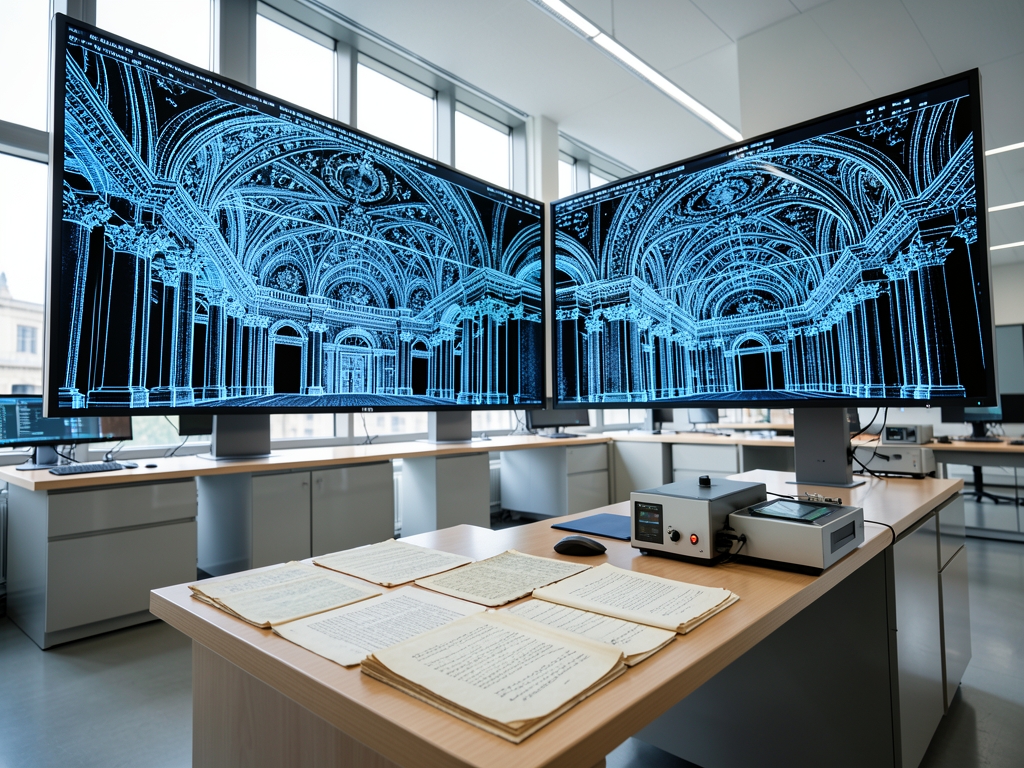
For centuries, the physical fabric of St. Peter’s Basilica has stood as a monumental testament to human engineering, artistic genius, and religious history. Spanning generations of master architects including Michelangelo, Bramante, and Bernini, the basilica houses countless treasures, intricate mosaics, and vast underground archives that chronicle the evolution of Western art and faith. However, studying these priceless artifacts has historically required physical presence, granting access to only a privileged few scholars and researchers. Today, a groundbreaking technological initiative is transforming how humanity interacts with this sacred space by introducing a fully realized digital twin equipped with an integrated memory of art and historical documentation.
The Genesis of the St. Peter's Basilica Digital Twin Project
The creation of a digital twin for one of the world's most visited and historically significant architectural wonders is no small feat. Initiated through advanced photogrammetry, laser scanning, and high-resolution imaging technologies, the project captures every millimeter of the basilica's expansive interior and exterior surfaces. Millions of data points were gathered to map the complex geometry of the dome, the delicate curvatures of marble sculptures, and the microscopic details of centuries-old oil paintings and mosaic tiles.
Beyond capturing the physical architecture, the project's true innovation lies in its digital memory. Archival records, handwritten papal decrees, architectural blueprints, and centuries of restoration notes have been meticulously digitized and linked directly to their physical locations within the 3D model. This integration bridges the gap between physical preservation and digital scholarship, allowing users to examine an artwork while simultaneously reviewing the original historical documents that detail its creation, patronage, and maintenance history.
By weaving together spatial 3D data and centuries of historical archives, the digital twin offers an unprecedented portal into the evolving life of St. Peter's Basilica, making global heritage accessible to every corner of the earth.
Unlocking Centuries of Art and Archival Research
For historians, art conservators, and researchers, the availability of a searchable, hyper-detailed digital counterpart represents a paradigm shift. Traditional archival research often involves navigating fragile paper manuscripts stored in climate-controlled vaults across Rome, requiring immense time and physical travel. The new digital platform brings these historical layers directly to desktop and mobile interfaces worldwide.
Researchers can now inspect brushwork on high-altitude frescoes that are virtually impossible to see clearly from the nave floor. By clicking on a specific sculpture or architectural element, users trigger contextual metadata pop-ups that reveal corresponding entries from the Vatican Apostolic Archive and related historical repositories. This seamless cross-referencing empowers scholars to track stylistic influences, identify material degradation over time, and reconstruct the economic and social history surrounding specific construction phases.
Technical Architecture and Precision Imaging
Achieving such high fidelity requires cutting-edge computational power and advanced data structuring. The underlying technology relies on dense point clouds generated by terrestrial laser scanners combined with drone-assisted aerial photography for the soaring dome structures. These data streams are processed into optimized 3D meshes capable of running smoothly in web browsers without sacrificing visual clarity.
Info! The digital twin project utilizes terabytes of spatial data, ensuring that even the most subtle surface imperfections and tool marks left by Renaissance stonemasons are preserved with sub-millimeter accuracy.
To manage the vast influx of historical documents, developers implemented robust semantic tagging and optical character recognition (OCR) systems capable of interpreting historic Latin, Italian, and Renaissance scripts. This ensures that archival documents are not merely stored as static images, but are fully searchable index items integrated into the spatial experience of the basilica.
Global Accessibility and Educational Impact
While academic research is a primary beneficiary, the public-facing aspects of the digital twin carry immense cultural value. Students, art enthusiasts, and the general public can explore restricted areas, examine hidden chapels, and access curated historical tours from anywhere in the world. Museums and educational institutions are already integrating these virtual environments into history and art history curricula, providing immersive learning experiences that surpass traditional textbook illustrations.
| Feature | Traditional Archive Access | St. Peter's Digital Twin Platform |
|---|---|---|
| Geographic Accessibility | Restricted to physical reading rooms in Rome | Global access via internet-connected devices |
| Document Integration | Physical separation between artwork and paper records | Direct spatial linking between 3D objects and manuscripts |
| Visual Detail | Limited by lighting, distance, and physical vantage points | Infinite zoom with high-resolution photogrammetric rendering |
| Preservation Impact | Handling risks physical wear and tear on fragile items | Zero physical contact required for daily study and exploration |
Preserving Heritage for Future Generations
As environmental pressures, climate fluctuations, and the sheer volume of physical visitors continue to pose challenges to historical monuments worldwide, digital preservation has evolved from a luxury into a necessity. The St. Peter's Basilica digital twin serves as a comprehensive baseline record, ensuring that even in the face of unforeseen future damage or natural degradation, the precise physical state and historical context of every artwork and stone are permanently secured.
Furthermore, ongoing updates to the platform mean that future archaeological discoveries, restoration findings, and newly cataloged documents can be continuously appended to the model. This dynamic approach guarantees that the digital archive remains a living, growing repository of knowledge rather than a static snapshot in time.
What is a digital twin in the context of St. Peter's Basilica?
A digital twin is a hyper-accurate 3D virtual replica of the basilica created using laser scanning and photogrammetry, integrated with centuries of digitized historical archives and artwork records.
Can the general public access the St. Peter's Basilica digital archive?
Yes, the platform is designed to serve both professional researchers and the general public, providing global web-based access to virtual tours and historical documentation.
How are historical documents linked to the 3D model?
Using advanced semantic tagging and spatial mapping, digitized manuscripts, blueprints, and restoration notes are anchored directly to their corresponding physical locations within the 3D environment.
What technology was used to capture the basilica's interior?
The project employs high-resolution terrestrial laser scanners, drone-assisted aerial imaging, and advanced photogrammetry to achieve sub-millimeter geometric accuracy.
Conclusion
The integration of a digital twin with a rich, centuries-old memory marks a monumental leap forward for cultural heritage preservation and historical scholarship. By dismantling physical barriers and uniting spatial precision with archival depth, this initiative ensures that the artistic and spiritual legacy of St. Peter's Basilica remains vibrant, searchable, and fully protected for generations of scholars and admirers to come.
