

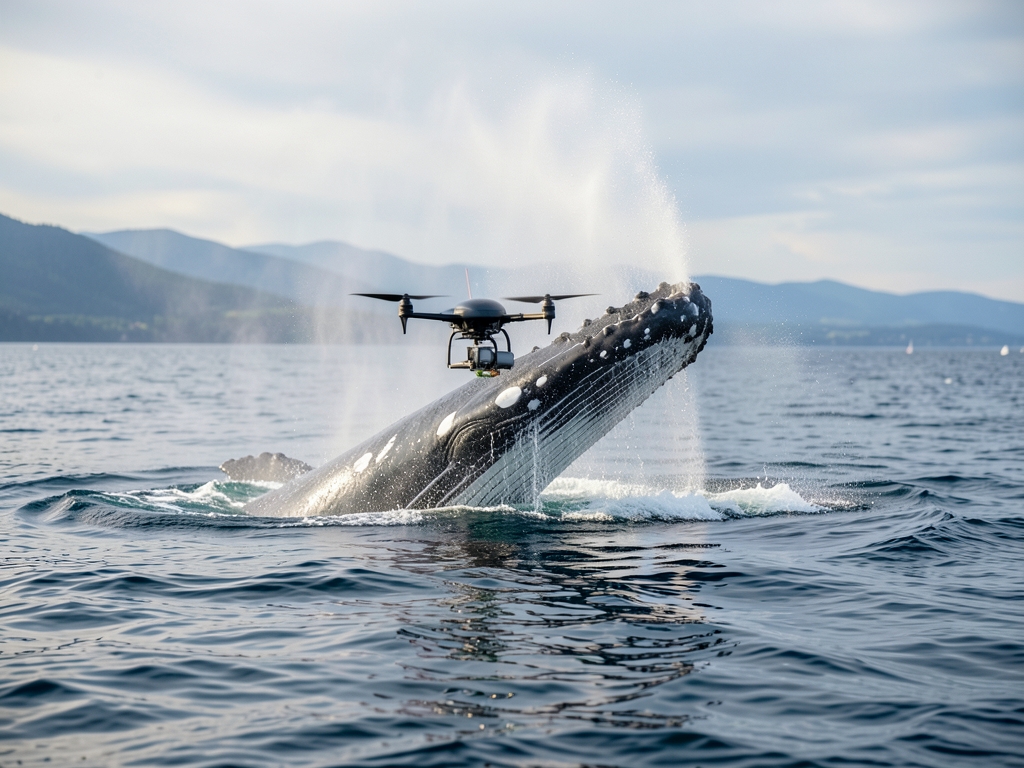
Marine conservation biology has reached a monumental milestone as researchers from the University of St Andrews successfully extracted and sequenced full humpback whale genomes using non-invasive aerial drones. Operating off the waters of British Columbia, Canada, the scientific team flew lightweight multirotor drones through the exhaled respiratory plumes—colloquially referred to as whale blow or snot—of wild humpback whales. Without touching a single animal or causing noticeable behavioral disruption, researchers captured high-quality cellular samples that yielded complete nuclear and mitochondrial DNA sequences. This technical breakthrough marks a major shift away from traditional, stress-inducing tissue biopsy methods and opens unprecedented opportunities for global marine mammal research.
The Shift to Non-Invasive Marine Mammal Research
For decades, gathering genetic data from free-swimming ocean giants required skin and blubber biopsy techniques. Marine biologists relied on crossbows or pneumatic rifles to fire hollow-tipped dart needles into the flanks of whales from nearby motor vessels. While generally safe, biopsy darting carries inherent drawbacks: it requires close boat approaches, inflicts minor localized wounds, triggers sudden startle responses, and risks introducing surface pathogens into exposed dermal layers. Furthermore, wary animals often alter their swimming trajectories or surface behavior, making repeated sampling across long-term ecological studies challenging.
The deployment of high-precision aerial robotics eliminates these physical stressors. Whales are completely unaware of lightweight drones flying several meters above their blowholes, enabling field researchers to collect essential biological matter during normal surfacing events. By capturing exhaled vapor composed of respiratory mucus, shed epithelial lining cells, and pulmonary surfactant droplets, scientists can extract high-fidelity biological material while preserving the natural state of marine ecosystems.
Engineering and Aerial Operations in Cold Coastal Waters
Executing precise flight maneuvers over open ocean waters off the Pacific Northwest requires specialized equipment and exceptional pilot navigation. The field operations off British Columbia demanded custom drone architectures capable of withstanding salt spray, high atmospheric humidity, and gusting ocean winds. Researchers outfitted compact multirotor platforms with hydrophobic collection surfaces—such as sterile petri dishes, specialized nylon membranes, or micro-trough arrays—attached directly to the frame.
When a targeted humpback whale surfaces to breathe, it discharges air at speeds exceeding 300 miles per hour through its blowhole, propelling a dense aerosol cloud up to 10 meters into the atmosphere. Operators maneuver the collection drone into position, hovering precisely within the apex of the misty spout just as it reaches maximum diffusion. As the aerosol passes over the drone's specialized surfaces, microscopic droplets adhere to the hydrophobic material. Once sampled, the drone returns to the research vessel, where technicians immediately freeze the mucosal samples to prevent enzymatic degradation of sensitive cellular nucleic acids.
| Parameters & Features | Traditional Skin Biopsy Darts | Aerial Drone Blow-Sampling |
|---|---|---|
| Physical Contact | Direct dart impact on dermal skin/blubber | Zero physical contact with the animal |
| Behavioral Impact | Startle reaction, rapid diving, avoidance | No measurable behavioral disruption |
| Genetic Material Yielded | Skin cells, blubber tissue, dermal collagen | Respiratory epithelial cells, mucosal DNA |
| Secondary Biological Data | Lipid profile, skin microbiome | Respiratory microbiome, lung pathogens |
| Sampling Risk Level | Moderate (potential wound infection) | Negligible (entirely non-invasive) |
From Exhaled Plumes to Whole Genome Sequencing
Historically, environmental DNA (eDNA) and breath samples contained far too little intact host DNA to perform deep, high-coverage genomic sequencing. Exhaled breath is overwhelmingly comprised of water vapor, seawater aerosols, airborne bacteria, and environmental debris. Extracting sufficient high-molecular-weight host DNA from microscopic cellular debris represented a formidable biochemical hurdle.
To overcome these limitations, the St Andrews team combined advanced micro-filtration methodologies with state-of-the-art long-read and short-read high-throughput sequencing platforms. Biologists separated the whale's respiratory epithelial cells from background marine microbes through targeted cell-sorting protocols. The resulting genetic yield was robust enough to reconstruct the entire nuclear genome of individual humpback whales alongside complete mitochondrial profiles.
Capturing high-depth genomic blueprints from exhaled breath confirms that non-invasive aerial sampling has matured from a simple diagnostic tool into a comprehensive genetic discovery platform for marine conservation.
Sequencing the full nuclear genome from snot spray allows geneticists to analyze complex trait architecture, monitor population diversity, assess inbreeding coefficients, and investigate evolutionary adaptation with accuracy equal to traditional muscle tissue biopsies.
Ecological and Conservation Implications for Ocean Giants
The ability to map whale genomes effortlessly across large populations provides vital insights for international ocean management. Humpback whales (Megaptera novaeangliae) undertake some of the longest seasonal migrations of any mammal, traveling between cold polar feeding grounds and warm tropical breeding sanctuaries. Despite population recoveries following global commercial whaling bans, these marine mammals face modern threats from commercial vessel strikes, entanglement in fishing gear, underwater noise pollution, ocean acidification, and climate-driven shifts in prey availability such as krill and forage fish.
Info! Non-contact genomic sequencing enables continuous monitoring of marine mammal health and population genetics without interrupting natural feeding or mating behaviors.
High-resolution genomic data collected through drone sampling unlocks multi-layered biological insights:
- Population Structure and Kinship: Biologists can reconstruct precise family trees within migratory pods, tracing matrilineal lineages and determining inter-population gene flow between distinct ocean basins.
- Health and Disease Profiling: Respiratory samples yield detailed profiles of the respiratory microbiome. Scientists can detect early markers of pulmonary infections, bacterial pathogens, or stress-induced hormonal changes before physical symptoms surface.
- Epigenetic Age Estimation: Genomic DNA extracted from respiratory cells contains epigenetic markers, such as DNA methylation patterns, allowing researchers to estimate the biological age of wild whales without relying on long-term historical photo-identification catalogs.
- Inbreeding and Adaptive Potential: Assessing global genetic diversity highlights vulnerable sub-populations that may suffer from low genetic variation, aiding international conservation bodies in tailoring localized protective measures.
Scalability and the Future of Wildlife Monitoring
The success of the University of St Andrews study sets a powerful precedent for wildlife research worldwide. By demonstrating that high-coverage whole-genome sequencing is achievable from delicate aerosol mist, this methodology can rapidly extend to other threatened cetacean species. Endangered North Atlantic right whales, elusive blue whales, deep-diving sperm whales, and coastal killer whales could all benefit from routine, stress-free genetic health audits.
Furthermore, integrating automated flight routines and real-time artificial intelligence object detection into drone hardware promises to make aerial sampling even more accessible for field teams. Autonomous research drones will soon be capable of identifying surfacing spouts, collecting breath samples, and returning to automated boat landing pads, multiplying the scale of data collection across remote ocean expanses.
How do drones collect DNA from humpback whales without touching them?
Drones fly directly through the cloud of mist exhaled from a humpback whale's blowhole. The mist contains biological droplets containing skin, lung cells, and mucus, which adhere to sterile collection plates attached to the drone's underside.
Why is whale snot genomics better than traditional dart biopsies?
Traditional biopsies require firing hollow-tipped darts into a whale's skin and blubber, which causes physical stress, potential wound infection, and behavioral disruption. Drone sampling is completely non-contact, allowing stress-free genomic sequencing without altering natural behaviors.
What genetic information can scientists extract from whale exhaled breath?
Researchers can sequence full nuclear genomes, mitochondrial DNA, assess genetic diversity, identify individual animals, trace lineage, determine sex, and analyze respiratory microbiomes to assess immune health and pathogen exposure.
Where was this drone sampling research conducted by St Andrews scientists?
The research team conducted field operations off the coast of British Columbia, Canada, tracking humpback whale populations as they navigated coastal feeding corridors.
A New Era for Marine Biology
The successful sequencing of humpback whale genomes from drone-collected respiratory vapor marks a transformative milestone in ecological research. By harmonizing robotics with advanced genomic sequencing, researchers at the University of St Andrews have proven that ocean giants can be studied in unprecedented detail without invasive contact. As non-invasive sampling platforms become standard global practice, marine scientists will gain critical insights into ocean wildlife health, population resilience, and species conservation, ensuring a healthier future for ocean ecosystems worldwide.
