

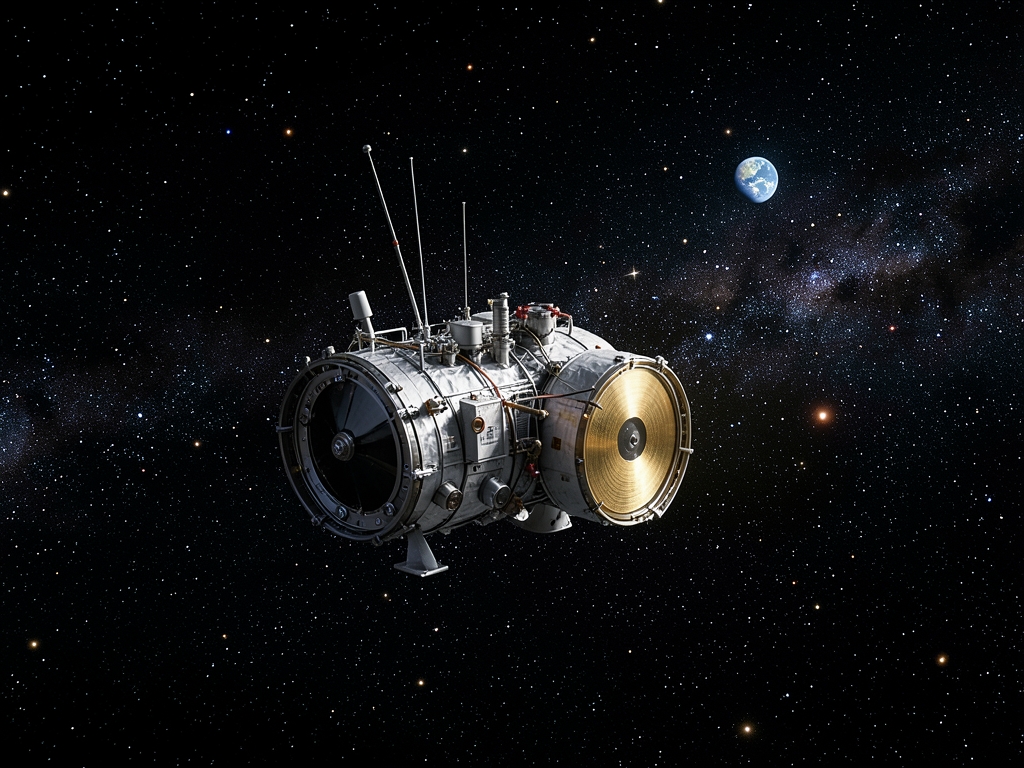
Few engineering achievements in human history match the astonishing endurance of NASA's Voyager 1 spacecraft. Launched nearly half a century ago, this iconic probe continues to push the absolute boundaries of human exploration, charting territory no manufactured object has ever traversed. Recently, NASA science updates highlighted a truly mind-bending milestone: Voyager 1 has officially reached a distance of one light-day away from Earth. To put this into perspective, radio signals traveling at the absolute speed of light now take a full twenty-four hours to bridge the gulf between our home planet and humanity's most distant ambassador. This achievement represents a profound leap in our species' operational reach across the cosmos, turning abstract astronomical scales into a tangible, measurable reality.
The Scale of Interstellar Space
Understanding what a light-day actually means requires shifting away from everyday terrestrial measurements and entering the realm of cosmic distances. Light travels through the vacuum of space at approximately 299,792 kilometers per second, or roughly 186,282 miles per second. In a single Earth day, light covers a staggering distance of about 25.9 billion kilometers, or roughly 16.1 billion miles. When Voyager 1 talks to Earth—transmitting telemetry, engineering data, and faint whispers of interstellar plasma measurements—its signals must cross this incomprehensible abyss.
Because the distance is so vast, a round-trip communication session with the spacecraft now takes nearly 48 hours. When mission controllers at the Jet Propulsion Laboratory send a command, they must wait an entire day for the instructions to reach the craft, and another full day to receive confirmation of execution. This extreme communication delay demands exceptional autonomy from the aging spacecraft and requires ground teams to plan maneuvers days or even weeks in advance.
Half a Century of Scientific Discovery
The journey of Voyager 1 began back in 1977, during an era of analog computing and foundational spaceflight engineering. Originally designed to take advantage of a rare planetary alignment to study Jupiter and Saturn, the twin Voyager spacecraft were only expected to remain operational for five years. However, the sheer robustness of their hardware, combined with the ingenuity of the engineering teams back on Earth, allowed both Voyager 1 and Voyager 2 to extend their missions into the outer solar system and eventually past the heliopause.
In August 2012, Voyager 1 officially crossed the heliopause, stepping outside the protective magnetic bubble of our Sun and entering the interstellar medium. Since that historic transition, the spacecraft has been sampling the ambient plasma density, magnetic field strength, and cosmic ray fluxes that originate from outside our solar system. These direct measurements provide scientists with unprecedented data regarding the structure of the local interstellar neighborhood and how our heliosphere interacts with the broader Milky Way galaxy.
Power Management at the Edge of the Solar System
Maintaining contact across a distance of one light-day is an extraordinary technical challenge, particularly given the spacecraft's dwindling power source. Voyager 1 is powered by three Radioisotope Thermoelectric Generators (RTGs), which generate electricity from the natural radioactive decay of plutonium-238. Over decades of operation, the output of these generators has steadily declined, forcing mission engineers to make difficult choices about which instruments to keep active.
To conserve energy, scientists have turned off several non-essential systems and heating elements over the years. Despite operating in temperatures that would freeze conventional electronics, critical science instruments and communication transmitters remain functional. Engineers have even utilized thruster lines that have been dormant for decades, employing brilliant software patches and hardware workarounds to keep the probe oriented correctly toward Earth so its high-gain antenna remains pointed precisely where it needs to be.
Info! Operating older space probes requires continuous innovation from ground engineering teams, who often consult original documentation and hand-written design notes from the 1970s to solve modern anomalies.
What the Data Tells Us About Interstellar Space
The scientific return from Voyager 1 has fundamentally reshaped our understanding of the space between stars. Before the Voyager missions, scientists could only theorize about the density and characteristics of the interstellar medium. Today, direct in-situ measurements reveal a surprisingly dynamic environment filled with galactic cosmic rays, ionized gas, and complex magnetic interactions.
The data sent back across one light-day of distance helps researchers map the shape of the heliosphere's boundary, offering clues about how our solar system moves through the Milky Way. These insights are crucial not only for planetary science and astrophysics but also for future deep-space exploration concepts, as they establish the baseline conditions any future interstellar probe would encounter.
The Ultimate Legacy of the Voyager Program
As Voyager 1 continues its lonely voyage into the dark, its physical journey is mirrored by its cultural legacy. Each spacecraft carries the famous Golden Record—a curated message from humanity containing sounds, music, spoken greetings in dozens of languages, and images designed to portray the diversity of life and culture on Earth. While the likelihood of an extraterrestrial civilization intercepting the probe is infinitesimally small, the record stands as a timeless poetic statement of human curiosity and optimism.
Reaching the one light-day mark serves as a powerful reminder of what human engineering and scientific collaboration can accomplish. Long after the spacecraft's power finally fades completely and its transmitters fall silent, Voyager 1 will continue its silent orbit around the center of the galaxy, carrying our scientific instruments and our artistic heritage far beyond the solar system that gave it birth.
How far away is Voyager 1 in miles and kilometers?
Voyager 1 is approximately one light-day away from Earth, which translates to roughly 16.1 billion miles or 25.9 billion kilometers.
How long does it take for a radio signal to reach Voyager 1?
Because the spacecraft is one light-day away, a one-way radio transmission takes 24 hours to reach the probe, making a complete round-trip communication session nearly 48 hours long.
What power source keeps Voyager 1 operational?
Voyager 1 is powered by Radioisotope Thermoelectric Generators (RTGs) that convert heat from the radioactive decay of plutonium-238 into electricity.
When did Voyager 1 enter interstellar space?
Voyager 1 officially crossed the heliopause and entered the interstellar medium in August 2012, becoming the first human-made object to leave the heliosphere.
The milestone of one light-day highlights both the fragility and the tenacity of human innovation. As Voyager 1 sails deeper into the unknown, it leaves behind an unmatched record of scientific achievement that will inspire generations of future explorers, engineers, and scientists across the globe.
