

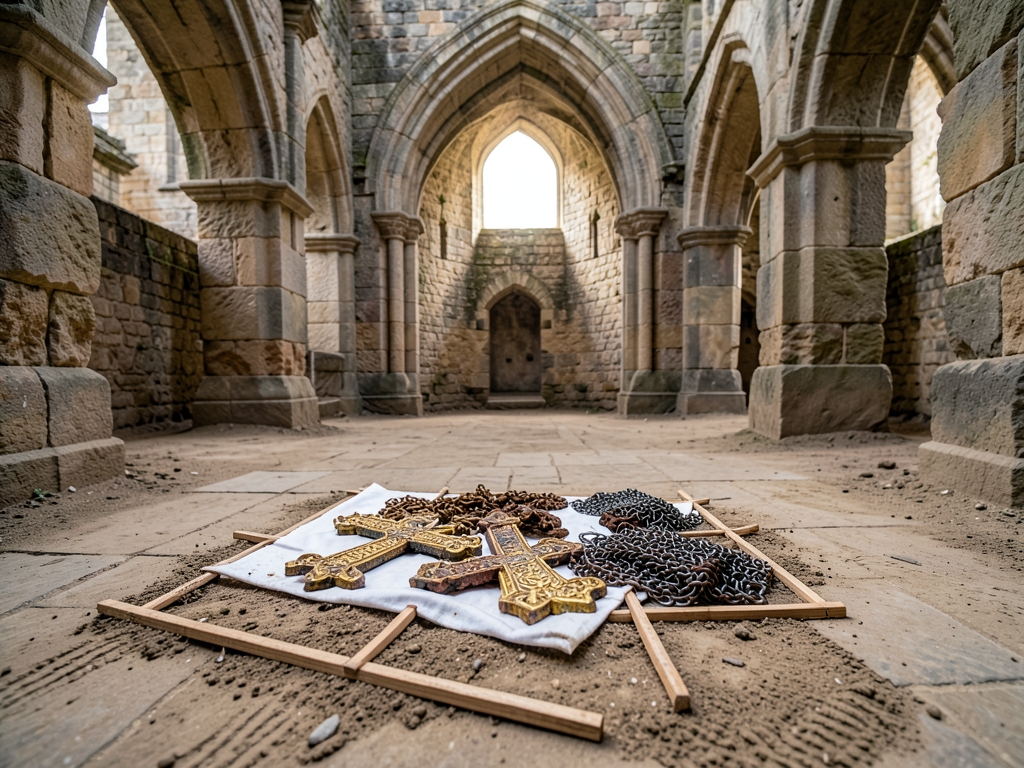
Archaeology often reveals its most profound secrets in the quietest corners of historic landscapes. Recent excavations at a medieval church site have brought to light a remarkable collection of artifacts, including an 800-year-old gilded cross and delicate fragments of ancient chainmail. These discoveries offer a tangible link to the turbulent and devout world of medieval Hungary, shedding new light on the religious architecture, military equipment, and daily rituals of communities that flourished centuries ago. As researchers continue to analyze the physical remains and material culture recovered from the site, historians gain a sharper understanding of how faith and conflict intertwined during the medieval period in Central Europe.
The uncovering of these ecclesiastical and military artifacts highlights the rich subterranean heritage preserved beneath rural and semi-urban landscapes across Hungary. Archaeological investigations of this scale require meticulous documentation, stratigraphic analysis, and multidisciplinary collaboration to ensure that fragile organic and metallic remains are preserved for future study. By examining the context of the find-spot within the broader layout of the medieval church, specialists can reconstruct not only the architectural evolution of the sacred space but also the social status and military responsibilities of the individuals associated with the site.
The Significance of the 800-Year-Old Gilded Cross
At the center of the recent discoveries is an exquisite gilded cross dating back approximately eight centuries. In medieval European society, objects crafted from precious metals or treated with gold leaf held immense symbolic and spiritual value. They served as focal points for personal devotion, liturgical celebration, and communal identity. The survival of such an object provides direct insight into the craftsmanship and artistic standards of medieval silversmiths operating within the Hungarian Kingdom during a period of significant political and cultural development.
Gilded objects from this era were typically manufactured using specialized techniques such as fire-gilding, where an amalgam of gold and mercury was applied to a base metal before heating. The durability of these coatings allowed sacred items to endure centuries of burial in varying soil conditions. Analyzing the elemental composition of the cross helps researchers identify the origin of the raw metals, potentially revealing long-distance trade networks that connected medieval Hungarian workshops with broader European economic centers.
Furthermore, the iconography and design elements present on the cross offer clues regarding the theological currents and stylistic influences circulating through Central Europe at the time. Whether commissioned by a wealthy ecclesiastical patron or donated by a local noble family, the cross reflects the deep piety and financial investment directed toward religious institutions during the thirteenth century.
Unearthing Chainmail Fragments: Evidence of Medieval Conflict and Protection
Alongside the gilded cross, archaeologists recovered corroded fragments of medieval chainmail. Chainmail, or mail armour, represents a crucial technological milestone in medieval defense. Comprising thousands of interlocking iron rings riveted or welded shut, this flexible form of protection shielded warriors against slashing and piercing weapons while maintaining mobility on the battlefield.
The presence of chainmail fragments within or immediately adjacent to a church site raises intriguing historical questions. Medieval churches frequently served as sanctuaries, administrative centers, and fortified strongholds during times of local feuds or foreign invasions. Nobles, knights, and armed retainers often maintained close ties with specific ecclesiastical foundations, sometimes seeking burial within consecrated church grounds while wearing or accompanied by their military gear.
Conservation scientists face unique challenges when stabilizing iron artifacts recovered from damp archaeological soils. Without prompt chemical stabilization, trapped chlorides can accelerate corrosion, destroying the delicate interlocking structure of the mail. Modern conservation laboratories utilize X-ray radiography and controlled environment storage to map the remaining metal core beneath layers of mineralized corrosion, allowing researchers to study manufacturing patterns such as alternating solid and riveted ring rows.
The Architecture and History of Medieval Hungarian Churches
To fully appreciate the context of these discoveries, one must examine the role of parish and monastic churches in medieval Hungary. Following the Christianization of the realm in the high medieval period, stone and timber churches spread rapidly across the landscape. These buildings were not merely spiritual shelters; they served as the focal points of community life, anchoring settlement patterns and marking territorial boundaries.
Many early medieval churches underwent successive phases of expansion, destruction, and rebuilding. Changes in architectural style—transitioning from austere Romanesque floor plans to soaring Gothic vaults—often mirrored shifting political alliances, economic prosperity, and ecclesiastical reforms. Archaeological excavations that expose earlier building phases beneath current floor levels allow researchers to map these transformations with remarkable precision.
| Artifact Category | Estimated Date | Historical Significance |
|---|---|---|
| Gilded Cross | Approx. 13th Century | Reflects high-status liturgical craftsmanship and medieval personal devotion. |
| Chainmail Fragments | 13th–14th Century | Provides evidence of military technology and armed presence near sacred sites. |
| Ceramic Sherds | Various Medieval Phases | Helps date stratigraphic layers and indicates domestic or ritual activity. |
| Architectural Stone Elements | Medieval Period | Illustrates structural modifications, masonry techniques, and stylistic evolution. |
Methodologies in Modern Medieval Archaeology
Modern archaeological investigations rely on advanced scientific techniques that extend far beyond traditional trowels and soil brushes. Non-invasive geophysical surveys, including ground-penetrating radar and magnetometry, are frequently deployed before excavation begins to map subsurface stone foundations, burial vaults, and ditch systems without disturbing the soil.
Once excavation commences, micromorphological analysis of soil samples helps reconstruct ancient environmental conditions, agricultural practices, and site formation processes. Isotopic analysis of human skeletal remains found within church cemeteries provides crucial data on the diet, geographic origins, and health status of medieval populations. When combined with material culture finds like the gilded cross and chainmail, these scientific methods paint a comprehensive picture of medieval life.
The integration of scientific analysis with traditional historical research transforms isolated artifact finds into vivid narratives about past human experiences, social structures, and cultural identities.
Info! Archaeological discoveries from medieval church sites are systematically documented and cataloged to ensure that national heritage collections are preserved for future academic research and public exhibition.
Preserving and Displaying Medieval Heritage
The discovery of significant artifacts places an immediate responsibility on conservation authorities and local museums to secure, restore, and interpret the finds for the public. Conservation protocols demand stable temperature and humidity conditions to prevent further degradation of organic and metallic materials. Once stabilized, these objects often form the centerpiece of specialized museum exhibitions that educate visitors about regional history.
Public engagement is an essential component of modern archaeology. Sharing excavation updates through academic publications, museum displays, and digital platforms fosters a deeper appreciation for cultural heritage. It encourages local communities to take an active role in protecting archaeological sites from unauthorized metal detecting and looting, which remain persistent threats to undisturbed historical strata.
What specific artifacts were recently unearthed at the medieval Hungarian church site?
Archaeologists recovered an 800-year-old gilded cross alongside delicate fragments of medieval chainmail and various architectural and ceramic remains.
Why is the discovery of chainmail near a church significant?
The presence of chainmail indicates the close association between armed elites and sacred spaces, as medieval churches frequently served as fortified sanctuaries or burial sites for knights and nobles.
How do conservation scientists protect metal artifacts after excavation?
Conservation specialists use X-ray radiography, chemical stabilization to remove harmful chlorides, and controlled environment storage to halt corrosion processes.
What role did medieval Hungarian churches play beyond religious worship?
Beyond hosting religious services, medieval churches acted as community centers, administrative hubs, and defensive strongholds during periods of regional conflict.
Ultimately, the unearthing of these medieval treasures reminds us of the complexity and depth of European history. Each artifact serves as a silent witness to the lives, beliefs, and struggles of people who walked the same landscapes centuries ago. Through rigorous scientific inquiry and careful preservation, these remnants of the past continue to enrich our understanding of human civilization.
