

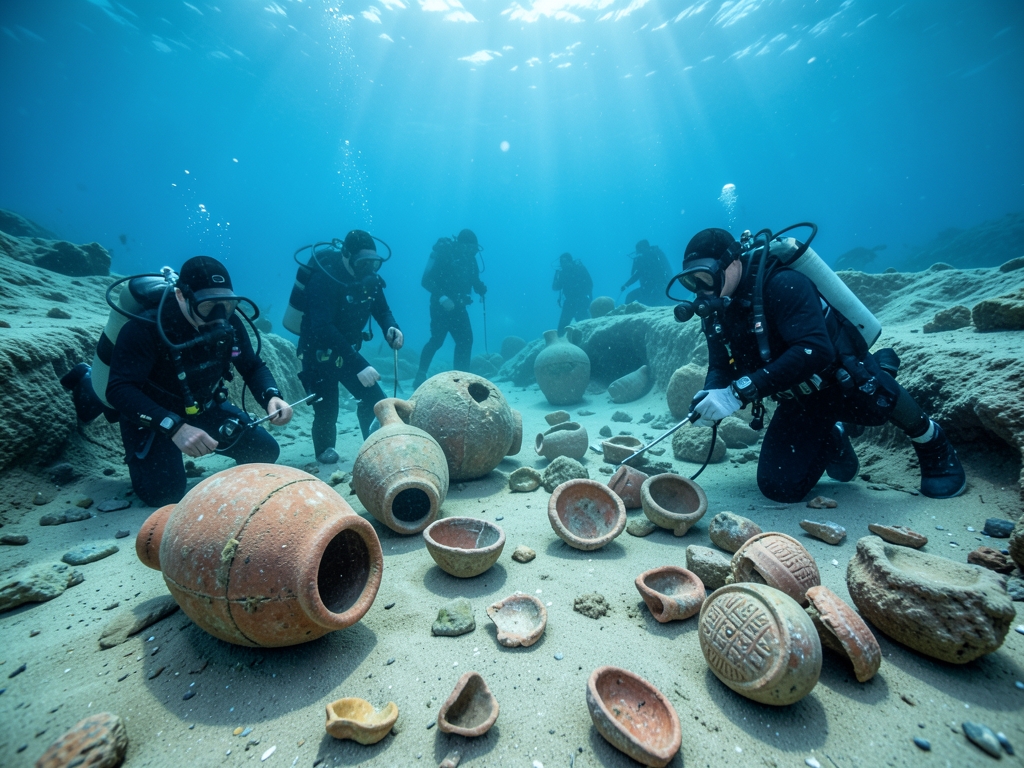
Maritime archaeology has long served as a key window into the economic engines of the ancient world, offering tangible evidence of how diverse civilizations interacted across vast expanses of water. Among the most compelling recent discoveries in underwater cultural heritage is the Adrasan Shipwreck, a site that has yielded extraordinary insights into Roman-era commerce. Through the recovery of 2,100-year-old pottery and various cargo remnants, researchers have been able to map out complex trade networks that once spanned the Mediterranean Sea. This remarkable find not only highlights the sophisticated seafaring capabilities of antiquity but also deepens our historical understanding of Mediterranean economic integration during the Hellenistic and early Roman periods.
The Mediterranean has always been a bustling highway of cultural exchange, migration, and commercial enterprise. Long before modern shipping lanes were established, ancient mariners navigated treacherous coastlines and open waters to transport precious commodities such as wine, olive oil, grain, and manufactured goods. Shipwrecks, preserved in the anaerobic and stable environments of the seabed, act as pristine time capsules of these voyages. When a vessel sank, its cargo was often frozen in time, providing modern historians and archaeologists with an unadulterated snapshot of commercial shipping manifests, manufacturing centers, and maritime trade routes.
The Discovery and Excavation of the Adrasan Shipwreck
The identification and subsequent exploration of the Adrasan Shipwreck represent a triumph of modern underwater archaeological methodology. Located off the coast of modern-day Turkey, the site presented significant challenges due to depth, currents, and the delicate nature of submerged artifacts. Marine archaeologists employing advanced acoustic mapping, remote-operated vehicles, and meticulous diving protocols managed to chart the debris field with unprecedented accuracy. The scattered remains of the hull, combined with dense concentrations of ceramic vessels, immediately signaled to researchers that they had encountered a commercial merchant vessel of substantial capacity.
Excavating an ancient shipwreck requires immense patience and precision. Every artifact recovered from the Adrasan site underwent a rigorous cataloging process designed to record its exact spatial coordinates within the debris field. This spatial data is critical for reconstructing how the ship was loaded, how the cargo shifted during its final moments, and what type of vessel architecture was utilized by shipwrights over two millennia ago. The careful extraction of delicate organic and inorganic materials also demanded immediate conservation protocols to prevent rapid degradation upon exposure to air and modern atmospheric conditions.
Analyzing 2,100-Year-Old Pottery and Ceramic Cargo
At the heart of the Adrasan Shipwreck discovery is an extensive collection of ceramic artifacts, most notably amphorae dating back approximately 2,100 years. These storage jars were the workhorses of ancient Mediterranean trade, utilized for the bulk transport of liquids and semi-solids over thousands of nautical miles. By examining the clay composition, morphological characteristics, and stamp markings on these vessels, ceramic specialists can trace the origin of the pottery to specific production centers around the Mediterranean basin.
The analysis of the Adrasan pottery reveals fascinating details about the commercial reach of the merchants operating the vessel. Petrographic analysis and chemical testing of the ceramic fabrics help researchers determine whether the jars originated from Aegean workshops, Levantine ports, or Italian kilns. Such data allows historians to reconstruct multi-stop trade itineraries, demonstrating that ancient merchant ships rarely traveled directly from a single origin to a single destination; instead, they often engaged in cabotage—trading along coastal routes and stopping at multiple ports of call to load and unload diverse cargoes.
| Artifact Type | Estimated Date | Primary Material | Likely Function |
|---|---|---|---|
| Amphorae | Approx. 2,100 Years Ago | Terracotta / Clay | Transport of Wine and Oil |
| Fine Ware Tableware | Hellenistic / Roman Transition | Slit-Coated Ceramic | Personal Dining and Service |
| Cooking Vessels | Circa 1st Century BCE | Coarseware Clay | Shipboard Food Preparation |
| Anchor Stocks | Hellenistic Period | Lead and Wood | Vessel Stabilization and Mooring |
Economic Integration and Roman-Era Trade Networks
The chronological placement of the Adrasan Shipwreck places it squarely within a transformative period of Mediterranean history, characterized by the gradual expansion of Roman hegemony and the unification of diverse regional economies under a single political administration. As the Roman Republic extended its influence across the eastern Mediterranean, trade routes experienced both standardization and increased security. The protection of shipping lanes from piracy allowed merchants to invest in larger vessels and undertake more ambitious commercial ventures.
The cargo carried by the Adrasan vessel reflects this burgeoning economic integration. The presence of standardized amphora types indicates the emergence of mass-production capabilities in pottery workshops, designed to meet the demands of growing urban centers throughout the Mediterranean. Furthermore, the distribution of these goods underscores the interconnected nature of ancient societies, where a disruption in agricultural production or pottery manufacturing in one region could have immediate economic ripples across distant coastal markets.
Info! The study of ancient shipwrecks provides direct physical evidence that often corrects or complements surviving textual records written by ancient historians, which were frequently biased toward political and military events rather than everyday commerce.
Technological Innovations in Ancient Shipbuilding
Beyond the economic insights provided by its cargo, the Adrasan Shipwreck offers valuable data regarding ancient naval architecture and shipbuilding techniques. During the Hellenistic and early Roman eras, shipbuilders transitioned from traditional shell-first construction methods toward more robust internal framing systems, though many ships of this specific era still relied heavily on sophisticated mortise-and-tenon joinery. This technique involved locking adjacent hull planks together with closely spaced tenons secured by dowels, creating a remarkably strong and watertight shell before internal ribs were fully inserted.
The structural remains found at Adrasan help naval historians understand how ancient shipwrights balanced hull flexibility with structural rigidity. Managing this balance was critical for withstanding heavy seas and the immense weight of dense ceramic cargoes. By analyzing wood samples recovered from the site, scientists can also identify the types of timber utilized—such as cedar, oak, or pine—shedding light on ancient forestry practices, timber trade, and regional resource management around the Mediterranean basin.
Preservation Challenges and Future Archaeological Research
Protecting underwater cultural heritage like the Adrasan Shipwreck presents ongoing challenges for international conservationists and maritime authorities. Submerged archaeological sites are vulnerable to various natural and anthropogenic threats, including coastal erosion, anchoring by modern commercial or recreational vessels, and unauthorized salvage operations by treasure hunters. Preserving these sites requires robust legal frameworks, continuous monitoring, and public education regarding the cultural value of intact archaeological deposits.
Future research campaigns at the Adrasan site aim to employ non-destructive underwater photogrammetry and 3D modeling to document every square meter of the debris field without disturbing fragile strata. By combining physical artifact recovery with advanced digital preservation techniques, researchers hope to secure a permanent, highly detailed digital archive of the shipwreck while continuing to analyze the physical objects in specialized conservation laboratories.
What makes the Adrasan Shipwreck significant for historians?
The Adrasan Shipwreck provides pristine physical evidence of Roman-era Mediterranean trade, featuring 2,100-year-old pottery and cargo that illuminate ancient commercial networks, manufacturing centers, and shipping logistics.
How do archaeologists determine the origin of ancient pottery found in shipwrecks?
Archaeologists utilize petrographic analysis, chemical testing of clay fabrics, morphological comparisons, and stamp markings to trace ceramic artifacts back to their specific production workshops and regional kilns.
What type of cargo was typically transported by merchant vessels during this period?
Merchant vessels of the Hellenistic and Roman eras commonly transported bulk commodities in terracotta amphorae, including wine, olive oil, fish sauce, grain, and various manufactured fine wares and raw materials.
What methods are used to protect underwater archaeological sites from damage?
Protection methods include establishing legal marine reserve boundaries, monitoring sites with remote surveillance, enforcing anti-anchoring regulations, and utilizing non-destructive 3D photogrammetry for digital documentation.
Conclusion
The discovery and ongoing study of the Adrasan Shipwreck stand as a testament to the enduring power of maritime archaeology to illuminate the past. By examining the 2,100-year-old pottery, structural timbers, and commercial cargo left behind on the Mediterranean seabed, researchers gain a clearer, more nuanced appreciation of how ancient societies forged economic and cultural connections across the ancient world. As new technologies continue to enhance underwater exploration and artifact preservation, sites like Adrasan will undoubtedly yield further revelations, ensuring that the remarkable stories of ancient mariners and traders continue to be told for generations to come.
