

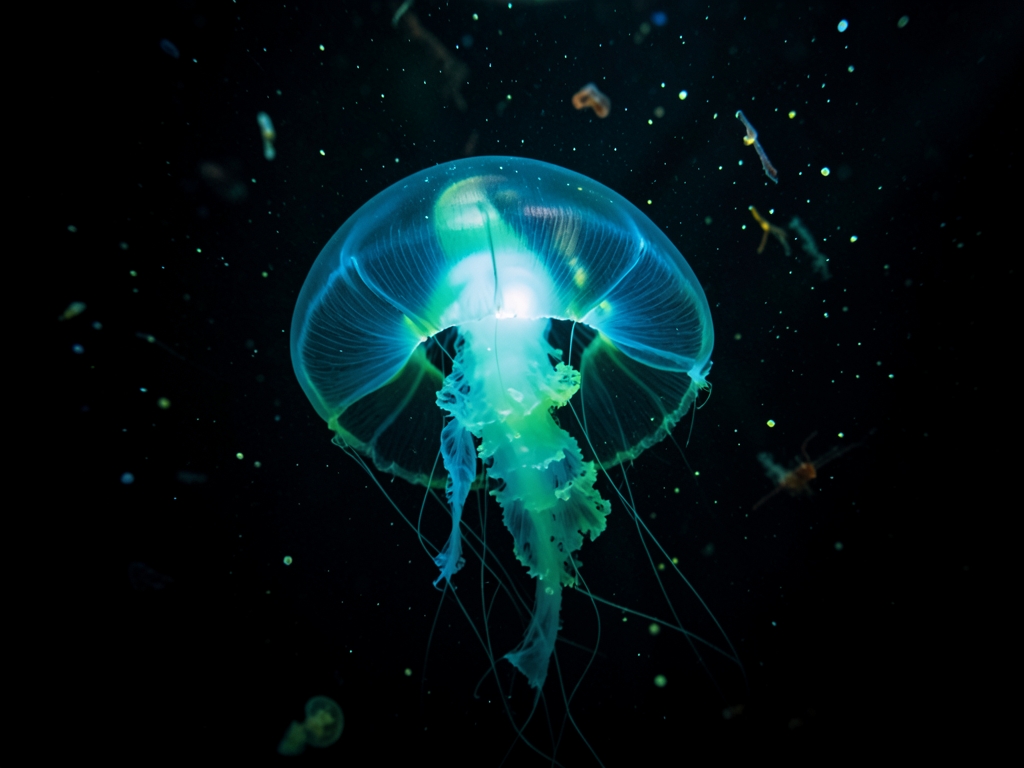
The deep ocean remains one of the least explored and most mysterious frontiers on Earth. Beneath the sunlit surface layers lies a vast, pitch-black realm where sunlight cannot penetrate. Yet, despite the perpetual darkness, this abyss is far from lifeless or invisible. Instead, it pulses with an ethereal, haunting glow produced by the organisms that call it home. This phenomenon, known as bioluminescence, represents one of the most fascinating evolutionary adaptations in the natural world. From microscopic dinoflagellates painting coastal waves with neon hues to deep-sea anglerfish luring prey with glowing appendages, living light is a cornerstone of marine survival.
Info! Bioluminescence is not limited to the ocean, but marine environments host the vast majority of bioluminescent species on Earth, ranging from bacteria and invertebrates to complex fish.
Understanding how and why marine organisms produce light requires an exploration of biochemistry, evolutionary biology, and oceanography. As researchers develop advanced submersibles and imaging technologies, our comprehension of this glowing underwater world continues to expand, revealing complex ecological interactions hidden beneath the waves.
The Evolutionary Origins and Distribution of Living Light
To fully appreciate the scope of marine bioluminescence, one must examine its evolutionary history. Unlike vision or echolocation, which evolved along distinct lineages, bioluminescence has evolved independently dozens of times across the tree of life. This evolutionary convergence suggests that the ability to produce light offers profound survival benefits in environments where darkness is absolute. From an evolutionary standpoint, the emergence of living light dates back hundreds of millions of years, adapting alongside the changing chemistry of ancient oceans.
Marine species display a remarkable diversity in how they acquire or produce this light. While many organisms synthesize the necessary chemical compounds internally, others rely on symbiotic relationships. For instance, many species of deep-sea fish and squids cultivate cultures of luminous bacteria within specialized organs called light organs or photophores. In exchange for a safe, nutrient-rich environment provided by the host animal, these microscopic bacterial partners continuously produce the glow. This intricate symbiosis highlights the interdependent nature of deep-sea ecosystems, where survival often depends on mutual cooperation.
Geographically and vertically, bioluminescence is distributed throughout the water column, but it reaches its peak density in the mesopelagic, or twilight zone, roughly 200 to 1,000 meters below the surface. In this intermediate layer, a faint trace of sunlight still filters down from above, creating a dynamic visual battleground where silhouette reduction and counter-illumination become matters of life and death. Deeper still, in the bathypelagic and abyssopelagic zones where complete blackness reigns, bioluminescence transitions from a tool of camouflage to a primary mechanism for hunting, escaping predators, and finding mates.
The Biochemical Mechanism Behind Living Light
At its core, bioluminescence is a form of chemiluminescence where chemical energy is converted directly into light energy with very little heat wasted as thermal radiation. The process relies on a chemical reaction involving a light-emitting molecule and an enzyme. While the exact chemical compounds vary significantly across different taxonomic groups, the fundamental components generally remain consistent.
The primary actors in this natural reaction are a substrate called luciferin and an enzyme called luciferase. When luciferase catalyzes the oxidation of luciferin, the reaction produces an excited state intermediate. As this molecule returns to its ground state, it releases energy in the form of a photon of visible light. In many marine organisms, another protein called a photoprotein is involved, which requires calcium ions or other triggers to initiate the reaction.
Interestingly, the color of the emitted light is closely tied to the physics of seawater. Red light is absorbed very quickly in the water column, usually within the first few meters, making it largely invisible in the deep sea. Blue and green wavelengths, however, travel the farthest through water. Consequently, the vast majority of bioluminescent marine organisms produce blue or blue-green light, as this is the most effective color for communication and visibility in their habitat.
Beyond luciferin and luciferase systems, researchers have discovered fascinating variations in how these chemical reactions are controlled. Some organisms maintain constant low-level glows, while others can flash brilliantly within milliseconds. This rapid-fire control is typically managed through nervous system impulses or hormone regulation, which either introduce oxygen to the reaction chamber or release cofactors necessary for the luciferase to interact with the luciferin substrate. Such precision allows animals to deploy light as a sudden flash to blind a predator or switch it off instantly to merge back into the oceanic background.
Ecological Functions of Marine Bioluminescence
Evolution does not invest energy into complex chemical processes without a purpose. The ability to produce light offers distinct evolutionary advantages, helping species survive in an environment characterized by extreme pressure, freezing temperatures, and scarce resources. Marine organisms utilize bioluminescence primarily for defense, predation, and communication.
Predatory Strategies and Lures
For many predators in the twilight zone and the abyss, finding food is an ongoing challenge. Some species have evolved active ways to attract prey using glowing lures. The most famous example is the female anglerfish, which features a modified dorsal fin spine tipped with a luminous bulb. Hanging directly in front of its cavernous mouth, this glowing lure attracts curious fish in the dark waters, bringing meals directly to the predator.
Other species use light to illuminate their surroundings. While most marine life is adapted to detect blue light, a small group of deep-sea fish, known as stoplight fishes, have evolved the unique ability to produce and detect red bioluminescence. Because their prey cannot see red light, these predators can effectively sweep the dark ocean with an invisible flashlight, locating unsuspecting meals without alerting them.
Additionally, some pelagic predators use bursts of light to disorient shoals of small fish or crustaceans, breaking apart tightly packed defensive formations and making individual targets easier to isolate and capture. This predatory versatility underscores how diverse selective pressures have shaped light production into numerous specialized hunting tools.
Defensive Mechanisms and Escapes
Conversely, prey species utilize bioluminescence to evade hungry predators. One common defensive tactic is the sudden release of a luminous cloud or slime. When threatened, certain species of deep-sea squid and shrimp discharge glowing secretions into the water. This dazzling display startles or temporarily blinds the attacker, creating a glowing decoy that distracts the predator while the prey escapes into the darkness.
Another fascinating defensive adaptation is counter-illumination. Many marine animals, particularly hatchetfishes and squids, possess light-producing organs called photophores on their undersides. By adjusting the intensity of the light emitted from these organs to match the faint downwelling sunlight from above, these animals eliminate their shadows. Viewed from below, they blend seamlessly into the background light, effectively rendering themselves invisible to predators lurking underneath.
In some gelatinous organisms like siphonophores and comb jellies, predation threats trigger a "burglar alarm" effect. When attacked by a small fish, these animals emit a bright, spreading glow that illuminates the attacker, making the small predator instantly vulnerable to larger, secondary predators swimming nearby. This clever evolutionary strategy turns the hunter into the hunted, deterring casual attacks.
Communication and Mating Signals
In the vast expanse of the open ocean, finding a mate can be extraordinarily difficult. Bioluminescence serves as a vital communication channel in the deep sea, allowing individuals to signal their species, sex, and readiness to reproduce. The flashing patterns and specific color hues are often unique to each species, preventing hybridization and ensuring that signals are received by the intended audience.
Ostracods, tiny marine crustaceans, are renowned for their intricate courtship displays. Males swim through the water column leaving glowing trails of light in specific temporal sequences, resembling underwater fireflies. Females observe these luminous choreography patterns and respond with their own flashes to guide the males closer.
Beyond courtship, intraspecific communication via bioluminescence can include signaling territorial boundaries, coordinating social grouping behaviors, or warning neighboring members of the same species about imminent environmental threats or approaching predators. The complexity of these light-based languages reveals a sophisticated level of social interaction operating entirely in the silent, dark layers of the ocean.
| Organism Type | Primary Mechanism | Main Purpose |
|---|---|---|
| Dinoflagellates | Mechanical shear stress triggering luciferin-luciferase reaction | Deterrence of grazers by attracting secondary predators |
| Anglerfish | Symbiotic luminous bacteria inside a specialized dermal appendage | Luring prey within striking distance |
| Deep-Sea Squid | Photophore glands emitting regulated chemical light | Counter-illumination camouflage and defensive distraction |
| Ostracods | Secreted chemical compounds released in rhythmic patterns | Species-specific mating signals and courtship |
Bioluminescent Bays and Coastal Phenomena
While deep-sea bioluminescence is hidden from daily human experience, coastal bioluminescence offers some of the most breathtaking spectacles on Earth. Certain bays and lagoons around the world, such as Mosquito Bay in Vieques, Puerto Rico, contain extraordinarily high concentrations of microscopic dinoflagellates, specifically *Pyrodinium bahamense*.
When these single-celled organisms are disturbed by movement—such as a paddle, a swimming fish, or breaking waves—they react mechanically by opening voltage-sensitive ion channels, initiating an electrical impulse that triggers the luciferin reaction inside the cell. The result is a brilliant, glowing blue shockwave that illuminates the water with every movement.
The persistence of these glowing bays depends entirely on specific geographic and ecological conditions. Enclosed mangrove lagoons provide a continuous supply of organic nutrients, such as vitamin B12, which dinoflagellates require to thrive, while simultaneously protecting the delicate populations from being washed away into the open ocean by strong currents. Conservation efforts in these regions are paramount, as even minor changes in water temperature, salinity, or pollution levels can trigger sudden population crashes, turning vibrant glowing waters into lifeless lagoons.
Warning! Coastal bioluminescent bays are fragile ecosystems. Chemical sunscreens, insect repellents, and heavy tourist traffic can disrupt the delicate balance of dinoflagellate populations, leading to a permanent decline in glow intensity.
Technological Challenges and Oceanographic Exploration
Studying bioluminescence in its natural habitat presents immense technical challenges. Traditional marine research involving nets often damages fragile gelatinous organisms that produce light, while bringing deep-sea creatures to the surface subjects them to lethal pressure and temperature changes. To overcome these hurdles, oceanographers and marine engineers rely on specialized instrumentation designed to capture the behavior of living organisms in situ.
Advanced remotely operated vehicles (ROVs) and autonomous underwater vehicles (AUVs) equipped with low-light cameras and hyperspectral sensors now allow scientists to record bioluminescent displays at depths exceeding several thousand meters without disrupting the environment. Furthermore, specialized laboratory chambers known as hyperbaric aquaria enable researchers to maintain precise pressure and temperature conditions, granting them a rare window into the physiological control mechanisms of deep-sea fauna.
Collaboration between engineers and biologists has also led to the development of bio-inspired optics and sensitive photon-counting detectors. These instruments not only help map the distribution of bioluminescent species across different ocean basins but also provide critical baseline data for assessing how climate change, ocean acidification, and deep-sea mining might impact these light-dependent ecosystems in the future.
Human Applications and Scientific Research
Beyond its natural beauty, bioluminescence has become an invaluable tool in scientific research and medicine. The discovery of Green Fluorescent Protein (GFP) from the jellyfish *Aequorea victoria* revolutionized cellular biology. Scientists can attach GFP genes to other proteins within cells, allowing them to track biological processes, monitor gene expression, and observe the progression of diseases such as cancer in real time under a microscope.
Furthermore, luciferase reporter assays are widely used in drug discovery and genetic research to test the efficacy of new medications and monitor molecular interactions. As biotechnology advances, researchers continue to explore sustainable applications, such as using bioluminescent plants and street trees to reduce urban lighting energy consumption.
In environmental science, bioluminescent bacteria are frequently utilized as living biosensors to detect toxicity in water and soil samples. Because these organisms dim or cease light production when exposed to heavy metals, pesticides, or industrial pollutants, they provide a rapid, highly sensitive indicator of environmental contamination, helping regulatory agencies monitor water safety with high precision.
What causes bioluminescence in the ocean?
Bioluminescence is caused by a chemical reaction involving a light-emitting molecule called luciferin and an enzyme called luciferase. When mixed with oxygen, the reaction releases energy in the form of visible light, usually blue or green.
Why do most deep-sea organisms emit blue or green light?
Blue and green wavelengths of light travel the furthest through seawater. Other colors like red and yellow are absorbed rapidly within the top layers of the ocean, making blue and green the most effective for visibility and communication in the deep sea.
Are bioluminescent bays safe to swim in?
In many protected locations, swimming is regulated or prohibited to protect the delicate dinoflagellate microorganisms from chemical pollutants like sunscreens and bug sprays, which can permanently damage the ecosystem.
How is bioluminescence used in modern medicine?
Bioluminescence and derived proteins like GFP are widely used in modern medicine and cellular biology to tag proteins, track cellular processes, monitor gene expression, and observe disease progression such as cancer growth under a microscope.
The study of living light bridges multiple scientific disciplines, offering profound insights into evolutionary biology, ecological conservation, and advanced biotechnology. As marine research progresses, the glowing depths of our oceans will undoubtedly reveal even more secrets of nature's most brilliant adaptation.
