

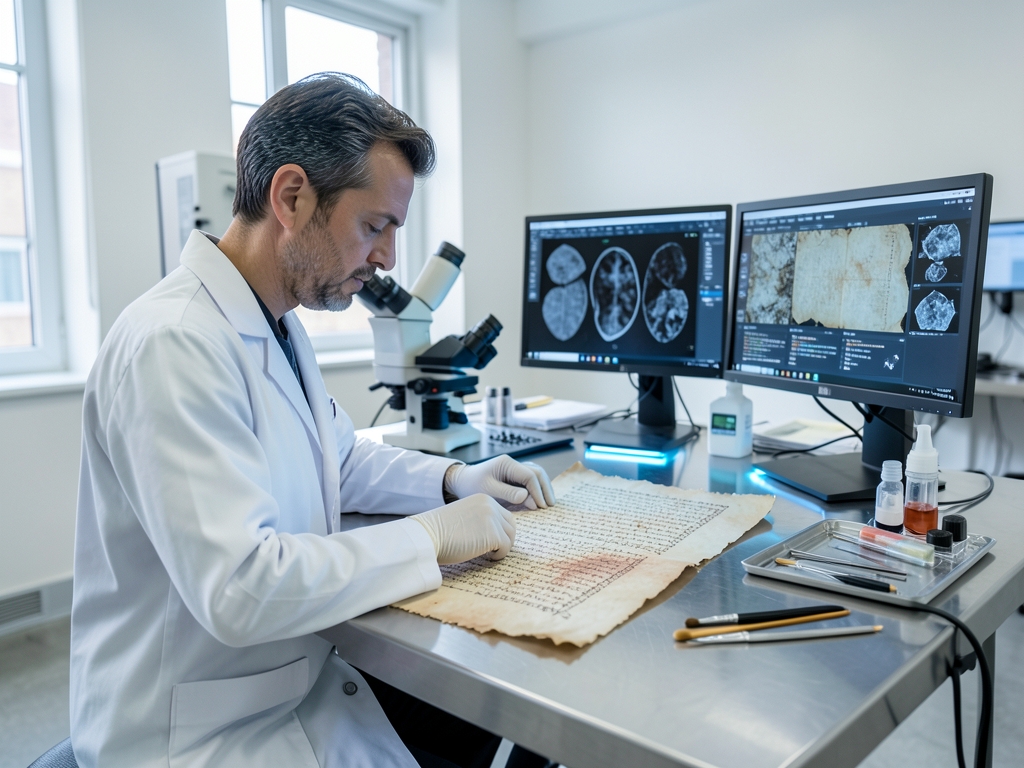
For centuries, the physical pages of medieval manuscripts have guarded secrets written deep within their fibers. Parchment, crafted from treated animal skins, was an expensive commodity during the Middle Ages. When scribes ran out of fresh writing material or when texts fell out of favor, monasteries and secular workshops frequently scraped away the original ink to reuse the valuable pages. These overwritten manuscripts, known to historians and bibliographers as palimpsests, have long presented a formidable puzzle. The erased text often remained invisible to the naked eye, frustrating generations of scholars eager to read the lost treatises, classical philosophies, and administrative records hidden beneath the surface.
Today, a quiet revolution is taking place in conservation laboratories, university archives, and specialized research centers across Europe and the United States. Advanced imaging technologies, non-destructive chemical analysis, and sophisticated computational processing are allowing historians to peel back the layers of time without causing a single microgram of physical damage to fragile historic documents. By harnessing the power of modern technology, paleographers and archival scientists are recovering texts that were deliberately concealed or accidentally faded away centuries ago, opening fresh windows into the political, cultural, and scientific landscapes of the medieval world.
The Evolution of Manuscript Recovery Techniques
The quest to read erased or damaged manuscripts spans more than two centuries, evolving from crude physical interventions to precise, non-invasive digital optical methods. In the eighteenth and nineteenth centuries, early antiquarians and scholars occasionally relied on chemical reagents to revive faded or scraped inks. Unfortunately, these aggressive chemical washes frequently left behind dark, corrosive stains that permanently degraded the parchment, rendering documents unreadable over the long term. Modern conservation ethics completely reject such destructive methods, prioritizing total preservation while pursuing maximum informational extraction.
The breakthrough in modern recovery arrived with the development of multispectral and hyperspectral imaging. Unlike standard photography, which captures only the visible spectrum of red, green, and blue light, multispectral systems illuminate documents using discrete narrow bands of light ranging from ultraviolet through the visible spectrum into the infrared. Different types of historical ink—whether iron gall, carbon-based, or plant-derived—interact with these specific light wavelengths in unique ways. By capturing dozens of separate images under varying illumination and processing the resulting data sets through advanced computer algorithms, researchers can mathematically isolate the chemical trace remnants of ancient ink from the surrounding parchment background.
Modern digital imaging does not merely replicate what the human eye can see; it penetrates the physical layers of history, making the invisible legible once more through precise optical mathematics.
Inside the Multispectral Laboratory Workflow
Recovering text from a heavily damaged or overwritten palimpsest requires a meticulous, multi-step scientific workflow. Archivists, conservationists, and computational specialists work hand in hand to ensure that every historical folio is handled with absolute care. The process relies heavily on controlled environments where temperature, humidity, and lighting are strictly regulated to protect fragile organic materials that have survived for upwards of a millennium.
To understand how modern institutions tackle these complex archival projects, consider the standard operational stages employed in leading research facilities:
- Physical Assessment and Condition Reporting: Conservators inspect the manuscript for structural vulnerabilities, tears, mold damage, or flaking pigment, ensuring the artifact can safely undergo digital scanning without physical stress.
- High-Resolution Multispectral Capture: The document is placed on a flat, calibrated stage beneath a specialized camera equipped with filter wheels or tunable light sources that systematically cycle through ultraviolet, visible, and infrared wavelengths.
- Data Calibration and Alignment: Specialized software aligns the dozens of individual spectral captures pixel by pixel to compensate for any micro-movements of the parchment during the capture sequence.
- Principal Component Analysis (PCA): Computational algorithms analyze the spectral differences across the image stack, separating the chemical signature of the erased undertext from the surface text and background discoloration.
- Paleographical Transcription: Historians and linguists examine the newly enhanced digital renders to transcribe the recovered letters, reconstruct damaged syntax, and contextualize the historical significance of the newly readable text.
Uncovering Lost Classical Texts and Administrative Records
The application of advanced digital imaging has yielded astonishing discoveries across numerous international collections. In many instances, palimpsests preserved fragments of ancient Greek and Roman literature that would have otherwise vanished entirely from the historical record. Because medieval scribes often recycled pagan philosophical treatises, legal codes, and scientific observations to create theological service books, modern imaging has frequently rescued lost works by authors such as Galen, Cicero, and Archimedes.
Beyond classical literature, digitized archives are illuminating the everyday administrative realities of medieval society. Tax rolls, trade agreements, ecclesiastical correspondence, and local court records frequently ended up scraped and reused during periods of economic hardship or political upheaval. When researchers apply multispectral analysis to these utilitarian documents, they uncover the granular details of medieval trade networks, demographic shifts, land disputes, and social structures that official chronicles routinely ignored.
| Imaging Technology | Primary Wavelength Range | Best Application for Manuscripts |
|---|---|---|
| Ultraviolet Fluorescence | 315 nm – 400 nm | Detecting faint surface residues, mold damage, and erasures |
| Visible Spectrum | 400 nm – 700 nm | Standard archival documentation and general paleography |
| Near-Infrared Reflectance | 700 nm – 1000 nm | Penetrating surface grime and modern ink overhauls |
| Multispectral Stacking | 365 nm – 950 nm (Discrete Bands) | Isolating deeply erased undertext in complex palimpsests |
The Role of Artificial Intelligence in Paleography
As the volume of digitized historical data expands exponentially, researchers face a new bottleneck: the sheer time required for human paleographers to read and transcribe thousands of newly revealed folios. This is where artificial intelligence and machine learning are beginning to play a transformative role in historical research. Computer vision models trained on thousands of verified medieval letterforms can now assist in recognizing degraded characters, predicting missing words based on historical linguistic patterns, and automatically indexing large collections of manuscript data.
Neural networks are particularly adept at handling script variations that present immense challenges to human readers, such as heavily stylized cursive hands, abbreviated legal Latin, and regional scribal idiosyncrasies. While AI does not replace the critical contextual judgment of trained historians, it acts as an extraordinarily powerful force multiplier, dramatically accelerating the transcription process and allowing scholars to explore vast corpuses of previously impenetrable texts.
Info! Researchers must continually train AI models on diverse regional scripts to prevent algorithmic bias and misinterpretation of unusual medieval abbreviations.
Global Collaboration and Open-Access Archives
The democratization of historical research is another profound consequence of the digital turn in manuscript studies. In the past, studying rare palimpsests required securing expensive travel grants, obtaining rare institutional access permissions, and handling fragile physical originals under restrictive supervision. Today, international digital humanities initiatives routinely upload high-resolution multispectral image sets to open-access online repositories.
This global accessibility fosters unprecedented collaboration across geographic and disciplinary boundaries. A paleographer in Rome, a computer scientist in California, and a linguist in London can simultaneously examine the same digital folio, sharing annotations and hypotheses in real time. Such collaborative frameworks ensure that the stewardship of human cultural heritage is shared globally, transforming isolated archival holdings into vibrant, interconnected nodes of international scholarship.
What is a palimpsest in historical manuscript studies?
A palimpsest is a manuscript page—typically made of parchment—from which the original text has been scraped or washed away so the material could be reused for a new writing project. Modern imaging techniques allow historians to recover the erased underlying text.
How does multispectral imaging reveal hidden text?
Multispectral imaging illuminates documents using specific, narrow bands of light ranging from ultraviolet to infrared. Because different inks interact uniquely with various wavelengths, specialized computer processing can separate the chemical traces of erased ink from the parchment background.
Why did medieval scribes reuse parchment pages?
Parchment, made from treated animal skins, was extremely labor-intensive and costly to produce. When writing materials were scarce or when older texts became obsolete or damaged, workshops scraped the pages clean to economize.
Are historical documents damaged during digital scanning?
No. Modern multispectral and hyperspectral imaging methods are completely non-destructive, requiring only controlled lighting and high-precision digital cameras without applying any physical or chemical agents to the fragile artifacts.
Conclusion
The intersection of historical inquiry and modern optical technology has fundamentally transformed our relationship with the written past. By recovering lost texts from damaged palimpsests and faded folios, contemporary researchers are bridging gaps in human knowledge that once seemed permanent. As imaging hardware grows more precise and artificial intelligence tools become more sophisticated, the hidden voices of medieval scribes, scholars, and ordinary citizens will continue to emerge from the shadows, ensuring that our shared cultural heritage remains vibrant, accessible, and continuously illuminated for future generations.
