

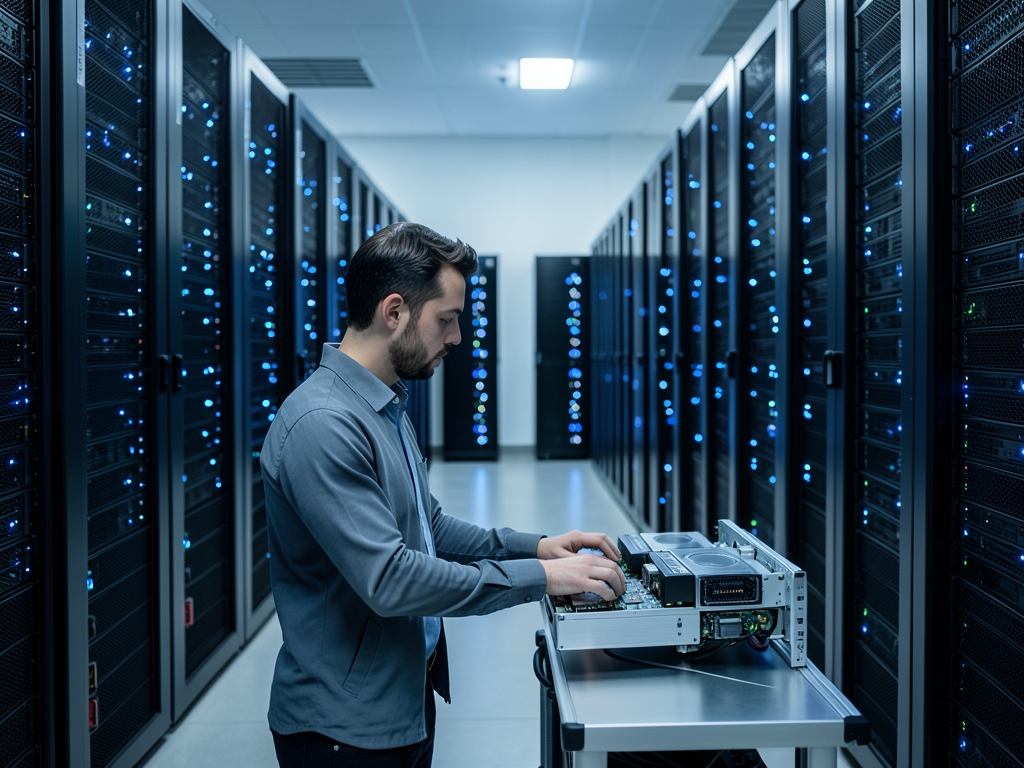
The landscape of enterprise artificial intelligence infrastructure is undergoing a fundamental transformation as cloud service providers and hardware pioneers forge new integration pathways. A striking milestone in this evolution involves the deployment of Google Tensor Processing Units (TPUs) onto Oracle Cloud Infrastructure, anchored by an innovative split architecture designed to handle massive computational workloads. This development bridges two major ecosystems, offering enterprise organizations unprecedented flexibility when scaling complex machine learning models, training large language networks, and executing high-performance inference tasks at scale.
Understanding the Google TPU and Oracle Cloud Integration
For years, specialized artificial intelligence hardware has remained closely tied to proprietary cloud environments or localized on-premise data centers. The arrival of Google TPU technology on Oracle Cloud shatters these traditional boundaries. By combining Google's purpose-built silicon accelerators with Oracle's robust enterprise infrastructure, organizations gain access to alternative high-speed compute options that bypass typical hardware bottlenecks.
Google TPUs are custom-designed application-specific integrated circuits engineered specifically to accelerate neural network training and inference. Unlike general-purpose graphics processing units, TPUs feature high-bandwidth memory architectures and specialized matrix multiplication units designed to process massive datasets concurrently. Integrating these processors into Oracle's cloud ecosystem allows enterprise customers to run demanding workloads without migrating their core data repositories or altering established database workflows.
This cross-platform availability reflects a broader industry shift toward interoperability. As enterprise clients demand greater choice and cost efficiency, cloud providers are increasingly dismantling walled gardens to offer diverse hardware accelerators. The partnership between Oracle and Google demonstrates that high-performance enterprise AI no longer requires a monolithic hardware stack.
The Mechanics of Split Architecture in Enterprise Compute
At the heart of this new deployment lies a sophisticated split architecture designed to optimize data flow between storage systems, traditional CPU instances, and specialized TPU accelerators. Traditional cloud configurations often suffer from latency overheads when moving colossal datasets from distributed storage buckets to deep-learning accelerators. The split architecture addresses this challenge by decoupling control plane operations from high-speed data plane processing.
In this configuration, specialized routing layers manage data ingestion, preprocessing, and model parameter management across distributed nodes, while the TPU clusters focus entirely on intensive tensor calculations. This division of labor significantly reduces idle time for the hardware accelerators, ensuring that expensive silicon is utilized at maximum capacity throughout the training lifecycle.
| Architecture Component | Traditional Cloud Setup | New Split Architecture |
|---|---|---|
| Data Ingestion | Sequential processing via single pipeline | Parallelized multi-node routing layers |
| Compute Utilization | Frequent idle periods during data transfer | Continuous high-capacity TPU utilization |
| Scalability | Monolithic instance scaling limits | Independent scaling of control and compute planes |
| Integration Flexibility | Vendor-locked hardware environments | Multi-ecosystem hybrid cloud compatibility |
Furthermore, the split architecture enhances fault tolerance. If a localized networking bottleneck occurs during large-scale model training, the decoupled control plane can reroute data streams dynamically without crashing the entire training job. Such resilience is vital for enterprise clients managing multi-day or multi-week training runs for frontier-class artificial intelligence models.
Transforming Enterprise AI Workflows and Economics
Beyond technical specifications, the introduction of Google TPUs to Oracle Cloud alters the economic calculus of enterprise AI deployment. Hardware scarcity and high capital expenditure have historically restricted advanced machine learning initiatives to the wealthiest technology conglomerates. By expanding access to specialized accelerators through flexible cloud consumption models, mid-sized enterprises and regulated industries can now compete on equal footing.
Regulated sectors such as healthcare, finance, and government often rely heavily on Oracle databases and enterprise resource planning systems. Previously, adopting Google's advanced AI hardware necessitated complex data migration strategies that raised compliance and security concerns. The new integration allows these organizations to leverage advanced TPU compute while keeping sensitive data securely within established enterprise boundaries.
Info! Enterprises can now execute high-performance machine learning workflows directly adjacent to their core operational databases, minimizing data transfer fees and security vulnerabilities.
Operational efficiency is further amplified by advanced orchestration tools that automate resource allocation. Enterprises can spin up TPU clusters on-demand for intensive training phases and scale down to standard CPU instances during routine maintenance and inference monitoring, optimizing cloud expenditure.
Technical Considerations and Implementation Challenges
Deploying cross-platform AI infrastructure introduces unique technical considerations that engineering teams must navigate carefully. Software framework compatibility remains a primary factor. While major machine learning libraries such as TensorFlow and JAX offer native TPU support, migrating existing PyTorch models or custom CUDA-optimized codebases to TPU-backed environments may require refactoring.
Network bandwidth and latency also demand rigorous calibration. The split architecture mitigates many traditional bottlenecks, but high-speed interconnects between Oracle's data centers and Google's accelerator modules must maintain consistent performance thresholds to prevent data starvation. Enterprise architects should conduct thorough benchmarking with representative workloads before transitioning mission-critical production pipelines to the new environment.
Warning! Always verify framework version compatibility and memory constraints when migrating large language models or complex neural networks to new cloud-based accelerator architectures.
The Future of Multi-Cloud AI Infrastructure
The collaboration between Google and Oracle signals the maturation of multi-cloud strategies within the enterprise sector. As artificial intelligence models grow exponentially in size and complexity, no single cloud provider can monopolize every aspect of hardware design, software optimization, and data storage. Open architectures and strategic hardware partnerships represent the logical progression of enterprise computing.
Looking ahead, industry analysts anticipate further convergence between disparate cloud environments. Standardized interconnection protocols and modular hardware designs will likely allow enterprises to mix and match processors from multiple vendors within a single unified pipeline. This competitive dynamism will drive down costs, accelerate hardware innovation, and empower organizations to tailor their infrastructure precisely to their computational demands.
What makes the Google TPU integration on Oracle Cloud significant for enterprises?
This integration combines Google's high-performance AI accelerators with Oracle's robust enterprise infrastructure, allowing organizations to run advanced machine learning workloads without migrating core databases or facing vendor lock-in.
How does the new split architecture improve compute efficiency?
The split architecture decouples control plane operations from high-speed data processing. This division allows parallelized routing layers to feed data continuously, preventing idle periods on the TPU accelerators.
Are existing machine learning frameworks compatible with Google TPUs on Oracle Cloud?
Major frameworks like TensorFlow and JAX offer robust native TPU support. However, teams migrating custom codebases or PyTorch models should review compatibility and perform benchmarking to ensure optimal performance.
How does this deployment impact security and regulatory compliance?
Regulated industries can utilize high-powered AI compute while maintaining sensitive data securely within established Oracle enterprise storage boundaries, significantly reducing compliance risks associated with data migration.
Conclusion
The arrival of Google TPUs on Oracle Cloud, powered by an innovative split architecture, marks a pivotal moment for enterprise artificial intelligence. By dismantling traditional hardware barriers and optimizing data throughput, this integration provides organizations with the flexibility, scalability, and economic efficiency required to build next-generation machine learning systems. As multi-cloud strategies continue to evolve, such collaborative architectures will define the future of high-performance enterprise computing.
