

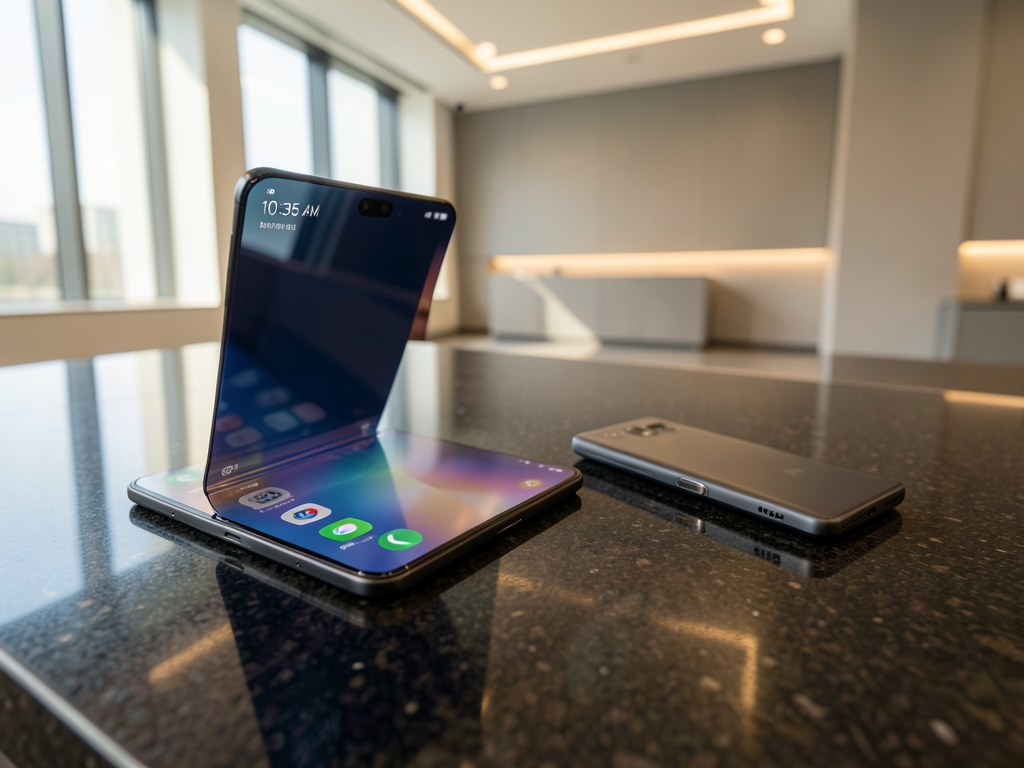
The smartphone industry has long grappled with a fundamental engineering paradox: how to deliver the expansive productivity and media real estate of a tablet without imposing the physical penalty of bulk, excessive weight, and pocket-stretching thickness. For years, early iterations of foldable phones were widely criticized for their hefty chassis, pronounced display creases, and awkward proportions when closed. However, the official arrival of ultra-thin foldable devices in international markets represents a major turning point in mobile engineering. By redefining internal component layouts, battery chemistries, and hinge mechanics, manufacturers are successfully bridging the gap between standard flagship candy-bar phones and next-generation foldable hardware.
Market analysts and tech enthusiasts across Europe and the United States have closely monitored these developments. The technical strategy behind achieving a profile thinner than many traditional single-screen flagships requires a radical overhaul of internal architecture. In this comprehensive technical review, we examine the structural innovations, display engineering, processor performance, and real-world usability considerations that define the current generation of ultra-thin foldables.
Engineering the Ultrathin Foldable Chassis
Achieving a closed thickness under ten millimeters in a foldable device requires eliminating wasted internal volume down to the fraction of a millimeter. Traditional hinge designs rely on complex multi-gear mechanisms that create a noticeable gap between the two screen halves when folded, letting dust in and increasing overall thickness. Modern engineering approaches replace these bulky assemblies with tighter, drop-shaped hinge structures fabricated from proprietary titanium alloys and aerospace-grade steel components.
This advanced metallurgy provides exceptional structural integrity while dramatically reducing weight. When the device closes, the flexible inner display forms a teardrop-shaped drop-loop inside the hinge cavity rather than folding sharply in half. This protects the delicate organic light-emitting diode layers from stress fatigue and virtually eliminates the visible crease that plagued earlier foldable generations. Furthermore, engineers have minimized the gap when closed, creating a uniform profile that slips easily into a pocket without awkward bulges.
Battery Chemistry and Thermal Management
One of the most difficult challenges in designing a super-thin foldable phone is housing a high-capacity battery without expanding the chassis. Standard lithium-ion cells require rigid rectangular housings that take up significant depth. To overcome this limitation, manufacturers have adopted silicon-carbon anode battery technology. These advanced cells offer significantly higher energy density compared to traditional graphite-based batteries, allowing for ultra-thin profile designs measuring barely two millimeters in depth while still storing substantial electrical charge.
Info! Silicon-carbon battery chemistry enables manufacturers to pack over 5,000 mAh of total capacity into a device profile previously thought impossible for dual-screen hardware.
Managing thermal output in such a confined space is equally critical. With powerful system-on-chip processors generating concentrated heat during intensive tasks like gaming or multi-window multitasking, efficient cooling is mandatory. Modern ultra-thin foldables employ vapor chamber cooling plates stamped from ultra-thin copper alloy, paired with high-conductivity graphite sheets distributed beneath both screen panels. This dual-zone thermal dissipation network spreads heat evenly across the entire chassis surface, preventing localized thermal throttling and maintaining steady peak performance during extended use.
Display Specifications and Ergonomics
The primary appeal of any foldable device lies in its dual-screen versatility. Users typically interact with an outer cover screen for quick messaging, notifications, and media playback, then unfold the device to reveal a tablet-sized inner canvas for immersive viewing, document editing, and split-screen multitasking.
| Display Feature | Cover Screen | Inner Foldable Screen |
|---|---|---|
| Panel Type | LTPO OLED | Foldable LTPO OLED |
| Refresh Rate | 1Hz - 120Hz Adaptive | 1Hz - 120Hz Adaptive |
| Peak Brightness | Up to 2,500 nits | Up to 1,600 nits |
| Protection | NanoCrystal Glass | Multi-Layer Impact Resistant Polymer |
The outer display adopts a standard, human-friendly aspect ratio rather than the unusually narrow, television-remote proportions seen on early foldable models. This ensures that typing on the virtual keyboard feels natural and familiar, eliminating the frequent input errors caused by cramped keys. Upon opening the device, the inner display opens into a nearly square workspace supported by dynamic refresh rate scaling. By dropping down to 1Hz during static reading tasks and scaling up to 120Hz during fast scrolling or gaming, the system preserves battery life without sacrificing visual fluidity.
Software Optimization and Multitasking Workflows
Hardware innovation alone cannot ensure a successful user experience; software integration is equally vital. Running modern mobile operating systems on dual-aspect-ratio displays requires dedicated interface layers that seamlessly transition applications as the user opens or closes the device. Multitasking features such as side-by-side app splitting, floating windows, and drag-and-drop file sharing transform the expanded canvas into a genuine productivity tool.
Warning! Not all third-party Android applications natively support dynamic aspect ratio scaling, which can occasionally result in letterboxing or stretched UI elements on the inner screen until developers push compatibility updates.
Optimized software frameworks allow users to run up to three active applications simultaneously on the inner screen while keeping a fourth app accessible in a floating window. This capability makes ultra-thin foldables increasingly popular among mobile professionals, content creators, and power users who require desktop-like workflow flexibility while traveling.
Practical Guidance for Prospective Buyers
Transitioning from a traditional smartphone to an ultra-thin foldable requires understanding both the capabilities and the physical maintenance requirements of advanced mobile hardware. While modern folding screens feature durable polymer protective layers and advanced scratch-resistant outer glass, they still demand more careful handling than rigid glass candy-bar phones.
- Evaluate your daily usage habits to determine whether you will genuinely utilize the expanded inner screen for productivity or media consumption.
- Inspect the hinge mechanism and check for smooth, uniform resistance throughout the entire opening and closing arc.
- Use only manufacturer-approved screen protectors, as applying generic aftermarket films to the inner foldable display can interfere with touch sensitivity and damage the delicate OLED panel.
- Invest in a protective case that offers hinge coverage if you work in dusty or demanding physical environments.
By following these practical steps, users can maximize the lifespan and daily reliability of their foldable investment while enjoying cutting-edge mobile technology.
How thin are modern ultra-thin foldable smartphones when closed?
Modern ultra-thin foldables measure under ten millimeters in thickness when closed, making them comparable in profile to traditional single-screen flagship smartphones.
What battery technology makes slim foldable designs possible?
Manufacturers utilize silicon-carbon anode battery chemistry, which delivers significantly higher energy density in an ultra-slim profile compared to traditional lithium-ion cells.
Are inner foldable screens vulnerable to scratches?
The inner flexible screen uses a multi-layer polymer structure that is softer than traditional rigid glass, meaning it requires careful handling and should never be cleaned with abrasive materials or sharp objects.
Can I use standard screen protectors on a foldable phone?
No, you should never apply third-party screen protectors to the inner folding display. Doing so can void your warranty, interfere with touch registration, and potentially damage the flexible OLED panel.
As manufacturing techniques continue to mature, the engineering barriers that once limited foldable adoption are steadily dissolving. With refined ergonomics, robust hinge durability, and high-capacity battery solutions, ultra-thin foldables have firmly established themselves as a premier choice for technology enthusiasts worldwide.
