

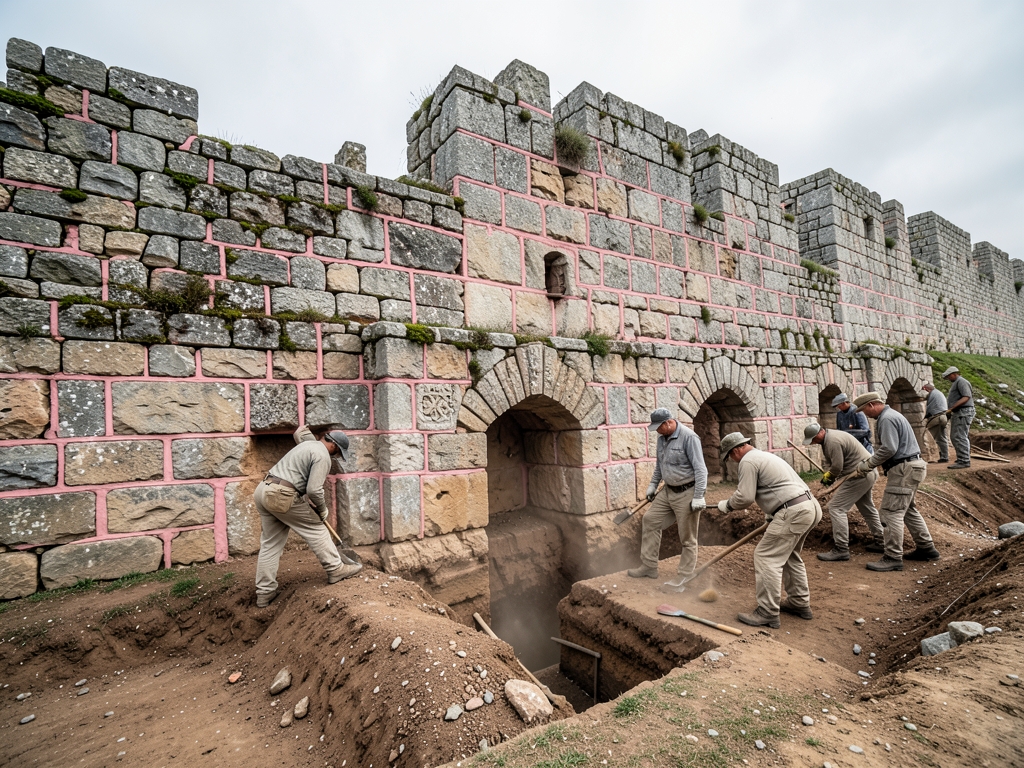
Archaeology often reveals its most profound secrets through the microscopic chemical composition of everyday building materials rather than just glittering gold and majestic statues. Recent archaeological excavations at a medieval fortress in Bulgaria have brought to light a remarkable architectural find: a monumental building constructed using an advanced and durable waterproof pink mortar. This discovery not only sheds light on the sophisticated engineering prowess of medieval builders in the region but also opens up new avenues of research into how historical civilizations mastered fluid dynamics, structural preservation, and material science long before modern industrial waterproofing compounds existed.
The study of medieval fortifications across Eastern Europe has traditionally focused on defensive walls, strategic positioning, and military tactics. However, the discovery of specialized hydraulic and waterproof mortars at this Bulgarian site offers an intimate look into the domestic and infrastructural priorities of medieval societies. By examining the precise mineral makeup of this pink mortar, researchers can reconstruct ancient trade networks, technological knowledge transfer, and the ingenious ways master masons adapted local geological resources to solve complex environmental challenges. This comprehensive exploration delves into the historical context of medieval Bulgarian architecture, the science behind ancient pink mortar, and what these enduring structures reveal about past civilizations.
The Historical Context of Medieval Bulgarian Fortresses
During the medieval period, the Balkan Peninsula was a fiercely contested geopolitical landscape characterized by shifting empires, dynamic trade routes, and constant military fortifications. Bulgarian medieval architecture evolved rapidly from simple timber-and-earth ramparts into sophisticated stone-and-mortar complexes capable of withstanding prolonged sieges and harsh environmental conditions. Fortresses served not merely as military garrisons but as administrative hubs, economic centers, and safe havens for local populations during times of invasion.
Master builders and architects of this era operated within a rich tradition of masonry that blended Byzantine engineering techniques with local Slavic and proto-Bulgarian building methods. These structures required exceptional durability. Walls had to resist both enemy battering rams and the relentless forces of weathering, freeze-thaw cycles, and water infiltration. The recent discovery of a monumental building featuring specialized waterproof mortar highlights the high degree of specialization within medieval construction guilds. Builders understood that moisture was the ultimate enemy of stone masonry, capable of fracturing foundations over decades if left unchecked.
The Science and Secrets of Waterproof Pink Mortar
What makes the newly discovered mortar at the Bulgarian fortress so fascinating to historians and materials scientists is its distinctive coloration and specialized hydraulic properties. In ancient and medieval architecture, standard mortar was typically made from a simple mixture of sand, lime, and water. However, structures exposed to moisture—such as cisterns, bathhouses, or buildings erected in damp terrain—demanded hydraulic mortars that could set and remain durable even in wet conditions.
The pink hue of the mortar is typically the result of adding crushed ceramic fragments, pottery shards, or specific local clays rich in iron oxides to the lime mix. This ancient technique, often referred to by modern conservationists as opus signinum or similar hydraulic lime variations, offered a dual advantage. First, the finely ground ceramics reacted chemically with the lime during the curing process, creating a dense, water-resistant matrix that prevented moisture from seeping through joints. Second, it drastically increased the compressive strength and longevity of the walls, allowing monumental buildings to endure for centuries with minimal structural degradation.
Analysis of similar medieval mortars across Europe demonstrates that builders possessed an empirical understanding of pozzolanic reactions. Even without modern chemical laboratories, these master craftsmen observed that certain volcanic ashes, crushed tiles, or specific sedimentary earths transformed soft lime mortar into a rock-hard shield against water. The presence of this pink mortar at a high-status monumental building within the Bulgarian fortress suggests that the structure served a critical function requiring superior water management, such as a large administrative hall, a palace wing, or a specialized water-storage infrastructure.
Comparative Analysis of Medieval Construction Techniques
To fully appreciate the significance of the Bulgarian discovery, it is helpful to place it within the broader context of medieval European and Byzantine engineering. The table below outlines key construction characteristics and mortar types utilized across various historical building traditions.
| Region / Culture | Primary Building Material | Mortar Type Used | Key Architectural Innovation |
|---|---|---|---|
| Medieval Bulgaria | Ashlar stone and rubble masonry | Hydraulic pink mortar (lime and crushed ceramics) | Superior moisture resistance and structural elasticity |
| Byzantine Empire | Brick and stone banding (opus mixtum) | Lime mortar mixed with crushed brick | Earthquake-resistant layered flexibility |
| Western European Gothic | Finely dressed limestone | High-purity lime mortar | Weight distribution via flying buttresses |
| Kievan Rus | Plinthite brick and fieldstone | Lime-charcoal mortar with brick dust | Decorative polychrome facades and waterproof cistern linings |
Engineering Resilience and Architectural Longevity
The survival of monumental medieval architecture into the twenty-first century is a testament to the foresight of historical builders. Modern civil engineers frequently study ancient mortars to develop sustainable, long-lasting building materials that can match the carbon-absorbing and self-healing properties of traditional lime mixtures. Unlike modern Portland cement, which can be rigid and prone to cracking under seismic stress, historic lime-based mortars possess a degree of flexibility that allows masonry walls to shift slightly without catastrophic failure.
Info! Analysis of historical hydraulic mortars provides modern architects with sustainable formulas that mimic ancient durability while reducing the carbon footprint of contemporary construction projects.
Furthermore, the discovery in Bulgaria emphasizes the importance of preserving archaeological strata during active excavations. Every trowel stroke through layers of sediment uncovers chemical signatures left behind by human hands nearly a thousand years ago. By combining traditional stratigraphic excavation with advanced spectroscopic and microscopic analysis, contemporary archaeologists can determine the exact provenance of the raw materials used, offering a vivid picture of regional quarrying, kiln operation, and supply chain logistics in medieval times.
Preserving and Interpreting Archaeological Heritage
Unearthing structures built with specialized waterproof mortar presents unique conservation challenges. Once exposed to modern atmospheric conditions, fluctuating humidity, and industrial pollution, ancient masonry can degrade rapidly if not properly stabilized. Conservation specialists must employ meticulous preservation strategies, utilizing compatible lime-based grouts and protective capping to shield fragile pink mortar joints from frost damage and biological growth.
Museums and heritage sites in Bulgaria and across the wider European continent increasingly rely on digital documentation, 3D laser scanning, and photogrammetry to record these architectural finds before environmental exposure alters their condition. These digital archives ensure that scholars worldwide can analyze the structural geometry and material composition of the fortress buildings, fostering international collaboration in medieval studies.
What caused the pink coloration in the medieval fortress mortar?
The pink hue was typically caused by mixing finely crushed ceramic shards, broken pottery, or iron-oxide-rich clays into the lime mortar, which also enhanced its water-resistant properties.
Why was waterproof mortar essential for medieval fortresses?
Waterproof mortar prevented moisture infiltration into foundational stone walls, protecting the structure from freeze-thaw cracking, structural weakening, and dampness over centuries.
How do modern engineers benefit from studying ancient mortars?
Modern engineers study historic mortars to develop sustainable, flexible, and self-healing building materials that reduce carbon emissions while matching the multi-century durability of ancient structures.
What archaeological techniques are used to preserve exposed medieval masonry?
Conservationists use compatible lime-based grouts, protective capping, and advanced digital 3D photogrammetry scanning to document and safeguard fragile excavated architectural elements from environmental degradation.
Conclusion
The discovery of a monumental building with waterproof pink mortar at a medieval fortress in Bulgaria serves as a powerful reminder of the ingenuity embedded in our historical past. Far from being crude or primitive, medieval construction methods frequently embodied sophisticated understandings of chemistry, material science, and environmental adaptation. As ongoing archaeological campaigns continue to unearth these hidden architectural treasures, they enrich our collective understanding of human history, demonstrating how ancient craftsmanship continues to inspire modern engineering and heritage preservation efforts worldwide.
