

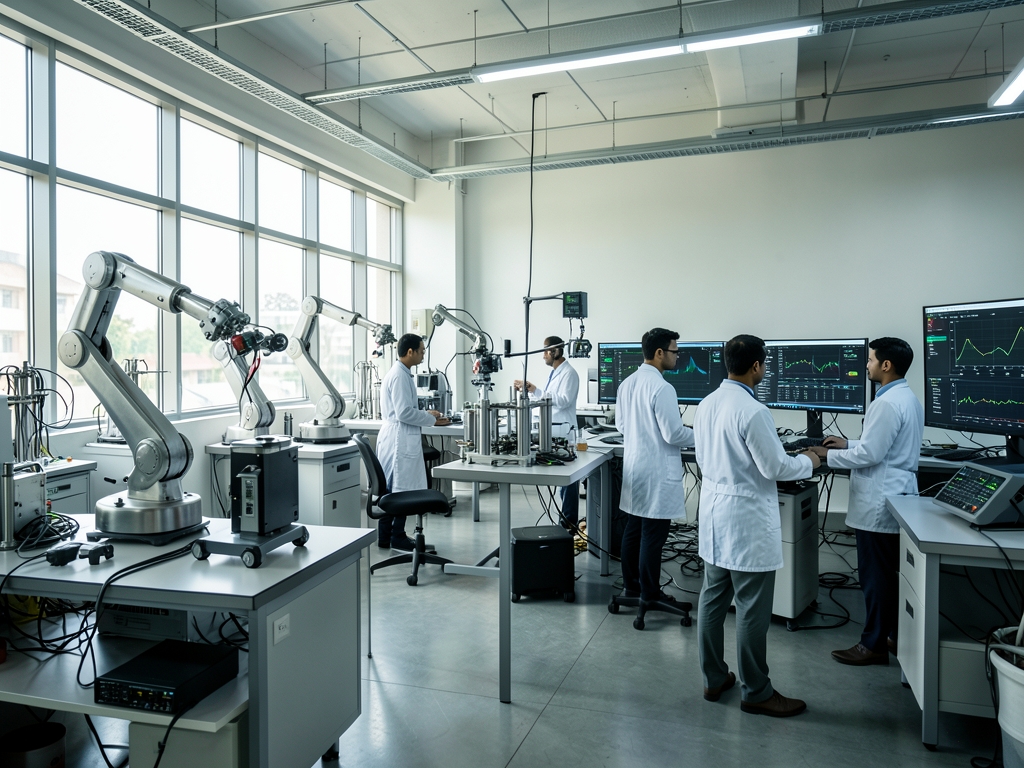
The rapid evolution of artificial intelligence has moved far beyond digital chatbots and software-as-a-service applications. Enterprises across manufacturing, supply chain logistics, and heavy engineering are increasingly seeking ways to integrate machine learning directly into physical machinery, factory floors, and core operational workflows. A major development in this space unfolded with the official launch of the BlueVerse Industrial AI Lab by LTM in Chennai, designed specifically to help global enterprises scale artificial intelligence across complex physical operations and smart products.
This initiative reflects a wider industry pivot toward localized, domain-specific artificial intelligence infrastructure. Rather than relying solely on generalized cloud models, modern industrial deployments require specialized computing environments capable of processing high-volume sensor data, managing heavy equipment automation, and ensuring real-time decision-making without latency risks. The Chennai lab aims to bridge the gap between theoretical software models and rugged industrial reality.
Understanding the Mission of the BlueVerse Industrial AI Lab
The inauguration of the BlueVerse facility in Chennai highlights the growing strategic importance of regional engineering hubs in shaping global technology trends. Chennai has long established itself as a prominent manufacturing and IT corridor in South Asia, making it an ideal environment for testing industrial-grade machine learning frameworks.
The lab's core objective is to provide businesses with the testing grounds, specialized hardware, and architectural frameworks necessary to deploy artificial intelligence across factory environments. Physical operations present unique engineering challenges that standard office software rarely encounters. Environmental dust, thermal variations, vibration interference, and the need for instantaneous safety shutdowns mean that AI models operating heavy machinery must achieve exceptional levels of reliability and precision.
By establishing this specialized research center, LTM intends to streamline how manufacturing firms, logistics providers, and heavy engineering enterprises transition from exploratory pilot projects to fully integrated, enterprise-scale deployments.
Key Capabilities and Enterprise Infrastructure
Modern industrial AI requires a robust convergence of advanced computing hardware, high-bandwidth sensors, edge computing nodes, and secure networking architectures. The BlueVerse Industrial AI Lab has been equipped with several specialized technological capabilities to support complex enterprise workflows:
- Edge Computing and Low-Latency Processing: Deploying machine learning models directly onto factory floor hardware to eliminate cloud dependency and ensure instantaneous response times during critical operational phases.
- Computer Vision for Quality Assurance: Advanced optical sensor integration designed to detect micro-defects in high-speed manufacturing lines with greater accuracy than traditional automated optical inspection systems.
- Predictive Maintenance Frameworks: Deep learning algorithms trained on historical vibration, temperature, and electrical load data to anticipate equipment failures before catastrophic breakdowns occur.
- Robotic Process Automation Integration: Coordination frameworks that allow autonomous guided vehicles and robotic arms to adapt dynamically to changing warehouse layouts and supply chain bottlenecks.
Info! Industrial AI architectures prioritize deterministic safety protocols alongside probabilistic machine learning outputs to guarantee that automated systems can never bypass hard-coded physical safety thresholds.
The Broader Shift Toward Industrial Artificial Intelligence
The launch of specialized laboratories like BlueVerse arrives at a time when industrial sectors in Europe, North America, and Asia are accelerating digital transformation strategies. For years, enterprise AI adoption was heavily skewed toward customer service automation, financial modeling, and marketing analytics. However, the largest economic gains are frequently locked inside physical supply chains, energy grids, and large-scale manufacturing plants.
Analysts note that scaling AI across physical operations demands a fundamental redesign of corporate IT and operational technology (OT) networks. Historically, IT systems and OT systems operated in strict isolation due to security and reliability concerns. Modern industrial AI labs focus heavily on secure convergence models, allowing data to flow safely from shop-floor sensors up to enterprise resource planning systems without exposing critical infrastructure to external cyber vulnerabilities.
Challenges in Scaling Physical AI Solutions
Despite the immense potential of industrial machine learning, enterprises attempting to scale physical AI encounter distinct hurdles that differ sharply from digital software deployments. Understanding these barriers is essential for assessing why dedicated regional labs are necessary:
- Data Heterogeneity: Industrial machinery often uses proprietary communication protocols, legacy firmware, and non-standardized data formats, making data ingestion exceptionally complex.
- Safety Certification and Compliance: Regulated industries such as aerospace, automotive manufacturing, and heavy machinery require exhaustive safety validations before any autonomous algorithm can control physical actuators.
- Skill Gaps: Organizations frequently struggle to find engineering talent that bridges traditional mechanical engineering expertise with advanced machine learning proficiency.
Capital Expenditure Intensity: Upgrading legacy factory floors to support high-performance edge computing nodes and sensor arrays involves significant upfront investment.
Dedicated facilities like the BlueVerse lab serve as collaborative proving grounds where enterprises can test integration strategies, run stress simulations, and validate ROI before committing capital to full-scale factory retrofits.
Practical Guidelines for Enterprise AI Adoption
Organizations looking to replicate the success of advanced industrial AI deployments without incurring excessive financial risk should follow a structured, phased implementation roadmap. Rather than attempting a complete digital overhaul of legacy facilities, successful engineering teams typically adhere to established integration sequences.
- Audit Existing Infrastructure: Catalog all legacy machinery, control systems, and existing data collection pipelines to identify connectivity gaps and communication bottlenecks.
- Identify High-Impact Pilot Zones: Select a single, self-contained operational workflow—such as a specific conveyor bottleneck or an individual assembly inspection station—for initial deployment.
- Implement Edge Validation: Test lightweight machine learning models on local edge computing hardware to verify latency, accuracy, and operational stability under real-world factory conditions.
- Establish Security Boundaries: Enforce strict network segmentation between operational technology environments and corporate enterprise networks to prevent unauthorized remote access.
Following these steps ensures that engineering teams can isolate variables, measure performance gains accurately, and refine algorithmic models before expanding deployment across multiple manufacturing plants.
| Deployment Phase | Primary Objective | Key Technology Focus |
|---|---|---|
| Phase 1 | Infrastructure Audit | Sensor mapping and protocol normalization |
| Phase 2 | Targeted Pilot | Computer vision quality inspection |
| Phase 3 | Edge Scaling | Predictive maintenance algorithms |
| Phase 4 | Full Enterprise Integration | Autonomous robotics and OT-IT convergence |
