

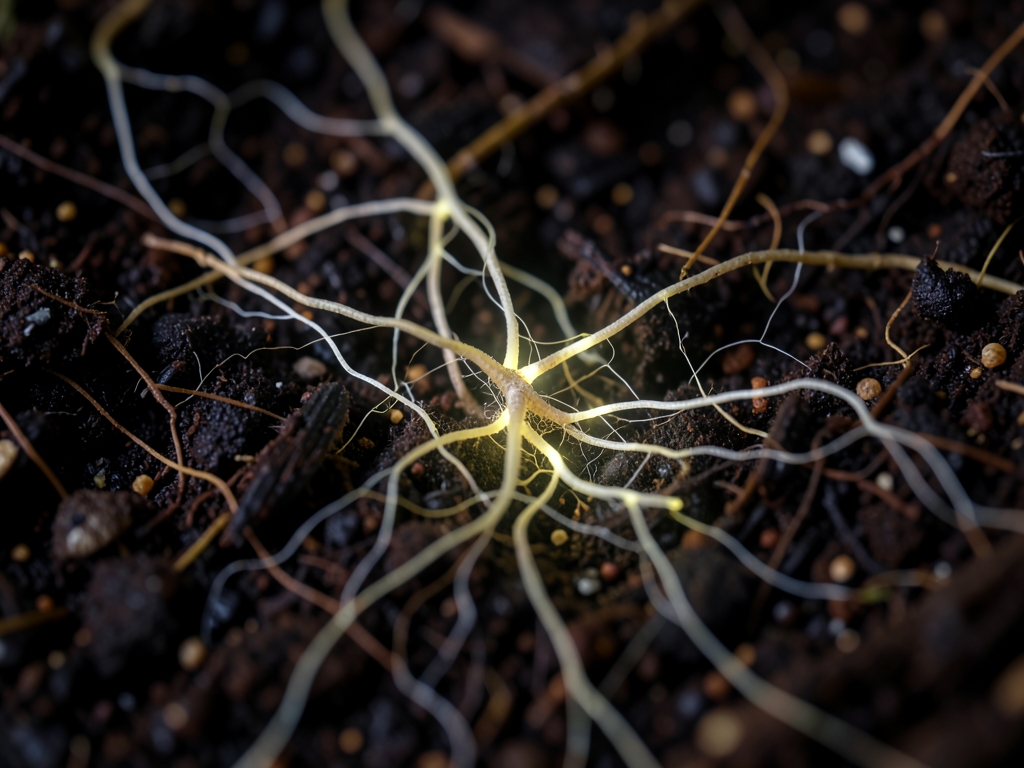
Beneath the quiet floor of a temperate forest lies a sprawling, intricate living network that fundamentally challenges our traditional view of plants as solitary organisms. While trees and shrubs appear to stand independently above ground, their roots are inextricably linked below the surface by vast colonies of fungi. This subterranean web, known scientifically as a mycorrhizal network, functions as a biological internet of the plant world. Through cooperative biological partnerships, these fungal filaments distribute nutrients, water, and chemical warning signals across entire woodland communities, transforming what we once thought of as a purely competitive natural environment into a deeply integrated and cooperative ecosystem.
Info! Mycorrhizal fungi form mutualistic associations with the roots of approximately ninety percent of all plant species on Earth, establishing an ancient evolutionary bond that dates back hundreds of millions of years, tracing back to the earliest colonization of land by primitive plants.
Understanding the Nature of Mycorrhizal Fusions
To understand how these underground networks operate, one must first examine the microscopic structure of fungi. Unlike plants, which manufacture their own food through photosynthesis, fungi must absorb organic carbon from external sources. Mycorrhizal fungi achieve this by wrapping around or penetrating the root cells of host plants. In exchange for the sugars and carbon compounds produced by the plant during photosynthesis, the fungus provides essential mineral nutrients mined from the soil.
There are two primary types of mycorrhizal associations that dominate forest soils: ectomycorrhiza and endomycorrhiza. Ectomycorrhizal fungi form a dense sheath around the exterior of plant roots, particularly common among trees such as pines, oaks, and beeches. Their hyphae—the thread-like building blocks of fungi—extend far out into the surrounding soil matrix, creating a massive surface area for absorption. Endomycorrhizal fungi, on the other hand, penetrate directly into the cortical cells of the plant roots, forming highly branched structures known as arbuscules. These arbuscular mycorrhizas are found across a vastly diverse range of plants, including many grasses, shrubs, and herbaceous flora.
The physical reach of these fungal threads is staggering. A single gram of forest soil can contain kilometers of hyphae, weaving together individual plants of the same species and even linking entirely different plant families. This creates a shared subterranean commons where resources are pooled and redistributed based on local availability and environmental stress.
Beyond these two major categories, ericoid and orchid mycorrhizas serve specialized ecological niches. Ericoid mycorrhizas form symbiotic relationships with plants in the Ericaceae family—such as blueberries, cranberries, and heather—which typically thrive in acidic, nutrient-poor soils. These specialized fungi possess robust enzymatic toolkits that break down recalcitrant organic matter, unlocking nitrogen and phosphorus that would otherwise remain inaccessible to standard plant roots. Orchid mycorrhizas, meanwhile, are essential during the germination phase of orchid seeds. Because orchid seeds lack nutrient reserves, they depend entirely on fungal partners to supply carbon and energy before the young seedling can develop green leaves and perform photosynthesis.
Evolutionary Origins and Geological Impact
The partnership between plants and fungi is not a recent evolutionary development; it is a foundational alliance that enabled the greening of the planet. Fossil evidence indicates that early land plants, which lacked true roots and vascular systems, formed primitive associations with glomermycete fungi over 400 million years ago during the Paleozoic era.
Without roots to anchor themselves or extract minerals from solid rock, these ancestral plants relied completely on their fungal symbionts to weather rock surfaces and acquire scarce nutrients like phosphorus. In return, the primitive plants provided photosynthetic carbon. This ancient metabolic trade accelerated the weathering of continental rock masses, drawing down atmospheric carbon dioxide levels and playing a pivotal role in stabilizing the Earth's climate. The legacy of this ancient symbiosis persists in almost every terrestrial ecosystem today, acting as the invisible engine driving nutrient cycles across global landscapes.
Nutrient Sharing and Resource Redistribution
One of the most profound discoveries regarding mycorrhizal networks is their capacity to facilitate resource sharing among plants. In a mature forest canopy, light distribution is highly uneven. Tall, established trees receive abundant sunlight, while understory seedlings struggle in deep shade, severely limiting their ability to photosynthesize and produce vital carbon.
Research into stable isotope tracing has revealed that larger, mature trees can pump carbon, nitrogen, and phosphorus down into the fungal network, transferring these critical resources to shaded saplings of the same or even different species. This provisioning acts as an ecological safety net, dramatically increasing the survival rates of young seedlings that would otherwise perish due to insufficient sunlight. When these saplings eventually grow tall enough to reach the canopy, the flow of nutrients may reverse or balance out, establishing a reciprocal dynamic that sustains the long-term health of the entire forest.
Furthermore, this redistribution mechanism extends beyond carbon and minerals to include nitrogen compounds fixed by soil bacteria. Certain trees act as hubs within the network, disproportionately acquiring nutrients from deep soil strata and redistributing them laterally to neighboring plants that lack deep root systems. This community-level resource balancing prevents localized nutrient depletion and ensures that patches of poor soil do not become biological deserts.
| Nutrient Type | Primary Source | Transfer Mechanism | Ecological Benefit |
|---|---|---|---|
| Carbon | Canopy Leaves | Fungal Hyphae | Supports shaded understory seedlings |
| Nitrogen | Soil Minerals | Mycorrhizal Roots | Enhances overall plant growth and vigor |
| Phosphorus | Bedrock Weathering | Extraratrical Mycelium | Improves root development and resilience |
| Water | Deep Soil Aquifers | Hyphal Transport | Mitigates drought stress during dry periods |
Chemical Warning Systems and Defense Signaling
Beyond simple nutrient exchange, mycorrhizal networks serve as communication channels that transmit chemical alerts across woodlands. When a tree or plant is attacked by herbivores, such as defoliating insects or pathogenic microbes, it undergoes physiological stress and begins synthesizing defensive compounds.
Rather than keeping these distress signals entirely localized, the plant can dispatch chemical warning messages through the connected fungal hyphae to neighboring plants. Upon receiving these molecular cues, neighboring trees preemptively ramp up the production of defensive enzymes, bitter tannins, or volatile organic compounds that deter pests before an attack even reaches them. This collective immune response transforms a localized infestation into an organized woodland defense.
Laboratory and field observations indicate that these electrical and chemical pulses travel through hyphal strands at measurable speeds. When an aphid infestation strikes a broadleaf tree, connected saplings begin producing defensive proteins hours before any insect reaches them. This early activation significantly reduces herbivore damage across the entire connected stand, demonstrating that the forest functions with a coordinated physiological strategy rather than purely isolated survival mechanisms.
The forest is not merely a collection of individual trees competing for survival, but a single, massive superorganism united by an invisible subterranean web of fungal intelligence.
Drought Mitigation and Water Management
Water availability is a primary limiting factor for plant growth, particularly in regions prone to seasonal dry spells or climate fluctuations. Mycorrhizal networks play an indispensable role in mitigating drought stress for forest vegetation.
Because fungal hyphae are significantly thinner than plant roots, they can infiltrate microscopic crevices in soil particles that are entirely inaccessible to roots. This allows the network to tap into moisture reserves deep within the soil profile. Water absorbed by the fungal web can then be translocated across considerable distances to plants experiencing acute dehydration. Furthermore, fungi improve soil aggregation by secreting a sticky, carbon-rich protein known as glomalin, which binds soil particles together, enhances structural stability, and drastically improves water retention within the ecosystem.
During extended dry periods, the presence of an active mycorrhizal network can mean the difference between forest survival and widespread dieback. Plants linked into the web maintain higher leaf water potentials and continue photosynthetic activity longer into dry seasons than isolated specimens. The fungal web essentially acts as a localized irrigation infrastructure, balancing moisture disparities between well-watered riparian zones and dry ridge tops.
Fungal Networks in Agricultural and Agroforestry Contexts
Understanding mycorrhizal networks has profound implications outside wild forests, particularly in agriculture and modern agroforestry systems. Conventional farming methods, which rely heavily on monocultures and synthetic chemical inputs, frequently disrupt or bypass these beneficial soil partnerships.
Agroforestry initiatives that integrate trees with traditional crops are beginning to leverage mycorrhizal webs to enhance crop resilience and reduce fertilizer dependency. By maintaining permanent living root systems and minimizing soil disturbance, farmers can preserve natural fungal networks. These preserved networks facilitate nutrient transfer between cover crops and cash crops, suppress soil-borne pathogens through biological competition, and improve soil structure without relying entirely on synthetic soil amendments.
Human Impact and Conservation Challenges
Despite their critical ecological functions, mycorrhizal networks face mounting threats from human activity. Intensive agricultural practices, industrial logging, urban expansion, and the excessive application of synthetic chemical fertilizers and fungicides can severely disrupt or destroy these delicate subterranean communities.
When soil is repeatedly tilled or saturated with agrochemicals, the fungal hyphae are fragmented and killed, stripping plants of their natural support systems. Protecting these underground ecosystems requires a shift toward sustainable land management, reduced tillage, organic soil enrichment, and the preservation of old-growth forests where complex fungal webs have spent centuries establishing themselves.
Furthermore, climate change poses an emerging threat to mycorrhizal communities. Altered precipitation patterns, rising temperatures, and shifting climatic zones force both trees and fungi to migrate or adapt at rates that may exceed their evolutionary capacity. Protecting these subterranean networks requires broad conservation frameworks that prioritize intact forest landscapes and limit fragmentation.
What exactly is a mycorrhizal network?
A mycorrhizal network is a subterranean web formed by symbiotic fungi that connect the root systems of different plants, facilitating the transfer of water, nutrients, and chemical signals.
How do plants and fungi benefit from this relationship?
Plants provide the fungus with essential sugars and carbon produced through photosynthesis, while the fungus supplies the plant with vital minerals and water absorbed from the soil.
Can plants of different species communicate through these fungal webs?
Yes, mycorrhizal networks frequently connect different plant species across a forest, allowing them to share resources and transmit chemical warning signals about pests or diseases.
How do modern agricultural practices affect mycorrhizal networks?
Intensive tilling, synthetic chemical fertilizers, and fungicides can fragment and destroy fungal hyphae, severely damaging the delicate underground networks that support plant health.
Conclusion
The intricate world of mycorrhizal networks reveals a level of ecological cooperation and complexity that reshapes our understanding of nature. Far from operating as isolated entities, plants are bound together by an ancient, living web of fungal threads that distributes vital resources, mitigates environmental stress, and coordinates community-wide defenses. Recognizing and protecting these subterranean ecosystems is essential for maintaining global biodiversity, enhancing agricultural resilience, and preserving the health of our natural forests for future generations.
