

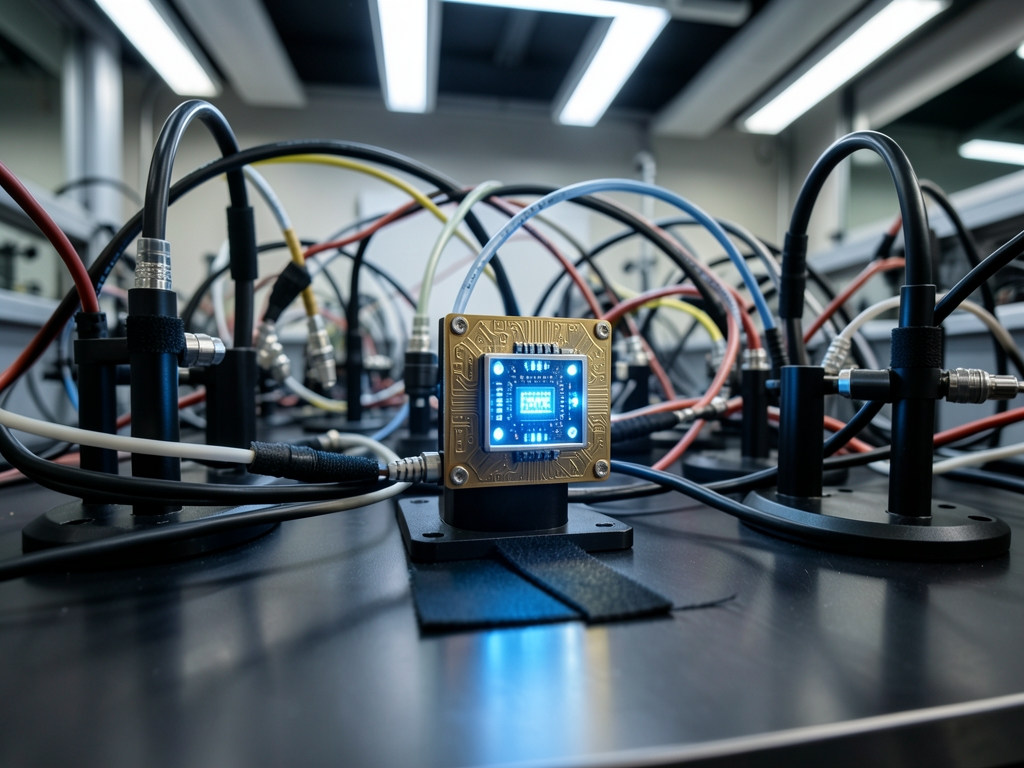
As digital connectivity expands across the globe, the security of sensitive data remains one of the most critical challenges facing modern society. Traditional encryption methods, which rely heavily on mathematical algorithms such as RSA and elliptic-curve cryptography, have served as the backbone of global cybersecurity for decades. However, the rapid advancement of quantum computing threatens to render these conventional security measures obsolete. As quantum computers grow more powerful, they will eventually possess the computational capacity to solve complex mathematical problems exponentially faster than classical computers, breaking the encryption that currently protects everything from personal bank accounts to classified government communications.
To combat this looming threat, scientists and engineers have turned to the laws of quantum mechanics to develop a fundamentally new approach to data protection: Quantum Key Distribution. Unlike traditional encryption, which depends on mathematical complexity, quantum key distribution relies on the fundamental laws of physics. This article explores how quantum key distribution works, its core principles, its advantages over conventional security, and the challenges it faces as it transitions from laboratory research to commercial deployment.
The Vulnerability of Classical Cryptography
To understand why quantum key distribution is necessary, it is essential to examine the limitations of current cryptographic systems. Most secure communications on the internet today use public-key cryptography. In this system, two parties—often referred to as Alice and Bob—use a public key to encrypt a message, while a private key kept secret by the recipient is used to decrypt it. The security of this method rests on the assumption that certain mathematical operations, such as factoring very large prime numbers, are computationally infeasible to reverse within a practical timeframe.
While this assumption holds true for classical supercomputers, it collapses in the face of quantum computing. In 1994, mathematician Peter Shor formulated an algorithm designed to run on a quantum computer, proving that a sufficiently powerful quantum machine could factor large numbers and calculate discrete logarithms with remarkable efficiency. While large-scale, fault-tolerant quantum computers are still under active development by researchers and technology companies worldwide, the theoretical framework for breaking modern encryption is already established. Organizations are acutely aware that data intercepted and stored today could be decrypted retroactively once advanced quantum hardware becomes operational, a threat strategy often referred to as store-now-decrypt-later.
What Is Quantum Key Distribution?
Quantum key distribution is not a method for encrypting and sending secret messages directly over a network. Instead, it is a secure protocol used by two communicating parties to generate and share a random, secret key known only to them. Once this shared key is established, it can be used with conventional symmetric encryption algorithms, such as the Advanced Encryption Standard, to encrypt and decrypt actual data messages.
The breakthrough of quantum key distribution lies in its ability to detect any unauthorized interception attempt. The fundamental principles of quantum mechanics dictate that the mere act of measuring a quantum system alters its state. In a quantum key distribution system, data is typically encoded onto individual particles of light, known as photons. If an eavesdropper—traditionally called Eve—attempts to intercept or measure the photons in transit, her interference introduces detectable anomalies into the quantum state. Alice and Bob can then analyze a subset of their transmitted data to check for errors. If the error rate exceeds a specific statistical threshold, they know an eavesdropper is present, they immediately discard the compromised key, and they abort the communication.
Info! Quantum key distribution guarantees absolute security based on the laws of physics rather than unproven mathematical assumptions, ensuring long-term confidentiality against future computational breakthroughs.
Core Protocols of Quantum Key Distribution
Over the years, researchers have developed several distinct protocols to implement quantum key distribution in practice. Each protocol approaches the encoding and measurement of quantum states in slightly different ways, catering to different hardware configurations and network environments.
The BB84 Protocol
Developed in 1984 by Charles Bennett and Gilles Brassard, BB84 was the very first quantum key distribution protocol. It utilizes the polarization states of photons to transmit binary data. In the BB84 protocol, photons are polarized using two different measurement bases: the rectilinear basis and the diagonal basis. Alice randomly selects a bit value (0 or 1) and a basis to polarize each photon, then sends the stream of photons to Bob through an optical fiber or free-space channel. Bob randomly chooses a basis to measure each incoming photon without knowing beforehand which basis Alice used. After the transmission is complete, Alice and Bob publicly communicate over a conventional channel to compare the bases they used for each photon, discarding the results where their choices did not match. The remaining matching results form their raw shared key.
The E91 Protocol
Proposed by Artur Ekert in 1991, the E91 protocol relies on a different quantum mechanical phenomenon: quantum entanglement. In this protocol, a source generates pairs of entangled photons and sends one photon to Alice and the other to Bob. Because the properties of entangled particles are intrinsically linked regardless of the distance separating them, measurements performed by Alice and Bob exhibit strong correlations. Eavesdropping on an entangled system disrupts these correlations, allowing the communicating parties to detect an intruder through a mathematical process known as Bell's theorem testing.
Practical Applications and Use Cases
As quantum technology matures, quantum key distribution is moving out of academic physics laboratories and into real-world operational environments. Financial institutions, government agencies, and critical infrastructure providers are actively exploring or deploying quantum security measures to protect high-value assets.
| Sector | Primary Use Case | Security Benefit |
|---|---|---|
| Financial Services | Inter-branch data transfer | Protects high-frequency trading and transactional data against future quantum decryption. |
| Government & Defense | Classified communications | Secures diplomatic cables and military intelligence from advanced foreign surveillance. |
| Telecommunications | Backbone network protection | Safeguards core fiber-optic routing infrastructure from unauthorized data interception. |
| Healthcare | Patient record storage | Ensures long-term privacy for sensitive medical histories and genomic data. |
Governments in various regions have already established metropolitan quantum networks to test secure communication links between municipal buildings. Similarly, banking consortia are conducting pilot programs to secure international financial transfers using quantum-generated keys, recognizing that financial data often requires confidentiality spanning decades.
Current Challenges and Limitations
Despite its theoretical perfection, implementing quantum key distribution in practical network architectures involves significant engineering hurdles. Understanding these limitations is crucial for assessing its realistic deployment timeline.
- Distance Limitations: Photons traveling through standard optical fibers suffer from attenuation and scattering. Without quantum repeaters, which are still in early stages of development, the maximum distance for direct quantum key distribution is typically limited to around 100 kilometers.
- Infrastructure Costs: Deploying dedicated optical fiber lines and specialized hardware, such as single-photon detectors and laser sources, requires substantial capital investment.
- Hardware Vulnerabilities: While the underlying physics of quantum mechanics is unassailable, real-world implementations rely on physical devices that can exhibit manufacturing flaws or side-channel vulnerabilities exploited by sophisticated attackers.
- Key Generation Rates: The throughput of secure keys generated per second is often lower than traditional key exchange methods, making it challenging to support high-bandwidth applications without complementary cryptographic solutions.
Warning! Quantum key distribution is not a universal plug-and-play solution; it requires careful integration with existing network infrastructure and robust authentication protocols to prevent man-in-the-middle attacks during the initial connection setup.
Future Outlook
The evolution of quantum key distribution is closely tied to advancements in satellite-based quantum communications and quantum networking. To overcome the distance limitations imposed by optical fiber attenuation, space agencies have successfully demonstrated quantum key distribution from orbiting satellites to ground stations on Earth. By utilizing space as a transmission medium where photons encounter minimal atmospheric interference in the upper atmosphere, intercontinental quantum networks are becoming increasingly feasible.
Simultaneously, researchers are working alongside post-quantum cryptography standardization bodies to create hybrid security models. In these hybrid architectures, quantum key distribution operates alongside post-quantum cryptographic algorithms—mathematical methods designed to resist quantum attacks running on classical hardware—providing a multi-layered defense strategy for enterprise networks.
What is the main difference between quantum key distribution and traditional encryption?
Traditional encryption relies on complex mathematical algorithms that can theoretically be solved by powerful computers, whereas quantum key distribution relies on the fundamental laws of physics to generate secure keys and instantly detect any eavesdropping attempts.
Can quantum key distribution be used to encrypt normal internet traffic directly?
No, quantum key distribution is solely used to securely generate and exchange random cryptographic keys between two parties. Once the key is established, standard symmetric encryption algorithms are used to encrypt and transmit the actual data messages.
Why is distance a major challenge for quantum key distribution over fiber optics?
Photons traveling through standard optical fiber experience signal loss and scattering over long distances. Because quantum states cannot be amplified using traditional signal boosters without destroying the quantum information, distance is currently limited to roughly 100 kilometers without specialized repeaters.
How does an eavesdropper get detected during a quantum key distribution session?
According to quantum mechanics, measuring a quantum system alters its state. If an eavesdropper intercepts or measures the photons in transit, it introduces detectable statistical errors and anomalies that the communicating parties identify during error-checking protocols.
As cyber threats continue to evolve, the transition toward physics-based security protocols represents a monumental shift in how humanity protects digital information. While engineering hurdles remain, quantum key distribution stands out as a definitive technology for safeguarding the integrity and confidentiality of global communications in the quantum era.
