

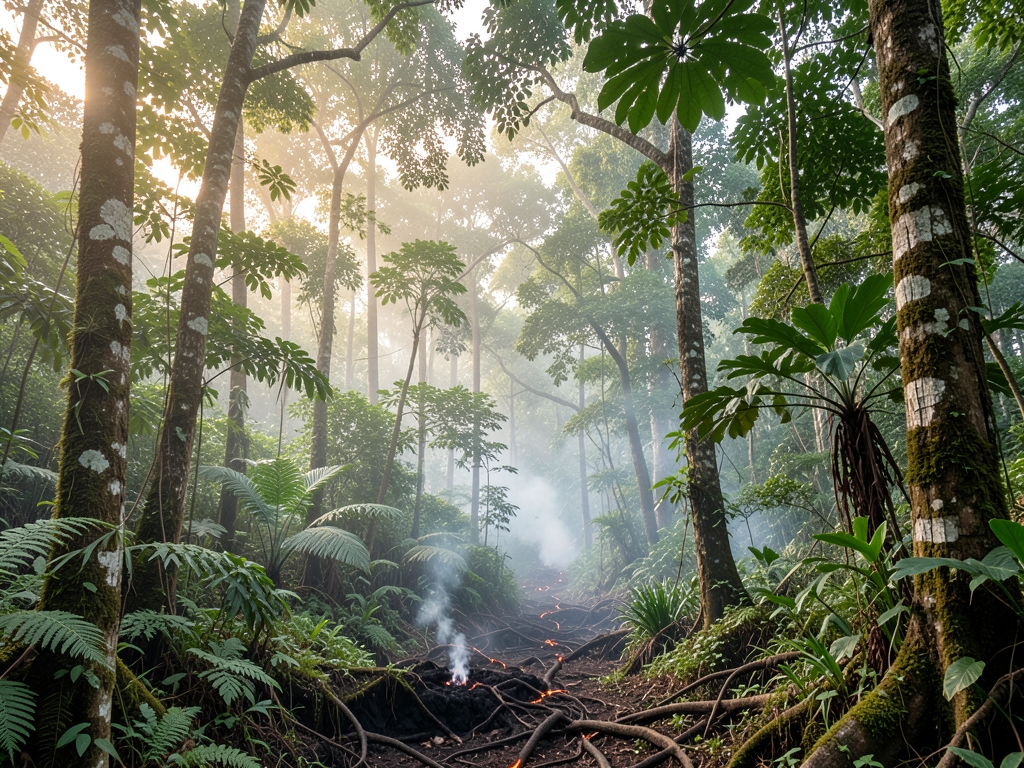
The Amazon rainforest, universally celebrated as the verdant and pulsing heart of global biodiversity, has long faced severe ecological pressures from surface deforestation, agricultural expansion, and seasonal climate shifts. However, recent scientific findings announced by researchers at the National Aeronautics and Space Administration have uncovered an entirely hidden and insidious dimension of environmental degradation. Beneath the dense canopy and root networks of the world's largest tropical rainforest, hidden fires are burning deep within rich organic soil and peat layers. Unlike fast-moving surface blazes that consume brush and timber in plain sight, these subterranean phenomena operate silently, resisting conventional satellite detection and burning for weeks or even months beneath the forest floor.
Understanding this newly highlighted phenomenon requires examining how tropical ecosystems store carbon and how changing hydrological cycles alter the flammability of deep organic soils. For decades, ecologists and earth scientists monitored Amazonian fire activity primarily through thermal infrared imaging that captured surface flames and smoke plumes billowing above the treeline. However, subterranean combustion occurs beneath layers of humus, decaying vegetation, and ancient peat deposits where oxygen levels are low enough to sustain slow, smoldering thermal reactions rather than rapid, flaming combustion. This distinct burning process releases immense volumes of carbon dioxide and methane directly from the soil while evading standard rapid-response containment strategies deployed by local environmental agencies.
The Mechanics of Subterranean Smoldering Fires
To grasp why underground fires pose such a profound challenge to modern conservation science, one must analyze the unique composition of tropical rainforest floors. Unlike mineral-rich soils found in other biomes, rainforest floors often feature thick accumulations of organic matter formed over centuries of fallen leaves, dead wood, and dense root mats. During prolonged periods of drought—which have become increasingly frequent and severe across South America due to shifting climatic patterns—these organic layers dry out completely.
When a surface fire passes through an area or when lightning strikes near exposed root systems, the fire can occasionally burrow downward into the dried organic substrate. Once established beneath the surface, the fire enters a smoldering phase. In this state, chemical reactions occur without flames at temperatures ranging between three hundred and six hundred degrees Celsius. The fire creeps slowly outward in all directions, consuming underground carbon stocks while leaving the upper vegetation deceptively intact. Walkers and even airborne observers may look down upon a seemingly normal section of forest floor unaware that a deep thermal cavity is consuming the foundational structure of the ecosystem.
Subterranean fires transform carbon storage systems into active emission sources, silently undermining decades of global climate mitigation efforts.
Advanced remote sensing technologies utilized by research teams have begun to map these hidden thermal anomalies by detecting subtle surface temperature gradients and subterranean moisture loss. These technological breakthroughs are critical because traditional firefighting methods—such as aerial water drops or surface trenching—are entirely ineffective against fires burning meters below the surface. Instead, halting these subterranean events requires massive soil saturation, prolonged hydrological intervention, or the natural arrival of heavy seasonal rainfall that can penetrate deep soil strata.
Ecological and Climatic Consequences for the Amazon Basin
The implications of persistent underground fires extend far beyond localized habitat destruction. The Amazon basin functions as one of the planet's most vital carbon sinks, absorbing immense quantities of atmospheric carbon dioxide annually. When surface fires occur, a significant portion of stored carbon is released instantly. However, when deep organic soils and peat layers burn, the total carbon release is exponentially higher because these layers represent centuries of accumulated biomass.
Info! Subterranean peat and organic soil fires can persist underground throughout entire dry seasons, reigniting surface vegetation when returning winds provide fresh oxygen supply.
Furthermore, these subterranean thermal anomalies destroy the intricate subterranean webs that support rainforest flora. Mycorrhizal fungi networks, insect colonies, seed banks, and root systems are incinerated from below. When the soil structure collapses following the burnout of organic layers, giant hardwood trees lose their structural anchorage and topple over months after the fire has seemingly passed. This secondary mortality rate alters forest architecture, creating large gaps in the canopy that invite invasive plant species and increase vulnerability to future desiccation.
| Fire Type | Combustion Speed | Detection Difficulty | Primary Impact |
|---|---|---|---|
| Surface Fires | Fast and visible | Low | Canopy scorching and immediate timber loss |
| Subterranean Fires | Slow and smoldering | Extreme | Root destruction and deep soil carbon release |
| Crown Fires | Rapid and volatile | Low | Widespread structural collapse of tall trees |
Broader Scientific Implications and Future Monitoring
The documentation of hidden fires beneath the Amazon rainforest marks a pivotal shift in how earth scientists conceptualize tropical fire regimes. For generations, policy frameworks focused almost exclusively on stopping intentional land-clearing burns and managing seasonal agricultural fires visible from space. The new evidence demands a complete reevaluation of regional conservation strategies, incorporating high-resolution ground-penetrating radar, advanced thermal satellite telemetry, and long-term soil moisture monitoring.
International research collaborations are currently working to model how prolonged droughts and rising regional temperatures influence the frequency of these underground events. By identifying vulnerable soil zones before desiccation reaches critical thresholds, conservationists hope to deploy targeted hydrological management to protect ancient carbon stocks. Protecting the Amazon thus requires looking beyond the green canopy visible to the naked eye and safeguarding the complex, living underworld that sustains the entire biome.
What causes subterranean fires in the Amazon rainforest?
Subterranean fires occur when prolonged droughts dry out deep organic soil and peat layers, allowing surface fires or lightning strikes to burrow underground and burn slowly without flames.
Why are underground rainforest fires difficult to detect?
Unlike surface fires that produce large smoke plumes and visible flames, subterranean fires burn beneath layers of soil and organic matter, hiding from standard visual observation and requiring specialized thermal imaging.
How do these hidden fires impact the global climate?
These fires release massive amounts of stored carbon dioxide and methane from ancient soil layers directly into the atmosphere, turning vital carbon sinks into major emission sources.
Can traditional firefighting methods extinguish subterranean fires?
Traditional methods like aerial water drops are largely ineffective against deep underground fires, which typically require extensive soil saturation or heavy seasonal rainfall to fully extinguish.
As scientific observation methods continue to evolve, understanding the hidden vulnerabilities of global ecosystems remains essential for effective environmental stewardship. The discovery of subterranean fires beneath the Amazon underscores the urgent need for comprehensive climate action and advanced ecological monitoring to protect the planet's most critical natural regulators.
