

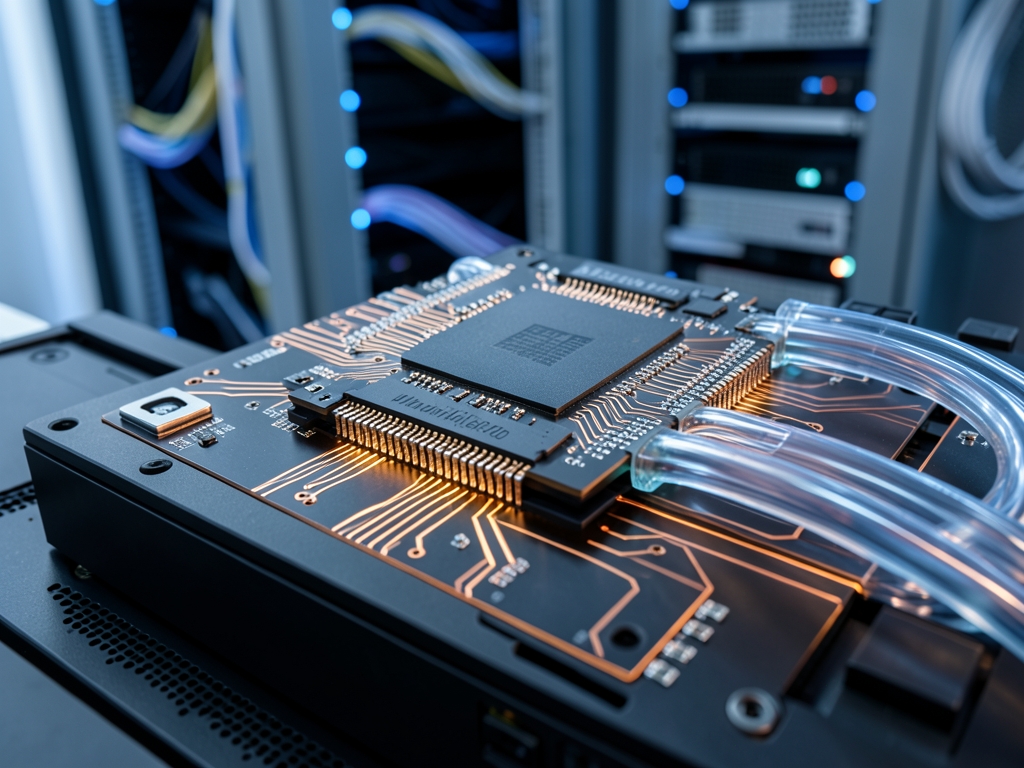
The landscape of artificial intelligence and high-performance computing is currently undergoing a massive structural transformation. As generative AI models scale into parameters numbering in the hundreds of billions and trillions, traditional data center architectures face unprecedented bottlenecks in compute power, memory bandwidth, and thermal dissipation. Addressing these rigorous demands, NVIDIA formally detailed and began rolling out its revolutionary Blackwell architecture, anchored by the flagship B200 Tensor Core GPU and the ultra-dense GB200 NVL72 rack-scale system. This technological leap represents more than just a generational tick in semiconductor manufacturing; it introduces entirely new paradigms in accelerated computing, hardware-level decompression, and multi-node interconnect technology designed specifically to make real-time generative AI inference economically and operationally viable for global enterprise deployments.
The Semiconductor Engineering Behind the Blackwell B200 GPU
At the silicon level, the NVIDIA Blackwell B200 GPU is an engineering marvel designed to squeeze maximum performance out of advanced semiconductor nodes. Built using a custom-built 4NP TSMC process, the chip integrates a staggering 208 billion transistors. Due to the physical limitations of reticle size in lithography, NVIDIA engineered Blackwell as two distinct die halves connected by a ultra-high-speed 10 terabytes-per-second chip-to-chip link. To the operating system and software stack, however, the dual-die configuration appears and functions as a single, unified GPU.
This monolithic software visibility is crucial for developers and systems engineers. It eliminates the programming complexities typically associated with multi-GPU scaling on a single card. Furthermore, the B200 incorporates a second-generation Transformer Engine that dynamically adjusts precision down to FP4 and FP8 formats. This capability allows large language models to run with drastically reduced memory footprints and heightened computational throughput without suffering noticeable degradation in output quality or reasoning accuracy.
Breakthroughs in Memory Subsystems and High-Bandwidth Architecture
One of the most persistent bottlenecks in modern machine learning workloads is memory wall latency—the delay incurred when data must travel between processor cores and dynamic random-access memory. Blackwell addresses this through the adoption of advanced High Bandwidth Memory, specifically utilizing configurations of HBM3e that deliver up to 8 terabytes per second of total memory bandwidth per GPU.
This immense bandwidth ensures that the massive compute engine inside the Blackwell architecture is never starved for data during intensive matrix multiplication operations. Whether handling multi-modal token processing or massive parameter weight updates during fine-tuning, the memory subsystem maintains high saturation levels. For enterprise data centers, this translates to faster time-to-solution and the ability to process much larger context windows simultaneously.
| Metric / Feature | NVIDIA H100 (Previous Gen) | NVIDIA Blackwell B200 |
|---|---|---|
| Transistor Count | 80 Billion | 208 Billion |
| Process Node | 4N Custom TSMC | 4NP Custom TSMC |
| Memory Bandwidth | 3.35 TB/s (HBM3) | 8.0 TB/s (HBM3e) |
| Inference Performance (FP4) | N/A (Introduced here) | Up to 20 PFLOPS |
| Interconnect Speed | 900 GB/s (NVLink 4) | 1.8 TB/s (NVLink 5) |
The GB200 NVL72 Rack-Scale Liquid-Cooled System
Moving beyond individual components, the true innovation of the Blackwell generation lies in its scale-out systems engineering, exemplified by the GB200 NVL72. Traditional server racks rely on numerous discrete servers connected by sprawling bundles of copper cables and network switches, which introduce latency and massive heat outputs. The NVL72 architecture completely reimagines the data center rack as a single, massive 72-GPU supercomputer.
The system combines 36 Grace CPUs and 72 Blackwell GPUs into a single liquid-cooled rack enclosure. These components are interconnected via fifth-generation NVLink switches, delivering a bidirectional bandwidth of 1.8 terabytes per second per GPU. This high-speed fabric allows the entire rack of 72 GPUs to act as a unified accelerator, drastically accelerating trillion-parameter model training and massive inference workloads.
Warning! Deploying rack-scale liquid-cooled architectures like the GB200 NVL72 requires specialized data center facility upgrades, including high-capacity closed-loop cooling distribution units and significantly enhanced floor-load structural capacities to support extreme hardware density.
Hardware-Accelerated Decompression and Security Improvements
In addition to raw floating-point compute power, Blackwell introduces specialized hardware engines designed to offload auxiliary data center tasks from the main processing cores. One standout feature is the dedicated Decompression Engine, which natively accelerates database queries and data ingestion pipelines by processing compressed formats directly in hardware.
Info! The dedicated hardware decompression engine can process compressed data at speeds up to hundreds of gigabytes per second, effectively eliminating data ingestion bottlenecks in massive data lakehouse environments.
Furthermore, enterprise security has been integrated at the silicon level. Blackwell supports confidential computing features that protect data in use across multi-tenant cloud environments. Hardware-verified encryption ensures that model weights and sensitive corporate data remain secure even if the hypervisor or host operating system is compromised, meeting stringent regulatory compliance standards across the European Union and the United States.
Implications for Enterprise AI Adoption and Energy Efficiency
As enterprise adoption of generative AI shifts from exploratory proofs-of-concept to mission-critical production environments, return on investment and power consumption have become paramount concerns. Data center operators face strict carbon emission caps and soaring electricity costs. Despite delivering up to 30 times higher performance for large language model inference compared to previous generations, the Blackwell architecture achieves this with remarkable energy efficiency gains.
By drastically reducing the energy required per token generated, Blackwell alters the total cost of ownership equation for cloud service providers and Fortune 500 enterprises alike. Running inference on a GB200 system consumes significantly less power per query than legacy setups, enabling sustainable scaling of AI services to millions of concurrent users without requiring immediate, catastrophic expansions of regional power grids.
The software ecosystem surrounding Blackwell has also matured to ensure seamless migration. NVIDIA's CUDA platform and optimized TensorRT-LLM libraries allow developers to transition existing models to the new architecture with minimal codebase modifications. This backward compatibility protects existing software investments while unlocking immediate performance multipliers.
Conclusion
The introduction of the NVIDIA Blackwell architecture and its associated rack-scale systems marks a definitive inflection point for enterprise technology. By combining groundbreaking semiconductor manufacturing, massive memory bandwidth, revolutionary multi-node NVLink interconnects, and silicon-level security, Blackwell successfully addresses the core scalability, latency, and power challenges threatening the artificial intelligence boom. As hyperscale cloud providers and global enterprises integrate these systems into their infrastructure throughout 2026, the industry moves closer to fully realizing the transformative potential of autonomous agents, real-time multi-modal AI, and complex scientific simulation at unprecedented scale.
What is the primary difference between the NVIDIA H100 and the new Blackwell B200 GPU?
The Blackwell B200 features a dual-die configuration with 208 billion transistors compared to the H100's 80 billion, utilizes faster HBM3e memory delivering 8 TB/s of bandwidth, and introduces native support for FP4 and FP8 precision formats via a second-generation Transformer Engine for massive inference acceleration.
How does the GB200 NVL72 rack system manage thermal dissipation?
The GB200 NVL72 utilizes advanced closed-loop liquid cooling technology. Because the high transistor density and massive power draws of 72 GPUs and 36 CPUs within a single rack exceed traditional air-cooling limits, warm water is circulated directly through precision cold plates mounted on the chips to dissipate heat efficiently.
What is the purpose of the dedicated hardware decompression engine in Blackwell?
The dedicated hardware decompression engine is designed to offload data processing tasks from the primary compute cores, allowing the GPU to natively ingest and process compressed database and data lake formats at speeds reaching hundreds of gigabytes per second without software overhead.
Are existing AI models compatible with the NVIDIA Blackwell architecture?
Yes, models built using standard frameworks on the CUDA platform and optimized libraries like TensorRT-LLM are fully compatible with Blackwell. The architecture maintains strong backward compatibility while allowing developers to easily leverage new precision formats and interconnect speeds.
