

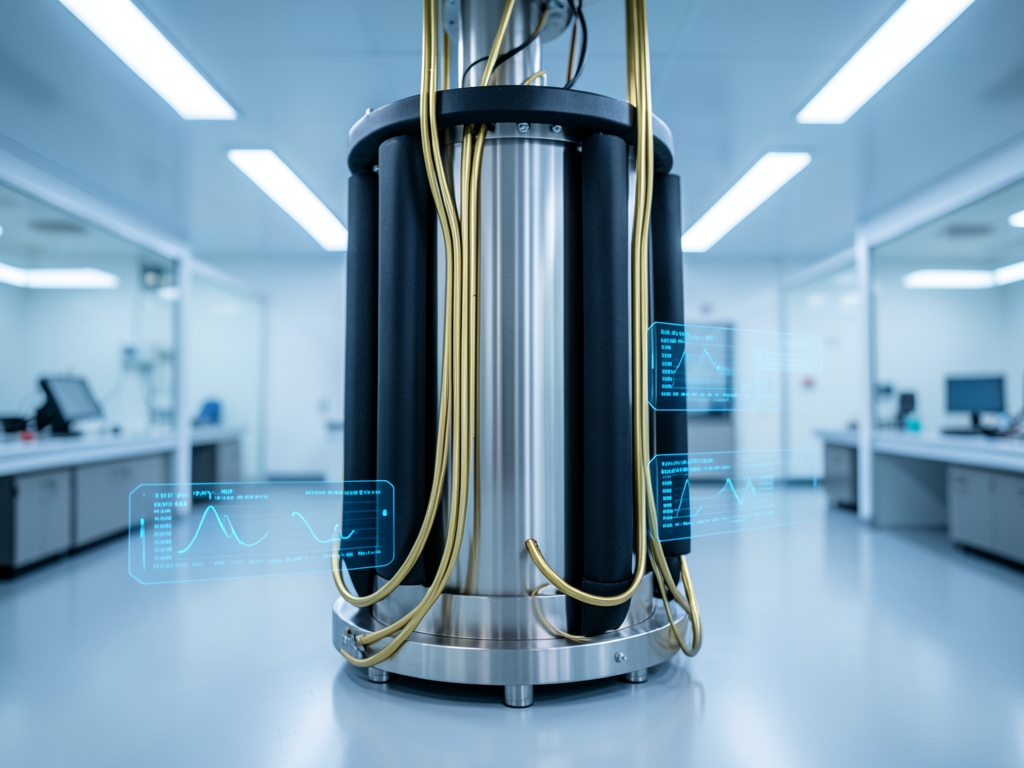
Quantum computing has long promised to revolutionize fields ranging from cryptography and molecular chemistry to artificial intelligence and materials science. However, the path toward fault-tolerant, commercial-scale quantum systems has faced a formidable barrier: physical qubits are notoriously fragile. Susceptible to environmental noise, temperature fluctuations, and electromagnetic interference, individual qubits frequently flip states or lose coherence before complex algorithms can execute. Recent research breakthroughs are shifting this landscape, offering a major step forward toward quantum computers that can detect and correct their own errors in real time.
For decades, the fragility of quantum states restricted developers to small-scale processors with limited operational lifespans. As processor architectures expanded to include hundreds or thousands of physical qubits, the aggregate error rate multiplied rapidly, corrupting calculations. Overcoming this hurdle requires moving beyond physical qubits to establish logical qubits—virtual processing units built from clusters of physical qubits working in concert. Recent scientific progress demonstrates that fault-tolerant error correction is transitioning from theoretical physics into tangible engineering reality.
The Physics of Quantum Decoherence and Noise
To understand the magnitude of recent error-correction milestones, one must examine why quantum processors fail so easily. Classical computers store information in binary bits represented as discrete zeros and ones. These states are highly stable and resistant to minor voltage variations. In contrast, quantum bits, or qubits, leverage the principles of superposition and entanglement, allowing them to exist in multiple states simultaneously.
This dual nature makes qubits exceptionally powerful, but also exquisitely sensitive. Any microscopic interaction with the outside world—a stray magnetic field, thermal radiation from the room, or even cosmic rays—can cause decoherence. When decoherence occurs, the fragile quantum information collapses or corrupts, resulting in computational errors. Traditional error correction used in classical computing, such as simple repetition codes, fails in the quantum realm because measuring a qubit directly destroys its superposition state.
Protecting quantum data without disturbing its superposition requires sophisticated error-correcting codes that identify faults indirectly through multi-qubit entanglement.
To bypass this limitation, physicists design quantum error-correcting codes. These architectures distribute a single logical piece of information across numerous physical qubits. By measuring collective properties rather than individual quantum states, error-detection algorithms can identify whether a bit-flip or phase-flip error has occurred and apply corrective adjustments before the calculation fails.
Recent Milestones in Fault-Tolerant Logical Qubits
Recent investigations by leading research groups and academic institutions have validated advanced error-correction protocols at scale. By deploying sophisticated lattice architectures, experimental systems have demonstrated the ability to execute multiple cycles of error detection while actually reducing the net error rate. This achievement crosses a critical theoretical threshold known as the fault-tolerance threshold.
Info! Achieving the fault-tolerance threshold means that adding more physical qubits to a logical architecture decreases the overall error probability rather than increasing it.
Key technical achievements driving this progress include:
- Syndrome Extraction Optimization: Refining the speed and accuracy of measuring error syndromes without introducing secondary noise into neighboring qubits.
- Cross-Dimensional Lattice Surgery: Enabling logical qubits to interact and entangle while maintaining continuous background error monitoring.
- Real-Time Feed-Forward Control: Implementing ultra-low-latency FPGA controllers that process error data and apply corrective pulses within nanoseconds.
- Crosstalk Mitigation: Upgrading microwave pulse shaping to prevent control signals from inadvertently disrupting adjacent physical qubits.
These hardware and software synergies allow quantum processors to sustain multi-step algorithms far longer than previously possible. Instead of succumbing to accumulated noise, the system continuously purges errors in the background, mirroring the self-maintenance functions found in biological or advanced classical redundancy systems.
Implications for Enterprise Computing and Cryptography
The transition toward self-correcting quantum architectures carries profound implications for the technology sector. While noisy intermediate-scale quantum (NISQ) devices have provided valuable experimental platforms, their lack of error correction limited enterprise adoption for mission-critical workloads. Verifiable, error-corrected logical qubits pave the way for deterministic execution in enterprise environments.
Industries heavily reliant on complex simulations stand to benefit first. In pharmaceutical research, accurate molecular modeling requires precise quantum state maintenance to simulate drug interactions at the atomic level. In logistics and financial optimization, large-scale combinatorial problems that overwhelm classical supercomputers will become tractable as logical qubit counts increase.
| Feature | Noisy Intermediate-Scale Quantum (NISQ) | Fault-Tolerant Quantum Systems |
|---|---|---|
| Qubit Type | Physical Qubits | Logical Qubits (Bundled Physical Qubits) |
| Error Handling | Post-processing mitigation and error filtering | Real-time active error correction |
| Circuit Depth | Short (restricted by decoherence) | Extended (unlimited theoretical depth) |
| Primary Use Case | Experimental algorithms and proof-of-concept | Commercial-scale simulation and cryptography |
Simultaneously, advancements in quantum error correction intensify the urgency surrounding post-quantum cryptography. As scalable processors overcome decoherence barriers, the timeline for breaking legacy asymmetric encryption standards accelerates. Cybersecurity agencies and financial institutions are actively migrating toward lattice-based cryptographic algorithms designed to withstand quantum attacks.
Engineering Challenges in Scaling Upward
Despite the optimism surrounding recent experimental data, significant engineering hurdles remain before fault-tolerant quantum computers become commercially ubiquitous. Scaling from a handful of logical qubits to thousands requires unprecedented manufacturing precision and cryogenic infrastructure.
Control wiring represents a primary bottleneck. Operating thousands of physical qubits inside a dilution refrigerator operating near absolute zero requires complex coaxial routing. Each cable introduces thermal load, threatening to raise the temperature of the processor. Researchers are addressing this by developing cryogenic control chips—CMOS integrated circuits designed to operate at sub-Kelvin temperatures directly adjacent to the quantum processor.
Furthermore, error-correction algorithms demand immense classical computing power to decode syndromes in real time. As qubit arrays expand, the decoding algorithm must process vast streams of error data instantaneously. Integrating high-speed classical processing nodes directly into the quantum hardware stack is becoming an essential design paradigm for next-generation architectures.
What is the difference between a physical qubit and a logical qubit?
A physical qubit is a single hardware element susceptible to environmental noise and decoherence. A logical qubit is a virtual processing unit constructed by grouping multiple physical qubits together, utilizing error-correcting codes to detect and correct faults without destroying the underlying quantum information.
Why is quantum error correction more difficult than classical error correction?
Classical error correction relies on direct measurement and copying of binary bits. In quantum computing, measuring a qubit directly collapses its superposition and destroys the stored data. Therefore, quantum error correction must use complex entanglement and indirect syndrome measurements.
What is the fault-tolerance threshold in quantum computing?
The fault-tolerance threshold is a theoretical error-rate limit for physical qubits. When physical error rates drop below this specific threshold, adding more physical qubits to a logical error-correcting code decreases the net error rate, enabling reliable, scalable quantum computations.
How do cryogenic control chips assist in scaling quantum processors?
Cryogenic control chips are specialized semiconductor circuits designed to operate at ultra-low temperatures inside dilution refrigerators. By placing control and readout electronics directly next to the qubits, engineers drastically reduce the number of external coaxial cables required, lowering thermal load and signal latency.
Conclusion
The recent strides in quantum error correction mark a pivotal evolutionary phase for advanced computing. By bridging the gap between delicate physical states and stable logical operations, researchers are systematically dismantling the barriers that constrained early quantum processors. While engineering challenges in cryogenic scaling, wiring complexity, and real-time decoding remain, the foundational framework for fault-tolerant computing is firmly established. As laboratories continue to refine error-correcting architectures, the horizon moves closer to reliable, industrial-scale quantum processing capable of solving humanity's most intricate computational challenges.
