

During the height of World War II, the Allied forces faced a daunting tactical puzzle: how to mislead German intelligence regarding troop movements, invasion sites, and operational strength. While traditional combat troops fought with rifles, artillery, and tanks, a uniquely specialized unit waged war with an entirely different arsenal. This unit used inflatable rubber tanks, synchronized acoustic sound trucks blasting the roar of phantom armored divisions, and elaborate theatrical trickery. Formed officially in March 1944, the 23rd Headquarters Special Troops—widely known as the Ghost Army—was a top-secret tactical deception unit that played a pivotal role in securing Allied victory in Europe.
Comprising just over 1,100 men, this extraordinary unit was a melting pot of artistic talent, engineering ingenuity, and theatrical flair. Many of its recruits were pulled directly from art schools, advertising agencies, design studios, and architectural firms in New York and Philadelphia. Rather than standard infantrymen, these soldiers were painters, sculptors, set designers, sound technicians, and radio operators. Their primary mission was simple yet extraordinarily difficult: create the convincing illusion of massive troop presence where none existed, thereby drawing enemy fire, confusing Nazi reconnaissance, and safeguarding actual Allied combat units from devastating counterattacks.
The Birth of Military Deception
Tactical deception was not entirely new in military history, but the scale and sophistication achieved by the Ghost Army marked a revolutionary turning point in modern warfare. Before the formation of the 23rd Headquarters Special Troops, British forces had successfully employed similar tactics in North Africa under the visionary leadership of commanders who understood that psychological warfare and visual manipulation could be just as effective as heavy artillery. As planning ramped up for the liberation of Europe, Allied high command realized that deception would be essential to the success of the cross-channel invasion, ensuring that the Wehrmacht would misallocate its finite reserves away from the actual landing beaches.
The concept drew heavily on lessons learned during Operation Bertram in North Africa, where camouflage expert Geoffrey Barkas used fake tanks, dummy pipelines, and altered vehicle silhouettes to trick German Field Marshal Erwin Rommel. Building upon these foundations, American planners sought to institutionalize and scale up these methods for the European Theater. The resulting unit was activated as a self-contained force capable of simulating two full divisions—roughly 30,000 men—complete with heavy armor, infantry units, and artillery batteries. To pull off this massive deception, the soldiers of the 23rd were divided into specialized operating companies, each tasked with mastering a specific sensory domain of modern warfare: visual deception, sonic deception, and radio deception.
Visual Deception: Inflatable Armor and Phantom Camps
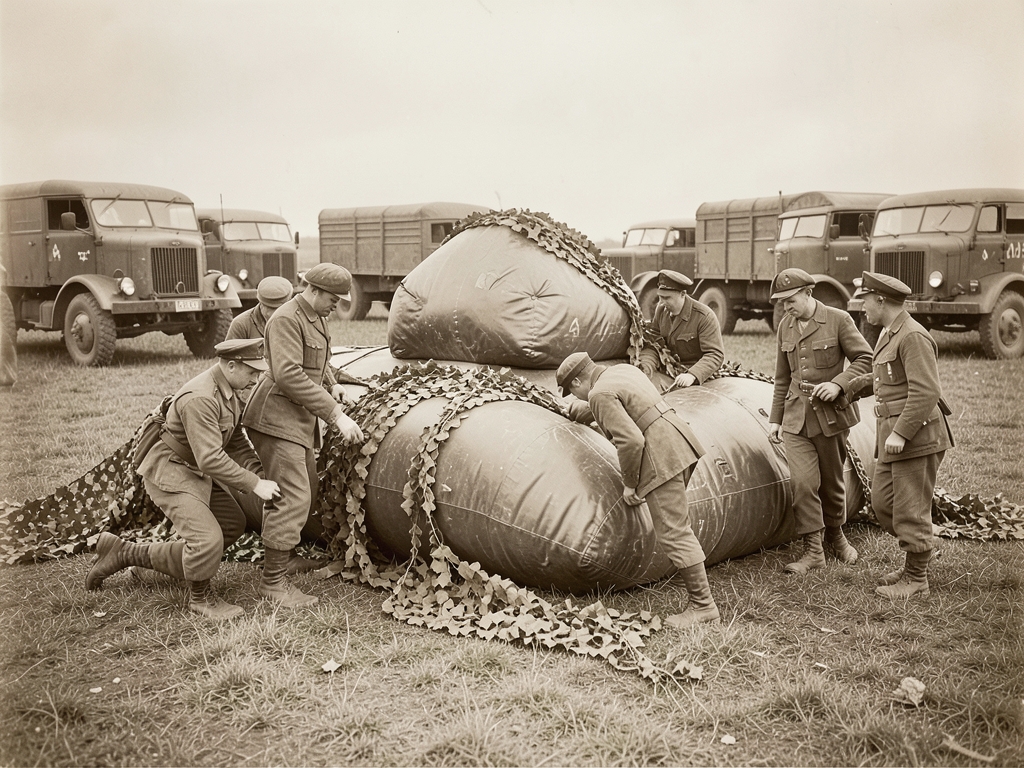
The visual deception element of the Ghost Army relied heavily on inflatable rubber equipment manufactured by specialized industrial companies, notably the Firestone Tire and Rubber Company. The unit carried dummy M4 Sherman tanks, heavy artillery pieces, half-tracks, and airplanes that could be inflated using portable air compressors in a matter of minutes. Deflating and packing them away was equally efficient, allowing the unit to pack up an entire phantom armored division and relocate before enemy forces could piece together the reality of the maneuver.
From a distance of a few hundred yards—or from the perspective of a high-flying German reconnaissance aircraft—these rubber replicas were virtually indistinguishable from real military hardware. However, inflatable tanks alone were not enough to fool experienced enemy spotters. The Ghost Army soldiers understood that an authentic military encampment required human activity, tire tracks, fuel spills, and realistic daily routines. Soldiers would intentionally drive actual vehicles in circles around the dummy tanks to create convincing tread marks in the mud. They built fake cooking fires using small amounts of smoke-generating materials, hung laundry on improvised clotheslines, and walked around the camp wearing different shoulder patches to simulate multiple shifting divisions.
Info! The inflatable tanks were so lightweight that soldiers could easily pick them up and carry them around, leading to iconic historical photographs of troops playfully lifting a Sherman tank over their heads.
Beyond rubber armor, the visual deception company also utilized camouflage nets, fake headquarters buildings, and painted plywood silhouettes to simulate supply dumps, motor pools, and anti-aircraft nests. Every detail was meticulously planned; if an aerial photograph showed a supply depot that vanished overnight, German intelligence would grow suspicious. Therefore, the Ghost Army had to maintain these phantom camps for precise windows of time, coordinating their appearance and disappearance with broader strategic movements elsewhere on the front lines.
Sonic Deception: The Sound of War
While visual tricks fooled aerial reconnaissance, auditory deception targeted enemy listening posts and frontline observers. The 3133rd Signal Service Company, the sonic deception branch of the Ghost Army, utilized powerful wire recorders and giant amplifiers mounted on the backs of heavy-duty military trucks. These speakers could project the terrifying, metallic roar of a moving armored column across distances of up to fifteen miles, depending on atmospheric conditions and terrain.
The unit worked closely with military intelligence analysts to record authentic sounds of tank engines revving, artillery pieces shifting into position, troops shouting commands, and metal tracks clanking against pavement. These audio recordings were captured using early magnetic wire recording technology, which was more rugged and reliable in the field than delicate vinyl or wax discs. Engineers carefully layered and edited together these sounds into complex soundscapes tailored to specific tactical scenarios—whether simulating the assembly of an infantry regiment or the staging of an armored brigade preparing for a breakthrough. By driving their sound trucks close to enemy lines at night, the Ghost Army could convince listening German patrols that an entire infantry division was preparing to launch a dawn assault.
Radio Deception: The Art of Traffic Control
Perhaps the most technically complex aspect of the Ghost Army's operations was radio deception, handled primarily by the Signal Corps. Enemy intelligence units—such as the German *Abwehr* and signals intelligence intercept services—relied heavily on radio traffic analysis to determine troop locations, unit sizes, and operational readiness. In modern warfare, every radio operator has a distinct "fist," a unique cadence and rhythm when tapping out Morse code, much like handwriting. Furthermore, radio traffic patterns swell and wane predictably during military shifts and reorganizations.
To manipulate this intelligence pipeline, Ghost Army radio operators impersonated the specific operators of actual combat units. They meticulously mimicked individual sending styles, Morse code rhythms, and transmission frequencies. While the real combat units maintained strict radio silence as they secretly repositioned for an offensive, the Ghost Army kept their former radio nets active, broadcasting fake messages, routine supply requisitions, and coded orders that made German intelligence believe the units had not moved at all. This digital ghost trail successfully blinded the enemy to major shifts in Allied order of battle.
Notable Operations and Combat Record
The Ghost Army participated in over twenty major deceptions across Western Europe, often operating mere miles from the front lines and taking on immense personal risk. Because their primary goal was to draw enemy attention, they frequently became targets of German artillery barrages and air raids, suffering casualties despite lacking heavy offensive weapons to return fire. Their first major test came shortly after the Normandy landings, where they helped conceal the buildup of Allied forces near Brest, France.
Another notable deployment occurred during the push through the heavily fortified Lorraine campaign, where the unit used its full suite of visual, sonic, and radio tactics to mask the redeployment of American armored forces. However, one of their most famous and critical missions occurred in March 1945 during Operation Viersen, the Allied crossing of the Rhine River. During Operation Viersen, the 23rd Headquarters Special Troops were tasked with drawing heavy German defensive fire away from the actual crossing point of the U.S. 9th Army. For several days, the Ghost Army deployed hundreds of inflatable tanks, broadcasted the deafening sounds of crossing preparations, and generated heavy radio traffic just north of Düsseldorf. The deception worked brilliantly. German artillery concentrated its fire on the phantom forces, allowing the real 9th Army to cross the Rhine with remarkably low casualties.
The men of the Ghost Army saved thousands of lives through deception, camouflage, and psychological warfare, operating in total secrecy for decades after the war ended.
Declassification and Historical Legacy
Despite their critical contributions to the war effort, the existence of the 23rd Headquarters Special Troops remained a strictly guarded military secret for more than fifty years. Declassified only in 1996, the operations of the Ghost Army were finally brought to light, allowing the surviving veterans to receive long-overdue recognition for their ingenuity and bravery. For decades, many veterans could not explain to their families why they carried drafting tables into combat zones or why their official military records seemed remarkably sparse and uninformative.
Many of the veterans went on to achieve remarkable civilian careers in the arts and design, benefiting from the keen observational skills and creative problem-solving techniques they had cultivated during the war. Renowned fashion designer Bill Blass, acclaimed abstract expressionist painter Ellsworth Kelly, and celebrated wildlife artist Arthur Singer all served in the ranks of the Ghost Army, channeling the observational skills and creative talents they honed during the war into their post-war professional lives.
Today, historians and military analysts study the Ghost Army not only as a fascinating historical anomaly of World War II, but as a foundational precursor to modern information warfare, electronic countermeasures, and tactical camouflage techniques used by contemporary armed forces around the globe. The principles of digital deception, signature management, and psychological manipulation pioneered by the 23rd Headquarters Special Troops continue to influence how modern militaries protect their forces and mask their operational intentions in an era of advanced satellite surveillance and electronic intelligence.
What was the primary mission of the Ghost Army during World War II?
The primary mission of the Ghost Army was to conduct tactical deception operations, using inflatable equipment, sound effects, and radio trickery to mislead enemy forces about the location and strength of Allied troops.
How many soldiers served in the 23rd Headquarters Special Troops?
The unit was relatively small, comprising just over 1,100 officers and enlisted men, yet their specialized equipment and tactics allowed them to simulate the presence of tens of thousands of troops.
When were the records of the Ghost Army declassified?
The operations and existence of the Ghost Army remained classified military secrets for over half a century until they were officially declassified by the United States government in 1996.
Did any famous artists serve in the Ghost Army?
Yes, many recruits were talented artists, designers, and actors. Notable figures who served in the unit include fashion designer Bill Blass and painter Ellsworth Kelly.
Reflecting on the extraordinary exploits of the 23rd Headquarters Special Troops reveals a remarkable chapter of military history where art, science, and psychology converged to protect human life and alter the course of history.
