

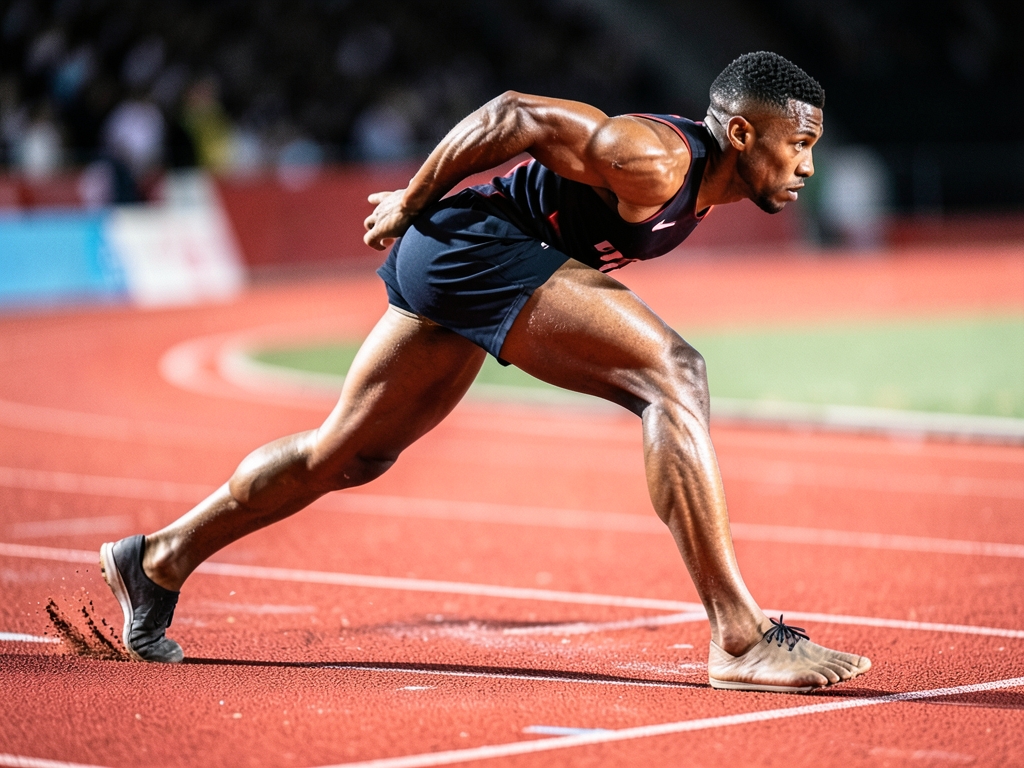
Sprinting is one of the most fundamental yet complex athletic movements in human history. At first glance, running as fast as possible appears to be a simple act of pushing off the ground and moving forward. However, beneath the surface of every elite 100-meter dash lies an intricate interplay of physics, neurology, and biomechanics. Every stride is governed by precise mechanical laws, muscular coordination, and energy transfer systems that allow human beings to propel themselves across the earth at speeds exceeding 27 miles per hour. Understanding the science of sprinting goes far beyond tracking finish times; it reveals how the human body functions under extreme physical demands.
When athletes step onto the track, they are not merely relying on raw muscular power. They are engaging in a high-speed physics experiment where gravity, ground reaction forces, and air resistance constantly influence performance. Sports scientists, coaches, and physiotherapists spend years analyzing the mechanics of elite sprinters to unlock marginal gains. By breaking down the sprint into distinct phases—acceleration, maximum velocity, and deceleration—we can better appreciate the physiological marvels that enable world-class performances.
The Anatomy of the Start and Acceleration Phase
The acceleration phase is arguably the most physically demanding portion of a sprint. It begins the moment the starting gun fires and typically lasts for the first 30 to 40 meters of a race. During this phase, the athlete transitions from a stationary position to maximum horizontal speed. The primary objective is to apply massive amounts of force into the starting blocks and subsequently into the track surface at an optimal angle.
Unlike maximum velocity running, where the body is upright, acceleration requires a distinct forward lean. This body angle allows the runner to direct the ground reaction force backward, which in turn propels the body forward and upward according to Newton's third law of motion. If an athlete stands upright too quickly during a race, the force vector is directed too high into the air rather than down and back, severely limiting horizontal propulsion.
Info! During the initial block clearance, elite sprinters can experience horizontal forces exceeding four times their own body weight with every single step.
To achieve this mechanical advantage, starting blocks are meticulously adjusted to fit the individual anthropometry of the athlete. The rear block is typically placed further back, allowing for a longer first stride, while the front block provides the initial explosive push. As the sprinter leaves the blocks, the ankles, knees, and hips extend in a coordinated triple extension pattern. This kinetic chain operates like a coiled spring unspooling in fractions of a second.
Muscle recruitment during this phase heavily favors the posterior chain, including the glutes, hamstrings, and calves. The hip extensors act as powerful levers, driving the thighs backward against the ground. Neurologically, the brain sends rapid electrochemical signals down the spinal cord to recruit fast-twitch muscle fibers instantaneously. These Type IIx muscle fibers are specialized for explosive, high-power output, though they fatigue very quickly compared to endurance-oriented slow-twitch fibers.
Furthermore, arm action plays a crucial supporting role during acceleration. The arms do not merely swing for balance; they act as a counter-rotation mechanism to offset the heavy torque generated by the legs. Elite sprinters drive their elbows back aggressively, with a shorter arm swing amplitude during early acceleration that gradually lengthens as the body rises into an upright posture.
Transitioning to Maximum Velocity
Once an athlete covers the initial acceleration phase, the body naturally rises into an upright posture. This marks the transition to maximum velocity, which usually occurs between the 40-meter and 80-meter marks in a 100-meter race. At this stage, the runner is no longer trying to accelerate further; instead, the goal is to maintain peak speed while minimizing velocity loss caused by air resistance and ground contact time.
Ground contact time becomes exceptionally critical at top speed. Elite sprinters spend a remarkably brief duration in contact with the ground—often less than nine-tenths of a second per step. During this fleeting moment, the foot must absorb the impact shock, stabilize the ankle and knee joints, and immediately apply a massive propulsive force before leaving the track again. Any wasted time on the ground acts as a brake, slowing the runner down.
| Sprint Phase | Primary Goal | Key Biomechanical Focus | Duration in 100m |
|---|---|---|---|
| Block Start | Overcome inertia | Low body angle, high force application | 0 - 10 meters |
| Acceleration | Increase speed | Backward force vector, powerful hip extension | 10 - 40 meters |
| Max Velocity | Maintain peak speed | Minimal ground contact time, high stride frequency | 40 - 80 meters |
| Deceleration | Limit speed loss | Maintain running form, neural fatigue management | 80 - 100 meters |
Stride mechanics are split into two primary variables: stride length and stride frequency. Coaches often debate which factor is more important, but biomechanical research shows that elite sprinters achieve their speeds through a sophisticated balance of both. Taller runners often leverage greater stride length, while shorter athletes may rely on an exceptionally high stride frequency. Regardless of height, the recovery phase—where the leg swings forward through the air—must be executed with maximum efficiency to prepare the limb for the next ground strike.
During maximum velocity, stiffness in the lower limbs becomes paramount. Tendons, particularly the Achilles tendon, act like elastic bands. They store mechanical energy when the foot strikes the ground and rapidly recoil to release that energy during toe-off. This stretch-shortening cycle (SSC) allows sprinters to generate high forces without requiring an equivalent increase in active muscle contraction time. Athletes with superior tendon stiffness experience less energy dissipation, converting metabolic effort into forward momentum with exceptional efficiency.
The Physiological Limits and Deceleration
A common misconception among casual sports fans is that sprinters accelerate all the way to the finish line. In reality, almost all human runners begin to decelerate slightly during the final 15 to 20 meters of a 100-meter race. This phenomenon is not necessarily a conscious choice by the athlete, but rather an inevitable consequence of neuromuscular fatigue and metabolic limitations.
Sprinting relies entirely on the anaerobic energy systems, specifically the ATP-PC (adenosine triphosphate-phosphocreatine) system and anaerobic glycolysis. The body does not rely on oxygen during a 10-second sprint because the metabolic demand far exceeds what the cardiovascular system can deliver in real time. As the muscles rapidly consume stored ATP and phosphocreatine, metabolic byproducts such as hydrogen ions accumulate within the muscle tissue. This accumulation impairs muscle fiber contraction velocity and reduces the firing rate of motor neurons from the central nervous system.
The ultimate barrier in sprinting is not just muscular strength, but the brain's ability to maintain high-frequency neural drive when the central nervous system begins to experience metabolic stress.
When the nervous system can no longer sustain rapid muscle recruitment, stride frequency drops, and form begins to break down. The athlete who wins a sprint race is rarely the one who runs the fastest initial 50 meters, but rather the one who experiences the least amount of deceleration in the final stretch. Maintaining relaxation in the face of fatigue is a hallmark of elite sprinting; tensing the upper body or jaw only exacerbates inefficient muscle contraction and drains precious neural resources.
Warning! Overtraining without adequate recovery between high-intensity sprint sessions significantly increases the risk of acute hamstring strains due to eccentric overload during the swing phase.
Practical Applications for Athletes and Coaches
Translating biomechanical principles into everyday training requires a structured, multi-disciplinary approach. Coaches do not simply ask athletes to run fast repeatedly; they focus on technical drills, strength development, and injury prevention protocols.
- Implement resisted sprinting (such as sled pulls) to develop specific horizontal force production during the early acceleration phase.
- Perform plyometric exercises, such as depth jumps and bounding, to improve tendon stiffness and reduce ground contact time at maximum velocity.
- Integrate technical A-skips and B-skips into dynamic warm-ups to reinforce proper leg recovery mechanics and posture.
- Monitor training volume closely to avoid central nervous system fatigue, ensuring high-quality efforts during speed sessions.
Furthermore, flexibility and eccentric hamstring strength are vital for long-term athletic durability. Because the hamstrings must decelerate the rapidly swinging lower leg before foot strike, they undergo intense eccentric loading. Strengthening these muscles through exercises like Nordic hamstring curls is one of the most effective ways to protect against common running injuries.
Periodization of speed training is equally critical. Athletes cannot sprint at maximal intensities every day without degrading their neuromuscular system. A balanced weekly microcycle typically includes two to three high-intensity acceleration or top-speed sessions, interspersed with active recovery, technical restoration, and targeted strength training. This structured variance ensures that adaptations occur without crossing the threshold into chronic fatigue or overuse injuries.
Why do sprinters lean forward at the start of a race?
Sprinters lean forward during the acceleration phase to direct their ground reaction forces backward. This horizontal force vector propels the body forward rather than straight up into the air, allowing for optimal acceleration from a stationary position.
How long does the human body rely on anaerobic energy during a sprint?
Short-distance sprints rely almost entirely on the anaerobic energy systems, specifically the ATP-PC system and anaerobic glycolysis, because the duration of the event is too short for aerobic metabolism to play a primary role.
What causes athletes to slow down at the end of a 100-meter sprint?
Deceleration near the end of a sprint is caused by neuromuscular fatigue, depletion of immediate energy stores like phosphocreatine, and the accumulation of metabolic byproducts that reduce muscle contraction speed and neural firing rates.
Is stride length or stride frequency more important for sprinting speed?
Elite sprinting speed is achieved through an optimal balance of both stride length and stride frequency. While taller athletes may benefit from greater stride length, shorter athletes often compensate with higher stride frequency to achieve competitive speeds.
Ultimately, sprinting is a profound demonstration of human physiological capability. By examining the mechanics of acceleration, maximum velocity, and energy depletion, athletes and sports scientists continue to push the boundaries of how fast the human body can travel under its own power.
