

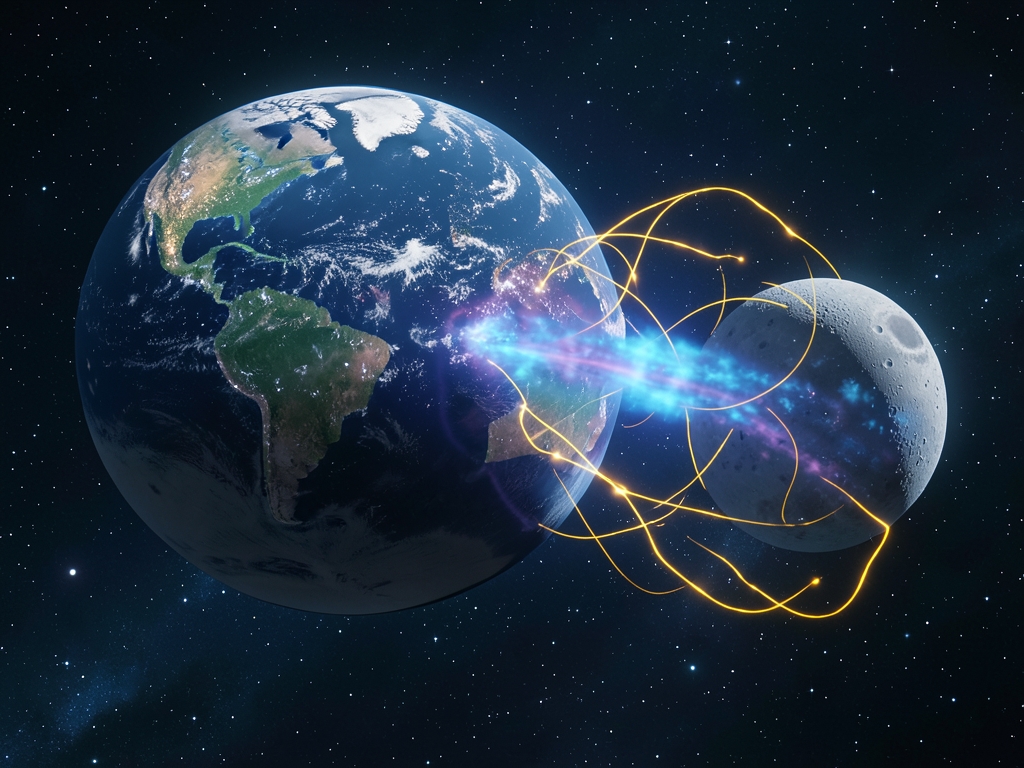
When we gaze up at the Moon, we often think of it as a dead, silent rock orbiting our planet in a quiet vacuum. However, modern space physics reveals a surprisingly dynamic interaction between our planet and its natural satellite. Far beyond the sunlit surface and the shadowy craters, Earth extends a massive, invisible magnetic bubble known as the magnetosphere. On the side facing away from the Sun, this magnetic field stretches out into a long, tapered wake called the magnetotail, extending millions of kilometers into deep space. Within this vast plasma environment, complex energetic processes occur continuously, chief among them being lunar reconnection events.
Magnetic reconnection is a fundamental physical process operating throughout the universe, occurring whenever oppositely directed magnetic field lines snap, break, and violently reorganize into a new configuration. This explosive realignment converts magnetic energy into kinetic energy, thermal energy, and particle acceleration. While much of our understanding of magnetic reconnection has traditionally focused on solar flares and Earth's own magnetopause, recent satellite missions have highlighted the critical role that the Moon plays as it orbits directly through Earth's magnetotail. As the lunar body plows through this sea of charged particles, it interacts with the ambient plasma sheet, triggering localized magnetic reconnection events that provide invaluable laboratories for space plasma physics.
The Anatomy of Earth's Magnetotail and the Lunar Orbit
To understand why magnetic reconnection happens near the Moon, one must first examine the architecture of Earth's magnetic environment. The solar wind—a continuous stream of charged particles flowing outward from the Sun—compressed Earth's magnetic field on the dayside while stretching it out on the nightside into the magnetotail. This tail consists of two primary lobes of magnetic field lines pointing in opposite directions, separated by a thin, dense region of hot plasma known as the plasma sheet.
As the Moon completes its monthly orbit around Earth, it spends several days every month passing directly through this magnetotail and its central plasma sheet. Unlike Earth, which possesses a strong, globally generated internal magnetic field, the Moon lacks a global dipole field. Instead, it has only weak, localized crustal magnetic anomalies scattered across its surface. Because the Moon has no thick atmosphere and no strong global magnetic shield, it acts as an obstacle in the solar wind and magnetotail plasma flow, creating a distinct plasma wake, cavity, and shock structures.
Info! The Moon's passage through Earth's magnetotail occurs predictably during every full moon phase, providing researchers with a reliable schedule for gathering plasma measurements from orbiting spacecraft.
When the Moon enters the plasma sheet, the local magnetic field topology undergoes significant distortion. The lunar body sweeps up ambient plasma, creating a cavity behind it where plasma density drops sharply. The surrounding magnetic field lines must drape around this obstacle, increasing magnetic tension and setting the stage for magnetic reconnection. These interactions shed light on how planetary bodies without global magnetic fields interact with magnetized plasma environments.
Furthermore, the physical dimensions of the magnetotail play an essential role in dictating the frequency and scale of these interactions. The magnetotail is typically about 20 to 30 Earth radii wide in the vicinity of the lunar orbit (which sits at roughly 60 Earth radii). Because the Moon's orbital velocity carries it steadily across this structure, the spacecraft crossing the tail observe systematic variations in magnetic field strength, plasma density, and particle temperatures. This predictable geometry allows mission planners to anticipate when instruments will capture high-resolution data on dynamic boundary layers and tail reconnection exhausts.
Mechanisms of Lunar Magnetic Reconnection
Magnetic reconnection in the vicinity of the Moon differs from the reconnection events occurring on the dayside of Earth or in solar flares due to the unique boundary conditions introduced by the lunar surface. When oppositely oriented magnetic field lines are pushed together in the plasma sheet near the Moon, the frozen-in magnetic flux condition—which dictates that plasma and magnetic fields are tightly bound together—breaks down in a tiny localized region known as the diffusion region.
Within this diffusion region, electrons and ions decouple from the magnetic field lines. The magnetic field lines tear and reconnect, releasing immense amounts of stored magnetic energy. In the context of the lunar environment, this process can be triggered by plasma pressure gradients, velocity shears, or the direct obstruction of the plasma sheet by the solid lunar body. As the field lines snap and reform, they eject high-speed plasma jets, accelerate electrons and ions to high energies, and generate intense electromagnetic waves.
Magnetic reconnection is the universe's premier particle accelerator, turning stored magnetic energy into explosive kinetic force across planetary magnetospheres and stellar coronae alike.
Spacecraft such as NASA's ARTEMIS (Acceleration, Reconnection, Turbulence and Electrodynamics of the Moon's Interaction with the Sun) mission have provided unprecedented in-situ measurements of these processes. By positioning two probes in stable lunar orbits, researchers have been able to capture simultaneous multi-point observations of reconnection exhausts, flux ropes, and energetic particle bursts occurring right in the Moon's orbital path.
At the microphysical scale, the interplay between the solar wind protons, magnetotail electrons, and the solid regolith creates complex kinetic behaviors. When the magnetic field lines reconnect, the resulting electric fields accelerate local electrons to tens or hundreds of electron-volts, while ions can reach kiloelectron-volt energies. These particle beams travel along newly formed magnetic field lines, impacting the lunar nightside surface or escaping back into the broader magnetotail. Understanding these mechanisms requires sophisticated kinetic plasma simulations that model the behavior of billions of individual particles under varying magnetic topology.
Consequences and Observations of Space Weather Near the Moon
The study of lunar reconnection events is not merely an academic exercise in plasma physics; it has direct implications for our understanding of space weather throughout the inner solar system. Space weather encompasses the dynamic conditions in the magnetosphere, ionosphere, and interplanetary space driven by solar activity. Understanding how obstacles like the Moon modify and trigger magnetic energy release helps scientists model how plasma behaves around other airless bodies, such as asteroids, comets, and unmagnetized exoplanets.
Furthermore, lunar reconnection events can accelerate ions and electrons toward the lunar surface. When these energetic particles bombard the unprotected lunar regolith, they contribute to space weathering processes. This energetic particle bombardment sputters atoms from the surface, alters the chemical composition of surface minerals, and helps sustain the tenuous lunar exosphere. Additionally, studying these events provides crucial safety data for future human exploration. Astronauts establishing long-term bases on the Moon will be exposed to space radiation environments influenced by magnetotail dynamics and reconnection-driven particle acceleration.
Space weather monitoring in the lunar environment also benefits our understanding of broader geophysical interactions. When geomagnetic storms occur on Earth due to intense solar eruptions, the entire magnetotail expands, compresses, and undergoes large-scale reconfiguration. During these disturbed intervals, the magnetotail reconnection events near the Moon become vastly more frequent and energetic. Observing these tail dynamics from a lunar vantage point gives scientists an early warning system and an alternative perspective on how planetary magnetic fields respond to severe solar disturbances.
| Parameter | Earth Magnetopause Reconnection | Lunar Magnetotail Reconnection |
|---|---|---|
| Primary Driver | Interplanetary Magnetic Field & Solar Wind | Moon Obstruction & Plasma Sheet Dynamics |
| Magnetic Field Strength | Strong (Global Dipole Influence) | Weak (Local Crustal Anomalies & Tail Fields) |
| Plasma Density | Variable (Depends on Solar Wind) | Low (Influenced by Lunar Wake Cavity) |
| Primary Observation Tool | Geostationary and Magnetospheric Satellites | ARTEMIS and Dedicated Lunar Orbiters |
Future Directions in Lunar Plasma Research
As international interest in lunar exploration accelerates, the scientific community is placing renewed emphasis on heliophysics and plasma physics surrounding the Moon. Future missions plan to deploy coordinated constellations of small satellites and surface-based magnetometers to map the lunar plasma environment with greater spatial and temporal resolution than ever before. These advancements will allow researchers to track individual magnetic reconnection diffusion regions in real time, measuring electron-scale physics that remain poorly understood.
Understanding these micro-scale plasma interactions ultimately bridges the gap between local space weather around Earth and universal astrophysical phenomena. Every time the Moon drifts through Earth's magnetic tail and triggers a sudden burst of magnetic reconnection, it offers a window into fundamental plasma behaviors occurring in distant nebulae, galactic cores, and stellar atmospheres across the cosmos.
Moreover, the integration of surface instrumentation will revolutionize our data collection capabilities. Placing magnetometers, plasma spectrometers, and energetic particle detectors directly on the lunar surface—particularly near strong crustal magnetic anomalies like Reiner Gamma—will enable scientists to study how local magnetic patches interact with tail reconnection products. These ground-truth measurements, combined with orbital satellite constellations, will yield a three-dimensional, comprehensive model of the lunar plasma environment.
What causes magnetic reconnection near the Moon?
Magnetic reconnection near the Moon is caused when the solid lunar body obstructs the flow of plasma within Earth's magnetotail plasma sheet, forcing oppositely directed magnetic field lines to compress, snap, and explosively reorganize.
Does the Moon have its own magnetic field to cause reconnection?
No, the Moon lacks a global dipole magnetic field. It only possesses weak, localized crustal magnetic anomalies, meaning the reconnection events are primarily driven by Earth's vast magnetotail environment interacting with the lunar obstacle.
How do scientists study lunar reconnection events?
Scientists study these events using specialized spacecraft missions, such as NASA's ARTEMIS probes, which orbit the Moon and take simultaneous multi-point measurements of plasma density, magnetic fields, and accelerated particle jets.
Why are lunar reconnection studies important for space exploration?
Understanding lunar reconnection helps researchers model space weather, evaluate radiation hazards for future astronauts on the lunar surface, and understand how unmagnetized planetary bodies interact with stellar winds.
In conclusion, lunar reconnection events represent a fascinating intersection of planetary science and plasma physics. By examining how Earth's sprawling magnetic wake interacts with our airless natural satellite, researchers gain deep insights into universal energy conversion processes. As humanity prepares to return to the Moon to stay, unraveling the invisible magnetic dynamics of the lunar environment remains a vital step in mastering our place in the solar system.
