

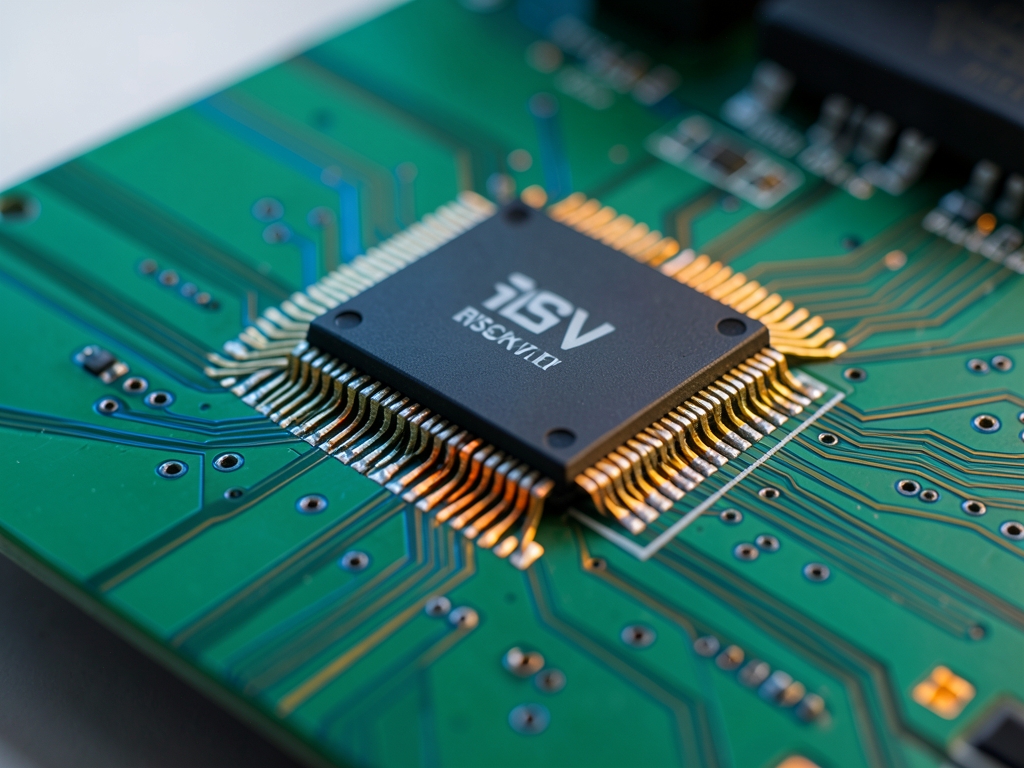
The global semiconductor landscape is undergoing its most profound structural shift in decades. For nearly forty years, commercial computing was dominated by proprietary Instruction Set Architectures, or ISAs. Companies and developers seeking to design high-performance processors had to license architecture blueprints from dominant patent holders, paying steep royalties and operating under restrictive contractual frameworks. Today, however, a disruptive force is fundamentally altering how engineers design microchips. RISC-V, an open-standard instruction set architecture originally born out of academic research at the University of California, Berkeley, has emerged as a formidable alternative to traditional proprietary computing paradigms.
Understanding RISC-V requires examining the foundational mechanics of how hardware interacts with software. An instruction set architecture acts as the fundamental dictionary and grammar rules that a processor uses to understand and execute software commands. When a compiler translates human-readable programming languages down into machine code, it outputs instructions tailored directly to that specific architecture's specification. Historically, choosing an ISA meant locking a product ecosystem into a proprietary vendor lock-in cycle. RISC-V shatters this paradigm by offering an open-source model where the foundational architecture specifications are freely available for anyone to use, study, modify, and implement without paying expensive commercial licensing fees.
The Core Philosophy of Reduced Instruction Set Computer Design
To grasp the technical elegance of RISC-V, one must first look back at the underlying design philosophy of Reduced Instruction Set Computer systems. Unlike Complex Instruction Set Computer architectures, which feature hundreds of highly specialized, complex instructions built directly into hardware, RISC architectures rely on a smaller, highly optimized set of basic instructions. Each instruction is designed to execute within a single clock cycle, streamlining pipeline execution and dramatically reducing the physical silicon area required for decoding logic.
The nomenclature of RISC-V reflects its lineage. It represents the fifth major iteration of RISC architectural research originating from Berkeley. What separates RISC-V from its historical predecessors is its modular design approach. A base integer instruction set provides the bare minimum required to build a functioning general-purpose processor. From there, engineers can selectively attach standardized extensions depending on their target application workload. These optional modular extensions cover floating-point arithmetic, vector processing, bit manipulation, and atomic operations.
Info! The modular nature of RISC-V allows hardware designers to strip away unnecessary silicon overhead, producing highly customized chips tailored exclusively for specific embedded workloads without paying for unused instruction logic.
This modularity introduces incredible versatility. An Internet of Things sensor node might implement only the basic integer instruction set to maximize battery life and minimize silicon footprint. Conversely, a modern artificial intelligence accelerator or high-performance server node can layer on dense vector extensions and custom coprocessor interfaces to handle massive machine learning workloads efficiently. This level of architectural customization was historically impossible or prohibitively expensive under rigid proprietary licensing models.
Furthermore, this architectural philosophy addresses the physical and electrical limits of modern silicon scaling. As traditional Dennard scaling has broken down and transistor density improvements have slowed, designers can no longer rely on raw frequency scaling to deliver performance gains. Instead, hardware developers must turn to domain-specific architectures—processors optimized for specific computing tasks. RISC-V provides an ideal sandbox for this approach, allowing engineers to strip away the historical baggage of general-purpose architectures and build hyper-efficient processing units that maximize performance per watt.
Why the Tech Industry Is Embracing Open-Source Hardware
The explosive momentum behind RISC-V is not merely an ideological movement favoring open-source software; it is driven by hard economic and technical realities. Designing modern proprietary processors requires immense capital investment. Licensing fees, legal negotiations, and compliance overheads create massive financial barriers to entry for startups, academic institutions, and mid-sized technology firms seeking to build custom silicon solutions.
By removing licensing friction, RISC-V democratizes hardware innovation. A university research lab or a small startup can design, simulate, and tape out a custom silicon chip without requiring millions of dollars in upfront licensing capital. This economic democratization has catalyzed an unprecedented burst of creativity in computer architecture, paving the way for domain-specific accelerators optimized for machine learning, edge computing, automotive systems, and aerospace engineering.
The shift toward open-source instruction set architectures represents a democratization of silicon design, transforming microchip engineering from a closed oligopoly into an accessible, collaborative global ecosystem.
Furthermore, geopolitical considerations play an increasingly vital role in semiconductor manufacturing. Because RISC-V is managed by a Swiss-based non-profit organization, the RISC-V International association, and its specifications are globally distributed as open standards, it offers a degree of regulatory insulation. Organizations across different continents can innovate on top of a shared, neutral standard without risking supply chain bottlenecks tied to a single country's proprietary technology export controls.
Major technology conglomerates have also recognized these strategic advantages, pouring significant resources into the ecosystem. Companies specializing in storage controllers, graphics processors, networking hardware, and microcontrollers are increasingly replacing internal proprietary cores with RISC-V implementations. This shift reduces reliance on external licensors, lowers production costs, and provides full visibility into the processor implementation, which enhances hardware security auditing and supply chain transparency.
Technical Architecture and Extensibility Features
A closer inspection of the RISC-V specification reveals why seasoned hardware engineers praise its clean-sheet design. Traditional architectures accumulated decades of legacy baggage, retaining obsolete instructions and backward-compatibility quirks that bloated silicon die size and complicated hardware verification. Because RISC-V started with a clean slate, its creators avoided legacy traps.
The architecture is meticulously partitioned into fixed-length and variable-length instruction formats. The base integer ISA is offered in 32-bit, 64-bit, and 128-bit variants, denoted as RV32I, RV64I, and RV128I respectively. The numbers indicate the width of the integer registers and address space, providing a seamless scaling path from ultra-low-power microcontrollers running pacemakers up to massive data center compute nodes managing petabytes of memory.
| RISC-V Variant | Register Width | Primary Target Applications |
|---|---|---|
| RV32I | 32-bit | Embedded systems, IoT devices, microcontrollers |
| RV64I | 64-bit | Laptops, servers, high-performance computing |
| RV128I | 128-bit | Next-generation theoretical massive scale systems |
In addition to standard base sets and extensions, RISC-V provides an explicitly defined mechanism for custom instruction encoding. Hardware developers do not need to hack around standard limitations; the specification reserves specific opcode space specifically for user-defined custom extensions. This allows companies to build proprietary acceleration blocks while remaining fully compliant with the broader open software toolchain ecosystem.
Another notable technical feature is the unprivileged and privileged architecture specifications. RISC-V cleanly separates user-mode execution from supervisor and machine modes, supporting robust virtual memory management and secure execution environments. This separation is vital for running modern multi-user operating systems securely, ensuring that user applications cannot compromise system-level kernel operations or access unauthorized memory boundaries.
Software Ecosystem Maturity and Compiler Support
A brilliant hardware architecture is useless without robust software support. Historically, new processor architectures struggled because compiling operating systems, compilers, libraries, and applications required monumental engineering efforts. Fortunately, the RISC-V ecosystem has achieved remarkable software maturity at an astonishing pace.
Major open-source toolchains, including GCC and LLVM, feature first-class support for RISC-V compilation. Operating systems like Linux, FreeBSD, and various real-time operating systems run natively on RISC-V silicon. Software developers can write code in high-level languages like C, C++, Rust, and Python, leveraging mature toolchains that automatically optimize binaries for specific RISC-V microarchitectures.
- Establish the base architecture specifications using official RISC-V International standards.
- Write or adapt low-level boot firmware and hardware abstraction layers.
- Compile standard Linux kernels or real-time operating systems using GCC or LLVM toolchains.
- Deploy application software and validate performance metrics against target workloads.
This rapid maturation of the software stack eliminates the chicken-and-egg dilemma that historically doomed many alternative computer architectures. Developers can build applications with confidence, knowing that the underlying software infrastructure is backed by a massive global community of contributors.
Furthermore, standard software libraries, container runtimes, and virtualization tools have been ported to support RISC-V. Developers can containerize applications using industry-standard tools and deploy them seamlessly across mixed-architecture data centers. The availability of robust simulation environments, such as QEMU and Spike, enables software engineers to test and debug compiled binaries long before physical silicon tape-outs are completed, drastically accelerating product development cycles.
Challenges and Real-World Implementation Hurdles
Despite its rapid ascent, RISC-V faces significant challenges on its path to total industry ubiquity. Established proprietary architectures have decades of entrenched market dominance, legacy code optimization, and deep software ecosystem integration. Dislodging an incumbent in high-performance computing or consumer smartphones requires overcoming immense inertia.
Warning! Fragmented silicon implementations can lead to ecosystem division if manufacturers implement non-standard proprietary extensions that break cross-platform software compatibility.
Another hurdle is hardware verification. While designing a basic RISC-V core is relatively straightforward using modern hardware description languages like Verilog or Chisel, ensuring that a complex commercial-grade core is completely bug-free requires exhaustive verification suites. Furthermore, software security vulnerabilities, side-channel attacks, and memory management unit standardization remain active areas of development within the community.
Addressing fragmentation requires strict adherence to ratified standards defined by RISC-V International. If manufacturers diverge and create incompatible custom variations of standard extensions, software portability suffers, undermining one of the core value propositions of an open architecture. Maintaining ecosystem cohesion demands continuous collaborative governance, rigorous compliance testing, and unified software maintenance standards.
What is RISC-V and how does it differ from traditional architectures?
RISC-V is an open-standard instruction set architecture based on established reduced instruction set computer principles. Unlike proprietary architectures that require expensive commercial licenses, RISC-V allows anyone to design, manufacture, and distribute custom microchips freely without paying royalties.
Do I have to pay royalties to manufacture a RISC-V chip?
No. The fundamental RISC-V instruction set architecture specifications are open-source and free to use. Companies can build commercial microprocessors based on the standard specifications without paying architecture licensing royalties, though proprietary value-added core designs from third-party vendors may still carry commercial costs.
Is the software ecosystem ready for RISC-V processors?
Yes, the software ecosystem has matured rapidly. Major compilers like GCC and LLVM support RISC-V, and popular operating systems including Linux and various real-time operating systems run natively on RISC-V hardware platforms.
Can companies add custom instructions to RISC-V designs?
Yes, RISC-V specifically reserves dedicated opcode space for user-defined custom extensions. This allows hardware engineers to build specialized acceleration blocks for custom workloads while maintaining standard compliance.
The rise of RISC-V represents a watershed moment in computer engineering. By merging open-source collaboration with rigorous modular design principles, it has dismantled historical barriers to silicon innovation. As the ecosystem continues to mature across embedded systems, automotive controllers, and high-performance data centers, open-source architectures will undoubtedly shape the future trajectory of global computing.
