

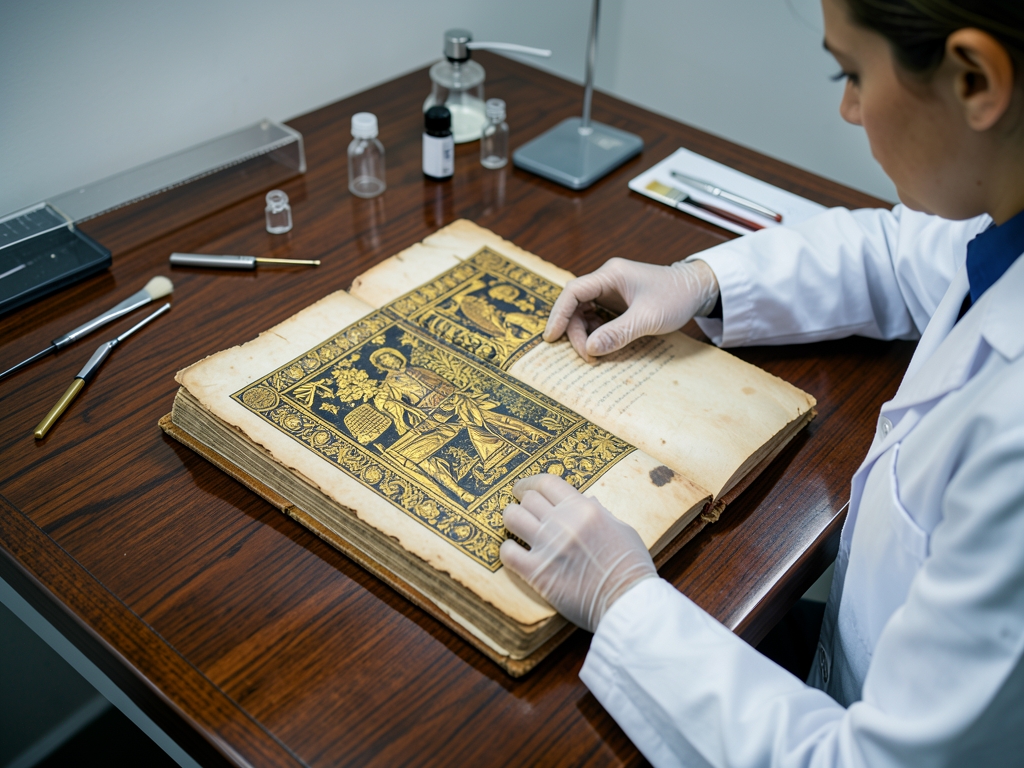
For centuries, historians and archivists have viewed medieval manuscripts primarily as literary, religious, and artistic treasures. Beautifully bound in leather and carefully penned on parchment by monastic scribes, these ancient texts preserved human thought through centuries of conflict, famine, and social upheaval. However, groundbreaking scientific research has revealed that medieval books harbor a second, invisible layer of history. By extracting and sequencing genetic material trapped within 1,000-year-old manuscript leaves, paleogenomic researchers have identified the DNA of deadly viral pathogens that once plagued medieval populations.
This innovative convergence of codicology—the study of physical books—and modern genetic sequencing is transforming our understanding of historical disease transmission. Parchment, crafted from the dried and stretched skins of livestock such as sheep, goats, and calves, acts as an extraordinary biomolecular archive. During production and over centuries of handling by scribes, monks, scholars, and readers, these organic surfaces absorbed biological residues. The survival of viral DNA fragments on ancient parchment provides unprecedented insights into how viruses evolved, spread across trade routes, and impacted medieval societies long before the advent of modern medicine.
The Biomolecular Vault: Why Medieval Parchment Preserves Ancient Pathogens
To understand how viral DNA survives inside ancient library collections, one must examine how medieval manuscripts were manufactured. Unlike modern paper made from wood pulp, medieval parchment is composed of animal dermis—a dense matrix of collagen fibers. The preparation process involved soaking hides in lime solutions, scraping away hair and flesh, stretching the skins tightly on wooden frames, and drying them under tension. This process created a durable, chemically stable membrane capable of enduring for over a millennium under appropriate environmental conditions.
Because parchment is fundamentally processed animal tissue, it retains endogenous biological material from the animal itself, alongside exogenous genetic traces left behind by human handlers. Scribes constantly interacted with the pages during production. They handled hides, used animal-based glues for bookbinding, and occasionally licked their quill pens or touched the pages with unwashed hands. Readers over successive centuries left behind microscopic skin flakes, sweat, and bodily secretions. When individuals suffering from active viral infections handled these volumes, viral particles became embedded within the porous collagen structure of the parchment.
Info! Environmental conditions within monastic libraries, cathedral archives, and royal collections played a pivotal role in preserving biological material. Low humidity, minimal light exposure, and stable temperatures prevented rapid microbial decay, effectively freezing viral genetic material in time.
Mapping Medieval Microbes: Viral Discoveries in Historical Texts
Recent high-throughput metagenomic analysis of historical manuscripts has identified several significant viral groups. Unlike bacterial pathogens such as Yersinia pestis (the causative agent of the Black Death), which readily leave signatures in the skeletal remains of victims, many viruses affect soft tissues and leave no trace on human bones. Consequently, paleogenomic studies of manuscript parchment offer a crucial complementary record of historical viral diversity.
Among the most notable findings is the detection of ancient viral sequences belonging to the Poxviridae and Hepadnaviridae families. Researchers have identified fragments of ancient Variola virus—the pathogen responsible for smallpox—as well as historical strains of Hepatitis B virus (HBV). Analyzing these ancient viral genomes allows bioarchaeologists to reconstruct evolutionary trees, revealing how viruses mutated over centuries and when specific pathogenic strains diverged from their ancestral lines.
"Medieval manuscripts are not merely static records of human writing; they are dynamic ecological archives containing the genomic footprints of the ancient biosphere, including the very pathogens that shaped human demographic history."
The discovery of viral DNA on parchment pages also sheds light on zoonotic spillover events in the Middle Ages. Because livestock lived in close proximity to human communities, ancient animal skins frequently harbor genomic traces of bovine, ovine, and porcine viruses. Studying these animal pathogens helps scientists trace how agricultural practices and animal husbandry contributed to the emergence of novel human diseases during the medieval era.
| Historical Period | Primary Sampling Matrix | Target Biomolecules | Key Epidemiological Insight |
|---|---|---|---|
| Early Middle Ages (500–1000 CE) | Vellum & Monastic Palimpsests | Endogenous & Viral DNA | Early divergence of zoonotic poxviruses and hepatitis strains |
| High Middle Ages (1000–1300 CE) | Illuminated Gospel Books | Human Skin Microflora & Viral DNA | Mapping disease transmission along monastic and trade routes |
| Late Middle Ages (1300–1500 CE) | Administrative & Guild Records | Pathogen & Bacterial Fragments | Tracking urban epidemic spikes alongside demographic shifts |
Methodological Breakthroughs: How Scientists Extract Ancient DNA Safely
Extracting delicate biological data from priceless, rare artifacts presents significant conservation challenges. Traditional genetic sampling required cutting small pieces of bone or tissue—an approach that is strictly unacceptable for unique medieval manuscripts. To overcome this barrier, interdisciplinary teams of geneticists, conservators, and archivists developed non-destructive sampling techniques that protect the structural and visual integrity of historical documents.
- Non-Invasive Surface Rubbing: Conservation scientists utilize specialized, non-abrasive synthetic erasers gently rubbed against the parchment surface. The electrostatic charge generated by rubbing lifts loose surface cells, dust, and microscopic biological residue without lifting ink or damaging fragile vellum fibers.
- Sub-Surface Micro-Extraction: In cases where deeper biological sampling is required, researchers extract microscopic collagen fragments from already damaged binder margins or trimmed waste edges that carry no script or illumination.
- High-Throughput Metagenomic Sequencing: Collected samples undergo enzymatic extraction to isolate highly degraded, short fragments of ancient DNA. Next-Generation Sequencing (NGS) platforms generate millions of individual sequence reads.
- Bioinformatic Filtering and Authentication: Advanced computational pipelines screen out modern human and environmental contamination. Scientists authenticate ancient viral DNA by searching for characteristic molecular damage patterns, such as cytosine-to-thymine (C-to-T) misincorporation resulting from post-mortem cytosine deamination over centuries.
Epidemiological Lessons for the Modern World
The field of historical paleogenomics extends far beyond satisfying historical curiosity. Understanding how deadly viruses evolved across a millennium provides practical insights for modern public health, virology, and evolutionary biology. By analyzing ancient viral genomes extracted from 1,000-year-old manuscripts, scientists can measure the historical mutation rate of viral lineages and evaluate how past human populations adapted to recurring epidemic threats.
Furthermore, mapping the geographic distribution of viral strains found in regional archives allows historians to reconstruct historical trade routes and human migration patterns with extraordinary precision. A specific viral variant preserved in a manuscript written in northern Europe may match sequences found in codices from the Byzantine Mediterranean, illustrating how international pilgrimage routes, trade networks, and military campaigns served as vectors for infectious disease transmission long before modern global travel.
Warning! While the genomic fragments discovered in medieval manuscripts provide invaluable data, they consist of highly degraded, non-viable nucleic acid fragments. They do not pose any biological hazard or risk of infection to modern conservators, researchers, or library visitors.
The Future of Molecular Codicology
As paleogenomic tools become increasingly sensitive, the field of molecular codicology is poised to expand exponentially. Millions of unexamined medieval manuscripts, legal rolls, and administrative charters preserved in libraries and archives across Europe, Asia, and North America remain untapped resources for genomic research. Future studies plan to analyze palimpsests—manuscripts where original text was scraped away to reuse the parchment—to uncover even older biological layers dating back to Late Antiquity.
By combining traditional historical analysis with state-of-the-art molecular genetics, researchers are building a richer, multi-dimensional narrative of human history. Manuscripts are no longer studied merely for the words inscribed upon their pages, but as living biological archives that document the co-evolution of humanity and the microscopic world.
How did viral DNA get onto 1,000-year-old manuscripts?
Viral DNA became trapped on medieval manuscripts through the biological raw materials used to make parchment (animal hides) and through human interaction. Monks, scribes, and readers infected with viral pathogens touched, handled, and occasionally coughed over the pages, leaving behind microscopic biological residues that bonded with the parchment's collagen matrix.
Does sampling ancient manuscripts destroy or damage the historical pages?
No. Modern paleogenomic researchers use non-destructive sampling techniques, such as gentle electrostatic eraser rubbings or dry swabbing. These methods lift microscopic surface residue and loose biological material without scratching the vellum, removing ink, or altering illuminated artwork.
Can ancient viruses found in medieval manuscripts revive and cause modern outbreaks?
No. The viral DNA recovered from ancient parchment consists of tiny, heavily degraded genomic fragments that have broken down over hundreds of years. The viruses are entirely non-viable and non-infectious, posing zero health risk to researchers or the public.
What specific viruses have scientists detected in ancient manuscripts?
Researchers have successfully identified genetic fragments belonging to historical strains of Variola virus (smallpox), Hepatitis B virus (HBV), herpesviruses, and various zoonotic poxviruses originating from domestic livestock used in parchment production.
The discovery of deadly viral DNA hidden within 1,000-year-old manuscripts marks a transformative milestone in historical research. By reading both the ink on the page and the biological molecules within the parchment, scientists and historians are uncovering an authentic, unfiltered record of human health, disease, and survival across the centuries.
