

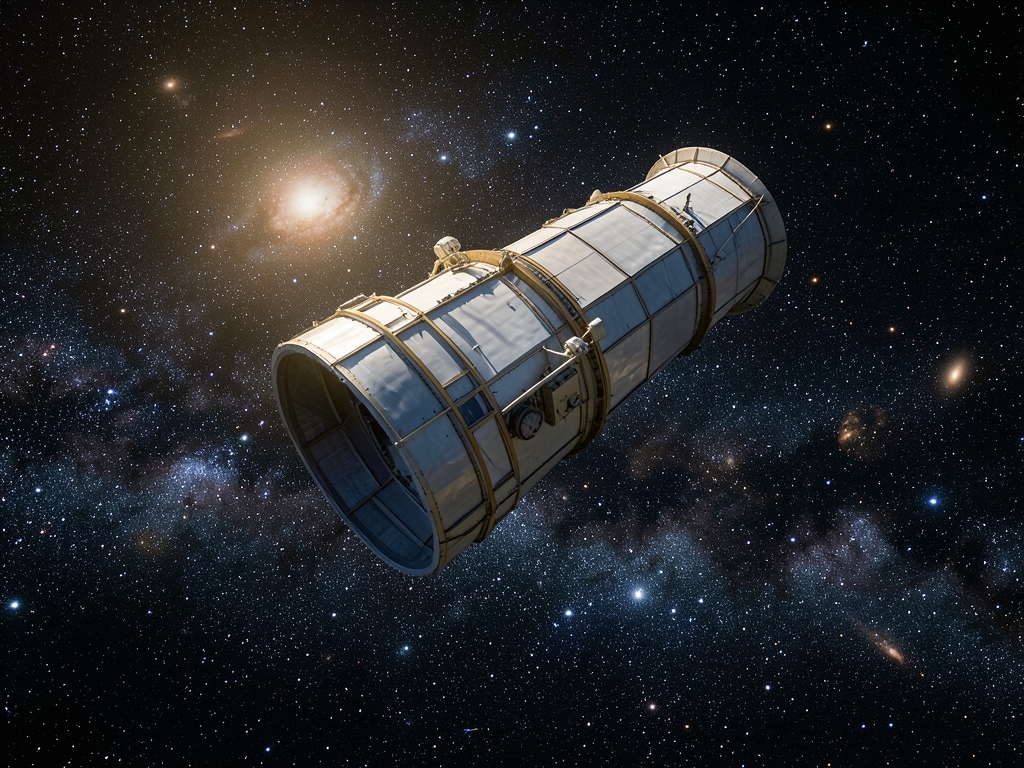
Modern observational astronomy has entered a remarkably productive era, particularly regarding our understanding of the early universe. For over a decade, astronomers labored painstakingly to locate and verify just ten ancient quasars, relying on scattered archival data and limited observation windows from ground-based facilities. Today, the landscape of deep space exploration has fundamentally shifted. Recent findings reveal that the European Space Agency’s Euclid space telescope has successfully identified twelve ancient quasars within the span of a single operational year. This breakthrough highlights not only the incredible engineering capabilities of modern space observatories but also the sheer volume of high-resolution data now becoming available to the international scientific community.
Understanding Quasars and Their Cosmic Significance
Quasars represent some of the most energetic and distant objects in the known universe. Powered by supermassive black holes lurking at the centers of young, developing galaxies, these luminous beacons emit staggering amounts of electromagnetic radiation. As matter spirals inward toward the central black hole, intense gravitational and frictional forces heat the material, creating a glowing accretion disk that can outshine entire galaxies containing billions of stars. Studying these cosmic powerhouses allows astrophysicists to peer backward in time, examining the conditions of the universe during its infancy.
Because light takes time to travel across the vast expanses of space, observing extremely distant objects means we are viewing them as they existed billions of years ago. Ancient quasars act as cosmic light-houses. As their light journeys toward Earth, it passes through various clouds of gas and dust scattered throughout the intergalactic medium. Each cloud absorbs specific wavelengths of light, leaving a distinct spectral signature. By analyzing these spectral absorption lines, researchers can map the distribution, chemical composition, and density of matter in the early universe, providing vital clues about how galaxies first formed and evolved.
The Technical Leap of Europe's Euclid Telescope
Launched to map the geometry of the dark universe and investigate the mysterious influences of dark energy and dark matter, the Euclid spacecraft was designed with unprecedented wide-field survey capabilities. Unlike traditional telescopes that focus on narrow, targeted patches of the sky, Euclid captures expansive panoramic images of the cosmos with remarkable sharpness. This wide-angle observational power is precisely what enabled the rapid discovery of these twelve ancient quasars.
Finding rare astronomical objects in massive datasets requires sophisticated filtering techniques and advanced computational algorithms. Researchers must sift through petabytes of imaging data to isolate faint, high-redshift candidates from millions of foreground stars and nearby galaxies. Euclid’s specialized optical and near-infrared instruments allow it to detect the faint infrared signatures characteristic of very distant celestial bodies. The spacecraft's ability to cover large swathes of the sky efficiently means that rare phenomena, once discovered only by accident or after years of exhaustive searching, are now being uncovered with statistical regularity.
The dramatic acceleration in discovering ancient quasars demonstrates how wide-field space surveys are transforming observational cosmology from a game of rare chance into systematic cartography.
Comparing Past Challenges With Modern Discovery Rates
To fully appreciate the significance of Euclid's recent milestone, it is helpful to examine the historical trajectory of quasar research. For many years, identifying high-redshift quasars was a bottleneck in astrophysical studies. Research teams spent years combining optical data from ground-based telescopes with infrared surveys, often confirming only one or two significant objects per decade of dedicated effort. The process was painstakingly slow, constrained by atmospheric interference, limited telescope time, and narrower fields of view.
Info! High-redshift quasars are those whose light has been heavily stretched toward longer red wavelengths due to the expansion of the universe over billions of years.
The transition from ground-based limitations to space-based wide-field surveys has completely altered this dynamic. By placing sensitive instruments above the distorting effects of Earth's atmosphere and equipping them with massive digital sensor arrays, space agencies have unlocked an unprecedented observational cadence. Finding twelve verified ancient quasars in a single year represents more than a numerical triumph; it signifies a methodological revolution in how astronomers survey the deep cosmos.
Implications for Dark Energy and Cosmic Evolution
The discovery of these twelve distant objects provides far more than a new entry in astronomical catalogs. Each newly confirmed quasar serves as a unique probe for investigating the epoch of reionization—a critical transitional period in cosmic history when the first generation of stars and galaxies flooded the universe with ultraviolet light, clearing out the neutral hydrogen fog that had previously filled space.
Furthermore, these findings tie directly into Euclid's primary mission objectives. By charting the distribution of massive structures across cosmic time, astronomers can better constrain models of cosmic expansion. Understanding how supermassive black holes grew so large so quickly in the early universe challenges existing theoretical models, forcing astrophysicists to refine their understanding of early black hole accretion and galaxy co-evolution.
| Observational Parameter | Traditional Ground Surveys | Euclid Space Survey |
|---|---|---|
| Survey Speed | Slow, targeted pointing | Rapid wide-field scanning |
| Atmospheric Interference | Significant optical distortion | Zero atmospheric obstruction |
| Discovery Rate | Approximately 1 per decade | Multiple per year |
| Spectral Coverage | Fragmented datasets | Integrated optical and infrared |
Future Outlook for Deep Space Exploration
As Euclid continues its multi-year mission, the international scientific community anticipates an even larger harvest of rare astronomical discoveries. The data pipelines processing these massive sky maps are continuously improving, aided by advanced machine learning tools designed to flag anomalous celestial objects with minimal human intervention. This synergy between advanced hardware and computational intelligence ensures that our map of the dark universe will become sharper, more detailed, and more comprehensive with each passing month.
Ultimately, missions like Euclid remind us of the vast scale of the cosmos and the ingenuity required to understand it. What once required a decade of painstaking labor by dedicated researchers can now be achieved in a fraction of that time, opening doors to questions about the universe's origin and evolution that previous generations of scientists could only wonder about from afar.
What is a quasar?
A quasar is an extremely luminous active galactic nucleus powered by a supermassive black hole, emitting vast amounts of energy as matter spirals into it.
Why are ancient quasars important to astronomers?
They act as cosmic lighthouses, allowing scientists to study the composition of the intergalactic medium and the conditions of the early universe billions of years ago.
How did the Euclid telescope find these quasars so quickly?
Euclid combines a wide-field survey capability with sensitive space-based optical and infrared instruments, allowing it to scan large areas of the sky rapidly and detect faint distant objects.
What is Euclid's primary mission objective?
Euclid's primary goal is to map the geometry of the dark universe, shedding light on the mysterious properties and influences of dark matter and dark energy.
The rapid acceleration in discovering ancient celestial objects marks a transformative chapter in modern astronomy. As space agencies continue to deploy sophisticated wide-field observatories, our collective view of the cosmos grows ever clearer, bridging the gap between theoretical cosmology and empirical discovery.
