

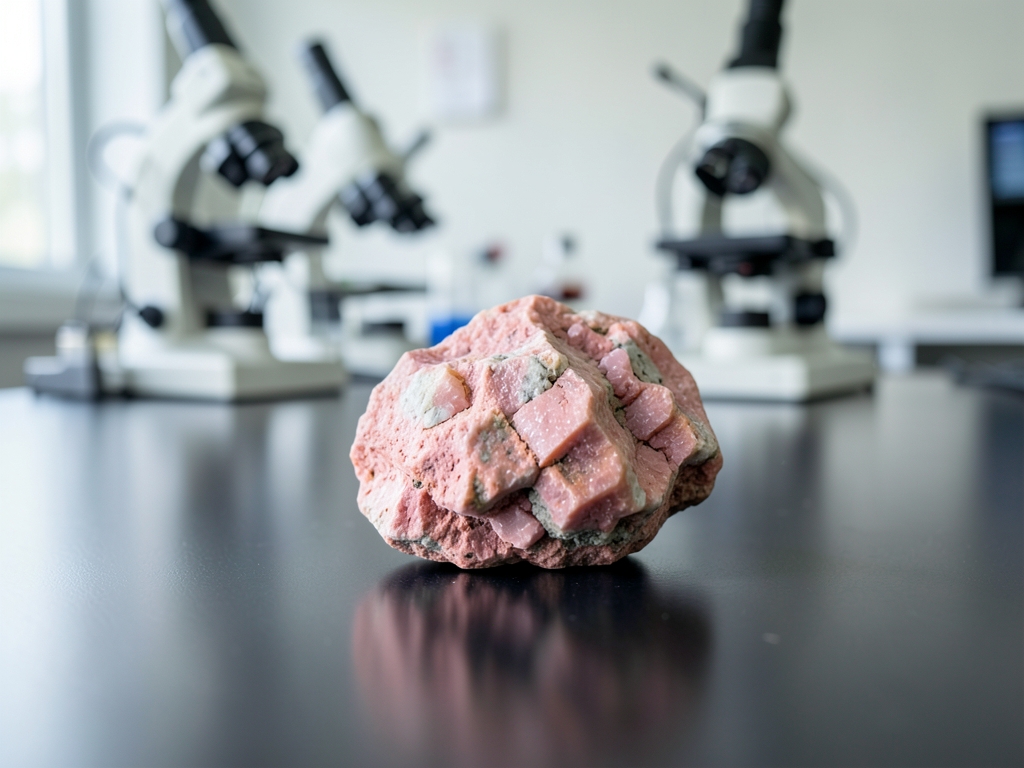
The vast expanses of the Sahara Desert have long served as one of Earth's most prolific natural repositories for extraterrestrial debris. Because the arid climate and minimal vegetation make dark or unusually colored rocks stand out against the sand, meteorite hunters and scientific expeditions frequently comb the dunes for clues about our solar system's history. Among the numerous discoveries recovered from these windswept landscapes, a peculiar 800-gram pink rock found in 2022 captured the intense curiosity of the international geological community. Following years of meticulous laboratory analysis, NASA-funded researchers have officially confirmed its extraterrestrial origin, shedding new light on planetary formation processes and the diverse mineralogy drifting through interplanetary space.
The journey of this unique specimen from the depths of space to a desert floor in North Africa highlights the collaborative and rigorous nature of modern planetary science. When unusual rocks are recovered by field researchers, they undergo a multi-step screening process before receiving official meteorite classifications. Specialized laboratories equipped with advanced mass spectrometers, electron microscopes, and X-ray diffraction tools analyze the chemical and isotopic composition of the sample. These tests are crucial for distinguishing Earth-bound terrestrial rocks from genuine meteorites originating from asteroids, the Moon, or Mars.
Mineralogical Composition and Laboratory Analysis
The 800-gram pink rock immediately drew attention due to its striking coloration, which is relatively rare among typical iron-nickel or ordinary chondrite meteorites. Mineralogical analysis conducted by the research team revealed a complex matrix composed of silicate minerals and unusual trace elements that do not match standard terrestrial geology. The pink hue is primarily driven by specific crystalline structures and iron-oxide interactions formed under unique thermal conditions in the early solar system.
To confirm that the rock was not a terrestrial imposter modified by desert weathering, scientists examined its isotopic signatures. The ratio of certain oxygen isotopes within the sample acts as a definitive fingerprint, aligning closely with established stellar and planetary evolution models rather than Earth's crustal materials. Furthermore, the presence of fusion crusts—formed as the rock melted during its high-speed atmospheric entry—provided undeniable physical evidence of its extraterrestrial journey.
| Analysis Method | Primary Objective | Key Scientific Finding |
|---|---|---|
| X-ray Diffraction | Mineral Identification | Detected unique silicate lattices and crystalline structures |
| Isotopic Ratio Testing | Origin Verification | Confirmed oxygen isotope ratios match solar system baselines |
| Microscopy Inspection | Fusion Crust Analysis | Identified aerodynamic melting patterns from atmospheric entry |
Broader Implications for Planetary Science
Discoveries like this pink Sahara meteorite provide valuable data points for astronomers and planetary geologists attempting to reconstruct the chaotic environment of the early solar system. While many recovered meteorites belong to well-documented classifications, outlier specimens challenge existing models and force scientists to expand their understanding of planetary differentiation. Rare mineral assemblages found within these space rocks often hint at parent bodies that underwent complex thermal histories, impacts, and volatile transport billions of years ago.
Moreover, the funding and involvement of NASA-supported initiatives underscore the importance of ground-truthing space missions with actual physical samples. While robotic probes and orbital telescopes gather incredible spectral data from afar, laboratory analysis on Earth allows researchers to examine atomic-scale structures and magnetic orientations that cannot be fully resolved remotely.
Info! Extraterrestrial samples recovered from desert environments are carefully cataloged in international meteorite repositories to ensure global access for peer-reviewed scientific study.
Challenges in Desert Meteorite Recovery
Recovering and authenticating meteorites in regions like the Sahara comes with distinct logistical and scientific challenges. Desert environments subject rocks to extreme temperature fluctuations, wind-driven sand abrasion, and chemical weathering from rare moisture events. These earthly processes can alter the exterior crust and even leach certain soluble minerals from the interior, complicating the analytical work performed by researchers.
To overcome these hurdles, research teams combine field archaeology techniques with advanced spectroscopy. By documenting the exact GPS coordinates and physical context of each find, scientists can better understand how long a meteorite has rested on the surface and how environmental exposure has affected its chemical integrity.
Future Research Directions
With the official confirmation of its origins now established, the 800-gram pink rock will become the subject of extended comparative studies. Researchers plan to compare its trace element distribution with samples returned by robotic asteroid-sampling missions. This comparative approach helps bridge the gap between meteorites that randomly fall to Earth and pristine samples collected directly from specific celestial bodies in deep space.
As analytical techniques continue to advance with higher-resolution imaging and more sensitive mass spectrometry, scientists anticipate uncovering even more subtle secrets locked inside these ancient messengers. Every authenticated meteorite adds another piece to the grand puzzle of how our solar system formed, evolved, and ultimately created the conditions necessary for life on Earth.
When was the 800-gram pink rock originally found in the Sahara Desert?
The distinctive pink rock was originally discovered in the Sahara Desert in 2022 before undergoing years of detailed laboratory analysis.
What evidence confirmed that the rock is a genuine meteorite?
Researchers confirmed its extraterrestrial origin by analyzing its unique oxygen isotope ratios, internal silicate mineralogy, and physical fusion crusts formed during atmospheric entry.
Why is the rock's pink coloration significant?
The unusual pink hue results from specific crystalline structures and iron-oxide interactions that reflect the unique thermal history of the rock's parent body in space.
NASA-funded research teams analyze meteorites to understand early solar system formation, asteroid differentiation, and the physical processes of planetary bodies.
