

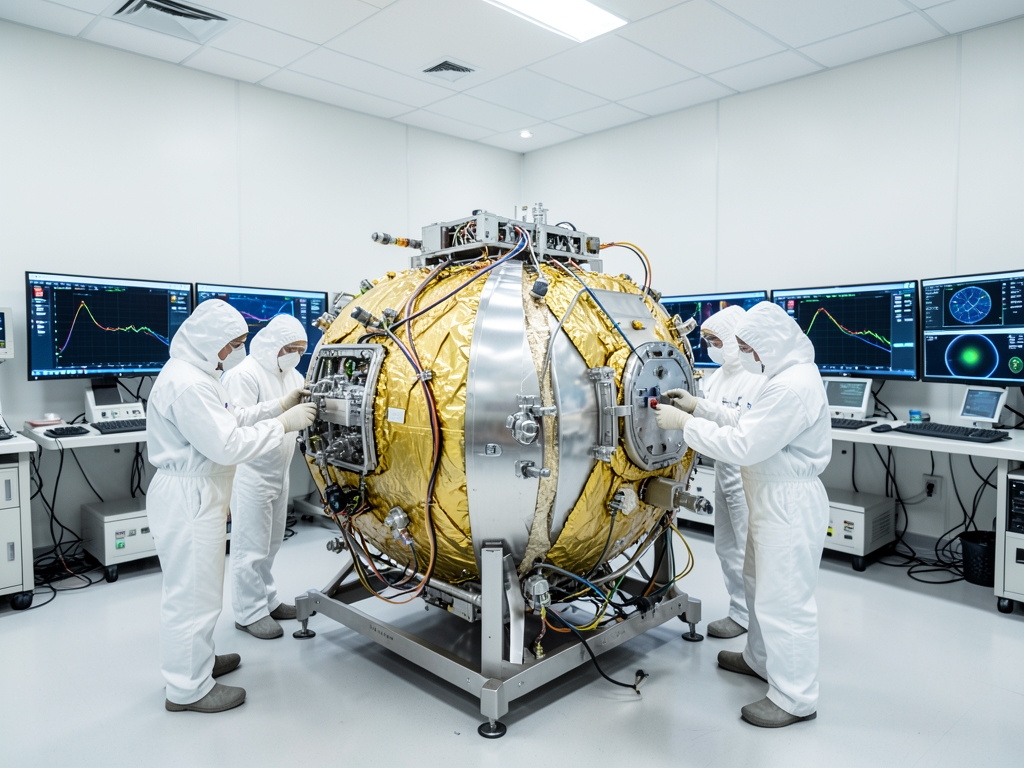
Advanced space exploration requires unprecedented collaboration between government space agencies and premier defense and aerospace contractors. In the latest milestone for deep-space observation architecture, BAE Systems has secured a critical role in supporting the National Aeronautics and Space Administration. The initiative centers on supplying the foundational spacecraft bus and spearheading rigorous environmental and functional testing for NASA’s upcoming PRIMA (Pioneering Infrared Astronomical Surveyor) telescope mission. This partnership marks a significant stride in humanity's quest to peer deeper into the infrared universe, promising to unlock unprecedented cosmic secrets that have remained hidden behind thick veils of interstellar dust.
As modern astrophysics shifts increasingly toward specialized infrared wavelengths to study early galaxy formation, stellar nurseries, and planetary atmospheres, the hardware demands placed on spacecraft engineering have grown exponentially. The PRIMA telescope is designed to address these complex observational challenges. By relying on robust industrial engineering and rigorous pre-flight validation protocols, mission planners aim to ensure that this sophisticated orbital observatory can withstand the punishing thermal extremes, mechanical vibrations, and radiation hazards of deep space deployment. The involvement of established aerospace manufacturers like BAE Systems brings decades of flight-proven reliability to a mission designed to reshape our understanding of cosmic evolution.
Understanding the Scope of the NASA PRIMA Telescope Mission
The Pioneering Infrared Astronomical Surveyor (PRIMA) mission represents a cornerstone in NASA's long-term strategic roadmap for astrophysics. Operating primarily in the infrared spectrum, the observatory will allow astronomers to detect faint thermal signatures from distant celestial bodies that are completely invisible to optical telescopes. Infrared astronomy is uniquely powerful because long wavelengths can penetrate dense cosmic dust clouds where stars and planetary systems are actively being born. By capturing these emissions, researchers can observe the life cycles of stars, map the distribution of complex organic molecules across the galaxy, and analyze the atmospheric composition of nearby exoplanets with remarkable precision.
However, achieving this level of observational sensitivity requires an exceptionally stable platform. Infrared detectors must be kept at extremely low cryogenic temperatures to prevent thermal interference from the spacecraft itself from blinding the instruments. This is where the spacecraft bus engineered by BAE Systems plays an indispensable role. The spacecraft bus serves as the foundational structural, power, and communications backbone of the entire observatory. It houses the propulsion systems, attitude control gyroscopes, solar power arrays, and high-gain communication antennas necessary to keep the telescope locked steadily onto distant targets while beaming gigabytes of scientific data back to Earth.
The Critical Role of BAE Systems in Spacecraft Bus Engineering
Building a spacecraft bus for an ambitious astrophysics mission is an engineering feat fraught with demanding specifications. The vehicle must be lightweight yet structurally rigid, capable of enduring the immense gravitational and acoustic forces exerted during launch aboard a heavy-lift rocket. Once in orbit, the spacecraft bus must provide ultra-precise pointing control, ensuring that the telescope's optics remain stable within fractions of an arcsecond.
BAE Systems brings extensive heritage in designing and manufacturing spacecraft structures, having contributed hardware and subsystems to numerous high-profile orbital missions. For the PRIMA telescope project, the company’s engineering teams are tasked with integrating power distribution units, thermal management loops, and autonomous navigation computers into a cohesive, highly reliable chassis. This architecture must function flawlessly for years in the vacuum of space, where routine maintenance is impossible.
The engineering of modern infrared space telescopes demands unprecedented coordination between thermal control, mechanical rigidity, and high-precision avionics to capture faint signals from the early universe.
To achieve this, the spacecraft bus incorporates advanced composite materials that minimize thermal expansion and contraction. Even microscopic shifts in structural geometry can distort alignment and ruin sensitive infrared measurements. By utilizing state-of-the-art computer-aided design, finite element analysis, and advanced manufacturing techniques, BAE Systems ensures that the structural framework maintains its integrity across extreme temperature gradients encountered during orbital maneuvers.
Rigorous Testing Protocols: Preparing PRIMA for the Void of Space
Before any instrument or satellite can be cleared for launch, it must undergo a grueling battery of environmental tests designed to simulate the harshest realities of space flight. BAE Systems has taken the lead in coordinating and executing this comprehensive testing regimen, utilizing specialized aerospace laboratory facilities.
Info! Spacecraft testing involves subjecting fully assembled hardware to acoustic vibration tables, thermal vacuum chambers, and electromagnetic interference evaluations to guarantee mission survivability.
The testing sequence typically includes several key phases:
- Vibration and Acoustic Testing: The spacecraft bus and structural simulators are mounted on massive shake tables that replicate the violent vibrations and roaring sound pressure levels experienced during rocket liftoff.
- Thermal Vacuum (TVAC) Testing: The entire assembly is placed inside large vacuum chambers where engineers cycle temperatures from extreme solar heating lows to deep-space freezing conditions, verifying thermal control system performance.
- Electromagnetic Compatibility (EMC): Technicians ensure that onboard electronics, transmitters, and power regulators do not emit electrical interference that could disrupt sensitive scientific instruments.
These rigorous protocols are vital for risk mitigation. In the realm of deep-space missions, there are no second chances once a payload separates from the launch vehicle. Discovering a flaw on the ground allows engineers to implement corrections, whereas an undetected anomaly in orbit can jeopardize an entire scientific investment.
Technical Specifications and Structural Architecture
To appreciate the magnitude of the PRIMA mission, it is helpful to examine the general engineering categories that govern modern space telescope architecture. The table below outlines the primary functional divisions of the observatory system.
| Subsystem Component | Primary Function | Key Engineering Requirement |
|---|---|---|
| Spacecraft Bus (BAE Systems) | Structural support, power generation, and propulsion | High rigidity, low mass, and thermal stability |
| Optical Payload Assembly | Infrared light collection and photon focusing | Cryogenic cooling and sub-micron alignment precision |
| Avionics and Attitude Control | Orbital navigation, pointing stability, and telemetry | Autonomous fault detection and ultra-precise gyroscopes |
| Communications Suite | Data downlink and command uplink with Earth stations | High-bandwidth X-band and Ka-band transmission |
Implications for Future Astrophysical Research
The successful development and eventual launch of the PRIMA telescope will fill critical observational gaps in contemporary astrophysics. While missions like the James Webb Space Telescope have demonstrated the immense power of deep-space infrared observation, the astronomical community continually requires complementary platforms to survey larger swathes of the sky, monitor variable cosmic sources, and conduct deep spectroscopic surveys.
By delegating the construction of the spacecraft bus and the rigorous testing infrastructure to experienced aerospace partners like BAE Systems, NASA can focus its internal scientific resources on instrument design, mission operations, and data analysis. This division of labor represents a mature model for modern space exploration, leveraging commercial aerospace expertise to accelerate scientific discovery and reduce overall mission risk.
Warning! Delays in aerospace supply chains or unexpected anomalies during environmental testing can push launch windows back by months, making rigorous early validation essential for keeping flagship science missions on schedule.
Frequently Asked Questions About the PRIMA Mission
What is the primary scientific objective of the NASA PRIMA telescope?
The PRIMA telescope is designed to conduct sensitive infrared astronomical surveys, helping scientists study early galaxy formation, star birth within dense cosmic dust clouds, and the atmospheric characteristics of distant exoplanets.
What is the role of BAE Systems in the PRIMA mission?
BAE Systems is responsible for supplying the foundational spacecraft bus—which provides power, propulsion, and structural support—and leading the comprehensive environmental and functional testing of the observatory hardware.
Why is infrared astronomy important for modern space research?
Infrared light can penetrate dense clouds of interstellar dust that block visible light, allowing astronomers to observe regions of space where stars and planetary systems are actively forming.
What tests are performed on the spacecraft bus before launch?
Spacecraft hardware undergoes intense vibration and acoustic testing to simulate rocket launch forces, thermal vacuum testing to verify behavior in space temperature extremes, and electromagnetic compatibility checks.
Conclusion
The collaboration between NASA and BAE Systems for the PRIMA telescope mission underscores the vital synergy between institutional scientific vision and industrial aerospace engineering. By ensuring that the spacecraft bus is built to rigorous structural standards and subjected to exhaustive environmental validation, the mission team is laying a secure foundation for groundbreaking astronomical discoveries. As work on the observatory progresses, the international scientific community moves one step closer to unlocking new windows into the infrared universe, promising a deeper understanding of our cosmic origins.
