

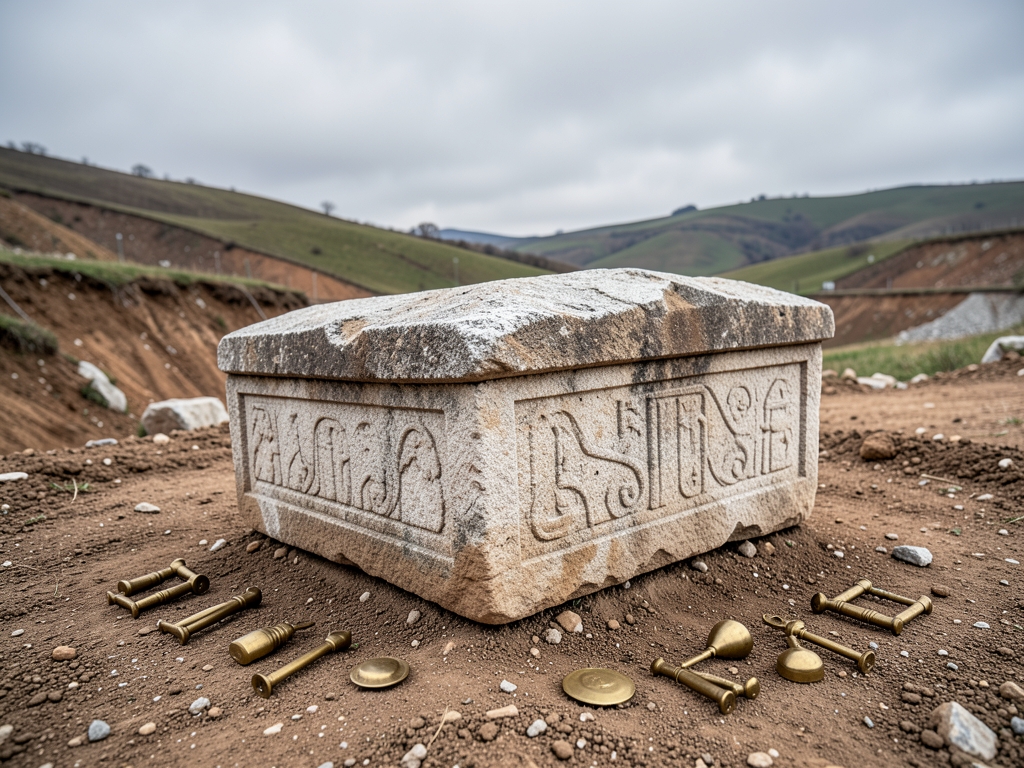
Archaeological discoveries often capture the public imagination by offering direct, intimate glimpses into the daily lives of people who lived millennia ago. While monumental temples, royal palaces, and grand military trophies frequently dominate historical narratives, the most profound emotional connections to the past are often forged through personal, domestic artifacts. A striking recent discovery in Romania has once again reminded historians and the public of the tender realities of ancient family life, bringing to light an 1,800-year-old stone sarcophagus containing the remains of a young child alongside a collection of preserved personal belongings and childhood toys.
The Unearthing of an Ancient Child's Tomb
The discovery, which has drawn intense interest from historians and international media outlets, centers around a meticulously crafted stone coffin unearthed during construction and rescue excavation work in Romania. According to archaeological reports released in late 2026, the tomb dates back to the height of the Roman Empire, a period when the region—then part of the province of Dacia—was a bustling frontier of multicultural exchange, commerce, and military administration.
Unlike many elite adult burials that feature ostentatious displays of political power, military insignia, or expensive jewelry meant to project status to the living community, this burial reflects a deeply personal grief. The small sarcophagus was designed specifically to house the physical remains of a young child, an individual whose life was cut tragically short nearly two millennia ago. The careful positioning of the stone container and the inclusion of precious personal objects demonstrate that, even in antiquity, grieving parents spared no effort to honor and comfort their lost offspring in the afterlife.
Toys, Lucky Charms, and Grave Goods of the Roman World
What makes this specific archaeological find truly exceptional is the remarkable preservation and variety of grave goods discovered inside the burial chamber. Alongside the skeletal remains of the child, excavators recovered a series of small artifacts that serve as poignant windows into ancient childhood. These items include miniature ceramic vessels, small figurines, and what researchers have identified as protective lucky charms or amulets.
In Roman society, childhood was viewed through a complex lens of affection, high infant mortality, and religious custom. While Roman parents experienced devastatingly high rates of child loss due to prevailing diseases and lower standards of medical care, historical texts and material evidence confirm that they cherished their children deeply. Toys were common in Roman households; children played with dolls made of clay, bone, or cloth, pulled wheeled animal toys, and played with marbles, knucklebones (known as tali), and miniature tools.
The inclusion of toys and protective amulets in a sarcophagus reveals the prevailing religious and metaphysical beliefs of Dacian-Roman families. Parents believed that children entering the underworld or the afterlife would need familiar comforts, games, and magical safeguards against malevolent spirits. Amulets were especially crucial for the vulnerable young, serving as apotropaic devices designed to ward off the evil eye and ensure safe passage into eternity.
Understanding Roman Dacia and Provincial Burial Customs
To fully appreciate the significance of this discovery, it is essential to examine the historical context of Roman Dacia. Following Emperor Trajan’s conquest of the Dacian kingdom in the early 2nd century AD, the region underwent a rapid process of Romanization. Indigenous traditions blended with Roman administrative systems, religious practices, and architectural styles, creating a unique provincial culture.
Burial customs in Roman Dacia varied widely depending on social status, economic standing, and local ethnic traditions. Cremation was widely practiced during the early imperial period, but inhumation—the practice of burying bodies intact within stone or tile tombs—grew increasingly popular by the 2nd and 3rd centuries AD. The use of a carved stone sarcophagus indicates that the child belonged to a relatively wealthy or prominent provincial family, as stone was costly to quarry, transport, and sculpt.
Archaeologists studying the site are conducting thorough osteological and chemical analyses on the skeletal remains. These scientific methods can reveal crucial details about the child's exact age at death, nutritional status, potential illnesses, and even geographic origins through isotopic testing of tooth enamel. Such data helps historians reconstruct not only the life of a single child but also the broader demographic and health realities of provincial Roman society.
The Preservation and Display of Material Heritage
Following the excavation, the artifacts and the sarcophagus itself were transferred to a specialized conservation facility for stabilization and detailed study. Protecting delicate organic materials and fragile stone carvings from rapid environmental changes is a critical priority for modern archaeologists. Once conservation work concludes, these items are expected to form part of a specialized museum exhibition, allowing the public to engage directly with the material culture of Roman-era childhood.
Info! Rescue archaeology plays a vital role in modern infrastructure development, ensuring that ancient historical artifacts are properly documented and preserved before modern construction projects permanently disturb subsurface cultural strata.
Finds of this nature highlight the delicate balance between modern development and historical preservation. As modern urban expansion and infrastructure projects continue across Europe, unexpected discoveries frequently rewrite our understanding of local history, proving that countless stories from antiquity still lie hidden beneath our feet.
When and where was the 1,800-year-old child sarcophagus discovered?
The sarcophagus was unearthed during rescue excavation work in Romania, with findings publicly reported in late 2026, dating back to the Roman imperial period.
What types of items were found inside the Roman child's coffin?
The coffin contained the remains of a young child alongside miniature ceramic vessels, small toys, and protective lucky charms or amulets meant to safeguard the child in the afterlife.
What does the discovery reveal about Roman burial customs in Dacia?
The use of a stone sarcophagus indicates that the child belonged to an affluent provincial family practicing inhumation, reflecting a blend of Roman traditions and deep familial devotion during the 2nd or 3rd century AD.
How do modern archaeologists study such fragile ancient discoveries?
Conservators stabilize fragile stone and organic materials in controlled laboratory environments, while osteological and isotopic analyses help determine the child's age, health, and regional background.
Conclusion
The unearthing of an 1,800-year-old child sarcophagus in Romania transcends mere academic curiosity, offering a profound emotional bridge across the centuries. Behind the scientific terminology and archaeological classification lies a universal human story of parental love, grief, and remembrance. As researchers continue to analyze the grave goods and skeletal remains, this remarkable discovery enriches our understanding of Roman provincial life, ensuring that the short life of an ancient child is remembered and honored in the modern world.
