

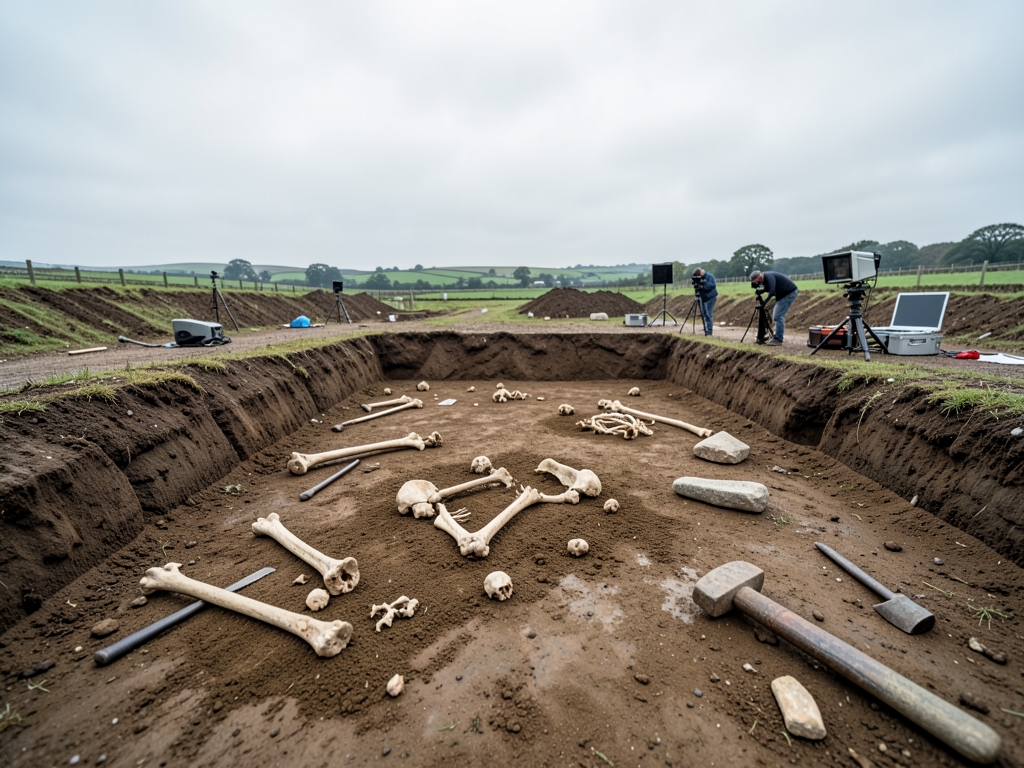
Archaeological discoveries often begin with grand monuments, glittering hoards of gold coins, or towering stone inscriptions left behind by ancient empires. Yet, some of the most profound insights into daily life, ritual practice, and environmental history emerge from the most unexpected places. Among the damp soils of Roman Britain, researchers recently uncovered an extraordinary zoological enigma: a subterranean deposit containing approximately 9,000 individual frog bones, all accumulated within a single structure over a span of centuries. For nearly 1,700 years, the precise reason behind this massive accumulation remained completely obscure, prompting intense debate among paleozoologists, classical historians, and field archaeologists. Recent scientific investigations have finally unraveled this ancient puzzle, shedding fascinating light on how Roman provincial communities interacted with their local environment, managed municipal spaces, and perhaps engaged in complex ritual behaviors that left behind enduring physical traces.
The Extraordinary Discovery at the Roman Settlement
The site in question, located within the shifting landscape of Roman Britain, yielded an exceptionally dense concentration of amphibian remains during systematic excavation work. When field teams first encountered the layer of small skeletal elements, the sheer volume of bones immediately set it apart from standard domestic refuse deposits. Standard faunal assemblages in Roman urban and rural contexts typically feature the discarded bones of cattle, sheep, pigs, and domestic fowl—species directly associated with human diet, leather production, or sacrificial rites. Finding thousands of tiny amphibian bones concentrated tightly within a specific subterranean feature was an entirely unprecedented occurrence that demanded rigorous scientific scrutiny.
Initial sorting and quantification by osteoarchaeologists confirmed that the assemblage comprised predominantly common frog species. Every skeletal element—from delicate limb bones and pelvic girdles to fragile cranial fragments—was represented in remarkable quantities. Crucially, the absence of extensive gnaw marks from rodents or carnivores indicated that the bones had not been casually scattered across an open surface or scavenged by stray animals. Instead, they had been deposited directly into a confined, protected environment, where they remained undisturbed for nearly two millennia until modern archaeological techniques brought them back into the light of day.
To understand the significance of this discovery, researchers had to reconstruct the ancient topography and environmental conditions of the settlement. Roman Britain was characterized by a delicate balance between managed agricultural landscapes, dense woodlands, and expansive wetlands. Amphibians naturally thrived in these damp, temperate conditions. However, natural mortality alone rarely produces such an intensely concentrated, monospecific bone bed without some form of deliberate human intervention or unique physical entrapment mechanism.
Evaluating Competing Hypotheses: Natural Trap Versus Human Agency
When faced with thousands of uniform animal bones, historians and archaeologists must systematically evaluate multiple explanatory hypotheses before drawing definitive conclusions. In the case of the 9,000 frog bones, researchers considered several distinct scenarios ranging from natural ecological events to deliberate cultural practices.
- Natural Pitfalls: Could the location have served as a natural pit from which the animals were unable to escape during seasonal migration events?
- Culinary Refuse: Were frogs harvested on a massive scale for human consumption within the local Romano-British community?
- Pest Control or Environmental Management: Did inhabitants attempt to clear amphibians from agricultural storage areas or residential structures?
- Ritual or Symbolic Deposition: Did the subterranean structure hold religious, medicinal, or apotropaic significance within local belief systems?
Each hypothesis presented distinct challenges when tested against the physical evidence. For instance, while some historical sources note that amphibians were occasionally consumed in various ancient cultures, culinary waste typically displays clear cut marks, burning patterns, or fracture signatures associated with butchery. Detailed microscopic analysis of the Roman Britain frog bones revealed a notable absence of such butchery marks, casting serious doubt on the widespread culinary interpretation.
Unlocking the Secrets of the Subterranean Feature
The definitive breakthrough came from a closer examination of the geological context and the physical structure of the deposit site itself. The bones were recovered from a deep, vertical subterranean feature—likely an abandoned well, cistern, or subterranean drainage installation that had fallen out of active municipal use. In ancient settlements, redundant water management infrastructure frequently served as convenient subterranean repositories for discarded material, but the sheer exclusivity of the frog remains suggested something far more deliberate than routine rubbish disposal.
Further stratigraphic analysis demonstrated that the accumulation occurred over an extended period, indicating that the feature acted as a persistent ecological trap or a recurring focal point for specific environmental conditions. During seasonal breeding migrations, large numbers of common frogs regularly move across damp terrain. A deep, stone-lined or timber-reinforced vertical shaft in the path of these migrations would easily catch dozens or hundreds of animals seeking moisture or shelter, preventing their escape.
Info! The absence of butchery marks and domestic garbage mixed into the primary bone layer strongly suggests that the accumulation was driven primarily by natural entrapment within abandoned infrastructure rather than deliberate human slaughter for food.
However, natural entrapment alone did not fully explain why the remains accumulated in such staggering numbers without being rapidly decomposed or scavenged by soil microorganisms and insects. Environmental conditions inside the subterranean feature—such as specific moisture levels, anaerobic soil chemistry, and restricted oxygen access—created an ideal micro-environment for bone preservation while halting the usual destructive biological cycles that typically disintegrate delicate amphibian skeletons over centuries.
Broader Implications for Understanding Roman-Era Ecology
This remarkable archaeological detective story offers far more than a quirky zoological curiosity; it provides a valuable window into the environmental history of Roman Britain. The local ecosystem was intensely dynamic, responding directly to human modifications of the landscape such as land drainage, deforestation, and the construction of extensive agrarian infrastructure. By analyzing the age distribution and species composition of the frog bones, paleoecologists can reconstruct local climate fluctuations, seasonal rainfall patterns, and the ecological health of habitats surrounding the ancient settlement.
Furthermore, the study underscores the importance of interdisciplinary collaboration in modern archaeology. Traditional artifact analysis focusing solely on pottery, coins, and architecture provides an incomplete picture of past societies. Integrating osteoarchaeology, taphonomy—the study of how organisms decay and become fossilized—and environmental science allows researchers to reconstruct the full sensory and ecological world inhabited by ordinary people in antiquity.
| Analytical Dimension | Initial Hypothesis | Physical Evidence | Final Scientific Conclusion |
|---|---|---|---|
| Bone Preservation | General refuse pit | Pristine, unfragmented tiny elements | Protected anaerobic subterranean micro-environment |
| Human Interaction | Culinary processing | Complete absence of butchery or knife marks | Natural mortality and entrapment, not food waste |
| Deposition Timeline | Single catastrophic event | Stratified layers spanning multiple decades | Recurring seasonal migration entrapment |
| Ecological Context | Random forest accumulation | Monospecific common frog concentration | Proximity to managed Roman agricultural wetlands |
Preserving and Interpreting Fragile Archaeological Heritage
As archaeological excavation techniques continue to advance, discoveries involving delicate organic and micro-faunal remains are becoming increasingly common. Handling thousands of fragile bones requires meticulous care during extraction, cleaning, and long-term curation in museum archives. Each microscopic fragment holds chemical and structural data that contributes to our broader understanding of historical biodiversity and long-term environmental change.
Protecting these subterranean sites from modern development and agricultural disruption remains a critical priority for heritage management agencies across Europe and the United Kingdom. When ancient infrastructure is unearthed, recording every detail before urban expansion or modern construction alters the landscape ensures that future generations of researchers can continue to ask new questions of the material record.
How many frog bones were discovered at the Roman Britain site?
Archaeologists recovered approximately 9,000 individual frog bones concentrated within a single subterranean feature at the ancient settlement.
Were the frogs eaten by the inhabitants of Roman Britain?
Detailed microscopic analysis revealed no butchery or knife marks on the bones, indicating the animals were not processed or consumed as food.
How did the bones manage to survive in such good condition for 1,700 years?
The bones were preserved inside a deep subterranean structure—such as an abandoned well or cistern—where specific anaerobic soil chemistry and moisture levels prevented normal decay.
What do these findings reveal about the local environment during Roman times?
The massive concentration provides valuable data on local amphibian populations, seasonal migration patterns, and the ecological conditions surrounding Roman agricultural settlements.
Conclusion
The resolution of the 1,700-year-old mystery of Roman Britain's 9,000 frog bones demonstrates the remarkable power of modern archaeological science. By looking beyond traditional treasures and examining the minutiae of natural deposits, researchers gain unprecedented clarity regarding the complex interplay between human infrastructure and local ecosystems in antiquity. Such discoveries remind us that history is written not only in grand royal chronicles but also in the quiet, enduring traces of the natural world preserved beneath our feet.
